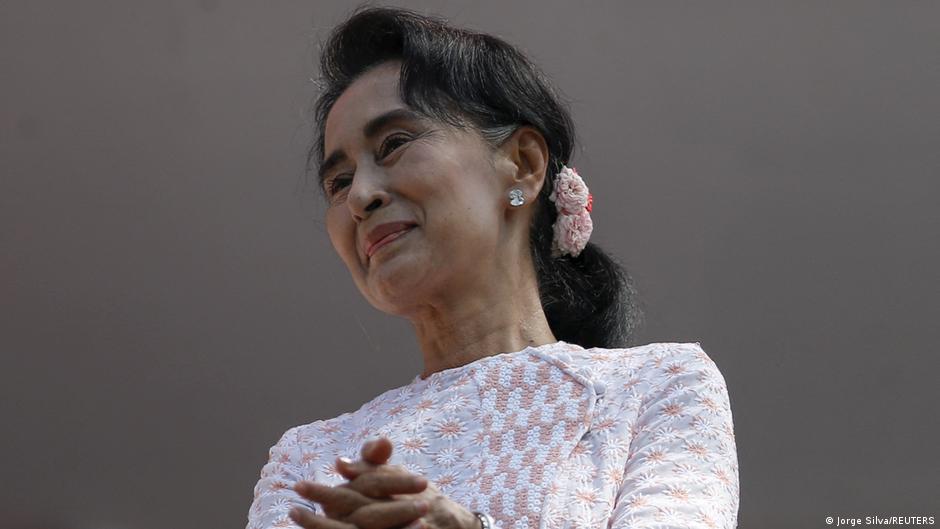
Myanmar’s former leader Aung San Suu Kyi has been put under house arrest after spending more than five years in prison, the country’s state media reported last week.
The 80-year-old Nobel laureate, who led the country as state counselor between 2016 and 2021, was detained in a military coup in February 2021.
Suu Kyi was subsequently convicted on charges including corruption, election fraud and violating official secrets rules. She was serving her sentence at an undisclosed location in the capital Napita.
His supporters say that the cases have been fabricated to keep him away from politics.
Suu Kyi is a world-renowned activist and the daughter of Myanmar’s independence hero, General Aung San. She had been in conflict with Myanmar authorities for decades, and spent nearly 15 years in detention between 1989 and 2010. Her release in 2010 was hailed internationally as a watershed moment for Myanmar, making Suu Kyi one of the world’s best-known symbols of peaceful resistance.
His National League for Democracy (NLD) was also severely repressed under the country’s previous military-run governments. In 2015, the party won a landslide victory in general elections and was allowed to assume office, with Suu Kyi serving as supreme civilian leader.
However, Suu Kyi’s international reputation took a hit after she made comments that saw her defending the country’s military and decrying its atrocities against the Muslim Rohingya minority.
Domestically, he has also been criticized for the slow pace of reforms, limited progress on the rights of ethnic minorities, and the fact that the military still has major influence on Myanmar politics.
The coup plunged the country into civil war.
After the NLD won another landslide victory in late 2020, the military claimed election fraud and soon staged a coup, locking Myanmar into a complex civil war.
UN figures show nearly 8,000 people have been killed and about 3.6 million displaced since 2021. Despite the junta’s efforts to project stability, conflict continues.
On April 30, the military-run government granted amnesty to 1,519 prisoners, including 11 foreigners, as part of a routine annual release tied to the Buddhist holiday.
Earlier in April, another major pardon was granted, including Win Myint, who served as president during the NLD’s tenure.
A signal for ASEAN?
The junta oversaw elections in December and January that were widely rejected by opponents, Western governments and rights groups as neither free nor fair.
Suu Kyi’s NLD was banned, the junta was unable to hold votes in many opposition-ruled areas of the country, and the military-backed Union Solidarity and Development Party dominated the process.
Still, the vote allowed junta chief Min Aung Hlaing to reinstall himself as president of a new administration, giving the military a civilian facade as it seeks to re-engage its regional allies.
Most analysts see the move to detain Suu Kyi as part of that diplomatic effort, particularly within the Association of Southeast Asian Nations (ASEAN).
After ASEAN partially suspended Myanmar from its high-level events in 2021, some member states, notably Thailand, have pressured the bloc to fully engage with the new military-run government.
The Philippines, the bloc’s chair this year, has taken a more ambiguous position.
“This announcement came just before the ASEAN summit in the Philippines, which suggests that the authorities in Myanmar may be taking steps for greater maneuvering within ASEAN,” Mo Thuzar, senior fellow and coordinator of the Myanmar Studies Program at the ISEAS-Yosof Ishak Institute in Singapore, told DW.
However, Thuzar said Suu Kyi is still in custody after being taken home, and has several years left on her prison sentence. His NLD remains illegal, with the party’s leadership decimated by arrests, exile and repression.
That hasn’t stopped the junta from using its position as a bargaining chip, analysts say.
“These narratives continue to flow, and I have heard diplomats from ASEAN countries characterize such steps as potentially indicating a willingness by the military to engage, even if the underlying realities remain unchanged,” Krystyna Kironska, an assistant professor at Palacký University Olomouc, told DW.
Demand for Suu Kyi’s unconditional release
A spokesman for UN Secretary-General Antonio Guterres said in a statement the decision to house Suu Kyi is a “meaningful step” towards a “credible political process”.
The United States had previously called for Suu Kyi’s immediate and unconditional release. However, there have been recent rumors that Washington is looking for ways to increase access to Myanmar’s abundant rare earth minerals, which may include a deal with the regime.
Myanmar’s information ministry recently contracted Roger Stone, a longtime lobbyist and ally of President Donald Trump, to represent the new quasi-civilian administration in Washington.
The European Union last week extended its sweeping sanctions on military-linked businesses and individuals for another 12 months, insisting that only wholesale democratic reforms in Myanmar would change its policy. The bloc also reiterated demands for Suu Kyi’s release following the news of her transfer under house arrest.
“We demand full respect for his physical and mental health, regular access to family and legal advice, and reiterate our demand for his full release and that of all remaining political prisoners,” an EU spokesperson said in a statement.
China’s role in Suu Kyi’s transfer?
There have also been reports that Beijing may have put pressure on Napita to ease Suu Kyi’s detention.
Chinese Foreign Minister Wang Yi visited Myanmar on April 25 and there are unconfirmed reports that he met Suu Kyi. Beijing has not commented on any such meeting.
A Chinese Foreign Ministry spokesman said at a press conference on April 30, the day of her reported transfer, that Suu Kyi “is an old friend of China. Her situation has always been in our minds.”
Beijing is widely seen as keen to stabilize its border, expand trade routes and pursue major infrastructure projects in Myanmar.
China has previously tried to shape the conflict by supporting various ethnic armed groups, and it has adopted an interventionist approach to expand crackdown compounds targeting Chinese citizens inside Myanmar.
Kironska told DW it was laudable that Beijing encouraged Suu Kyi’s release from detention because China “has significant influence over the military regime.”
“Beijing could pressure the junta toward cosmetic de-escalation and controlled political management to stabilize the country sufficiently to protect Chinese interests,” he said.
Whether the move changes Myanmar’s political trajectory is another matter. While Suu Kyi and the NLD remain popular, the pro-democracy movement has, in many ways, overtaken them in the five years since the start of the civil war.
Instead of focusing on its fate, civilian militias and ethnic armed organizations have increasingly turned their attention to issues such as federalism, minority rights, and dismantling the military’s political dominance.
Edited by: Srinivas Majumdaru