
The estimated exposure exceeds $560 billion in BTC.
The report suggests that BTC’s transition to post-quantum schemes would require several years.
A Project Eleven analysis released on May 6, 2026 warns that so-called “Q-Day,” the point at which quantum computing could break public-key cryptography, could arrive as soon as 2030. The report suggests that up to 6.9 million bitcoin (BTC), about 33% of the total supply, could potentially be exposed under certain conditions.
According to the organization, the risk is linked to the advance of quantum computing and recent experimental demonstrations that have achieved approaches to attacks on elliptic curve cryptography (ECDSA), the system that protects Bitcoin’s digital signatures. The focus of the problem is on the possibility that future quantum computers can solve mathematical problems that today guarantee network security.
It is worth highlighting that, for Project Eleven, the exposure would not be uniform. The most vulnerable bitcoins would be those associated with addresses where the public key has already been revealed on-chain, including old formats or reused addresses. In these cases, the exposure would be permanent if a cryptographically relevant quantum computer were to exist, with a potential impact estimated at more than $560 billion at current prices.
The report also uses the “Mosca inequality” framework to assess risk, a model that compares the time available to migrate cryptographic systems with the estimated time in which quantum computing could make them vulnerable. Under this approach, the key is not just whether the attacks will come, but whether the ecosystem will have enough room to adapt before they become viable.
In the case of Bitcoin, the analysis suggests that the transition to post-quantum schemes would require several years of technical coordination, reducing the margin of safety if quantum timelines compress into this decade.
It is important to clarify that Project Eleven proposes three scenarios for the arrival of quantum risk on Bitcoin: In an optimistic case, the impact could materialize as early as 2030; In a base scenario, the window is around 2033; and in a pessimistic scenario, it extends until 2042. These projections do not seek to set an exact date, but rather to reflect different rates of progress in quantum computing and error correction, as well as the degree of preparation of the ecosystem to migrate towards post-quantum cryptography, as reflected in the following graph.
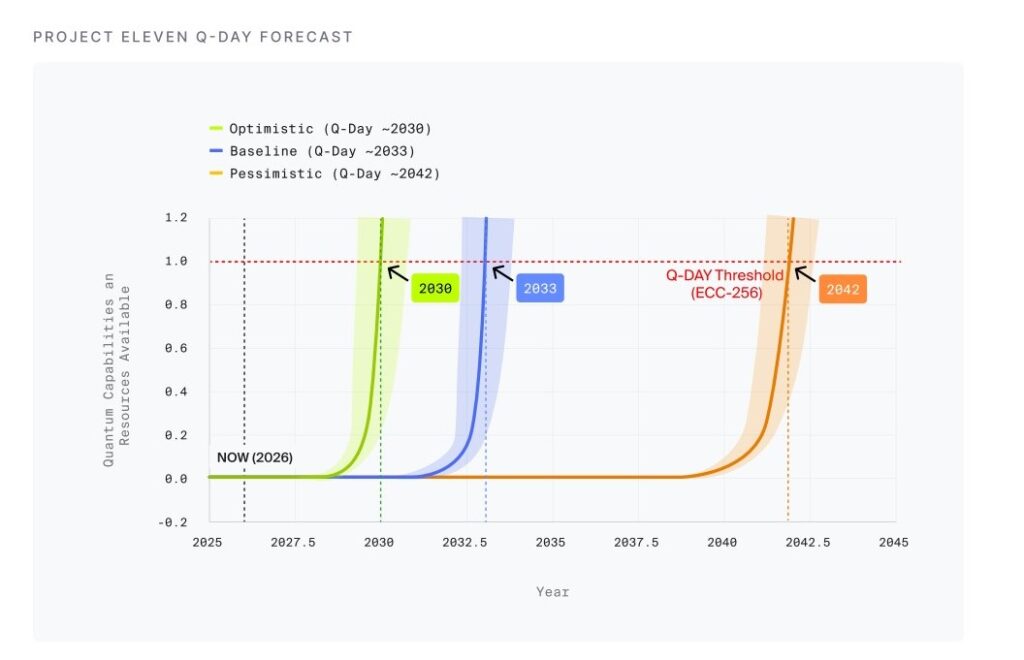
“Q-Day” continues to divide the sector
In this scenario, The debate within the sector remains divided. On the one hand, researchers like Mikhail Lukin from the environment of Harvard Quantum Initiative They maintain that fault-tolerant quantum computers could arrive before the end of this decade, a horizon that coincides with projections from actors such as Google, Cloudflare and Grayscale, which already contemplate migration windows close to 2029, as reported by CriptoNoticias. This view reinforces the idea that the readiness window is shrinking.
In contrast, figures such as Adam Back, Samson Mow or the developer Murch consider that quantum risk still more than a decade awaynoting that current capabilities are far from breaking 256-bit crypto under real-world conditions. Likewise, it recently happened that Cory Klippsten, CEO of Swan Bitcoin, accused Alex Pruden, CEO of Project Eleven, of exaggerate the quantum threat to boost commercial interestsreviving the differences in position within the sector.
Within this context, the Q-Day scenario is understood as a risk range and not as a definitive date. The possible exposure of millions of bitcoins reflects the sensitivity of the system to advances in quantum computing, although its real impact will depend on technological developments still in the experimental phase.