
Solana processes nearly 265 million transactions daily.
Visa, Circle and Western Union already use their network for real transactions and settlements.
CoinShares, an on-chain analysis firm, proposes that the Solana network could become a key infrastructure for digital finance, due to its ability to process high volumes of transactions with low costs.
In his most recent reportpublished on May 5, 2026, the firm compares Solana’s role to that of a highway designed to support the traffic of an entire economy and maintains that “the value is not in the speed itself, but in what that speed makes possible.”
According to the document, digital finance faces a specific technical question: which networks can handle institutional volume without congestion, service degradation or increasing costs.
In that comparison, CoinShares positions Solana as a network prepared to absorb operations at scale.
Financial system scale
To support their argument, the firm’s specialists give as an example the Visa case. The company chose Solana for its stablecoin settlement pilot, which already processes about $3.5 billion annualized. For CoinShares, that decision “had nothing to do with cryptocurrency speculation, but rather infrastructure logic: capacity, reliability, and costs at scale.”
The report highlights that this use no longer corresponds to an isolated test. “The liquidation case is not a prototype. It is a system in production, and scale,” he points out.
In turn, he mentions that banks such as Cross River and Lead Bank They settle payments in USDC on Solana, even on weekends and holidays, something that the traditional banking system does not allow in the same way.
In terms of performance, Solana processes about 265 million daily transactions, with an average cost of $0.00181 per trade.
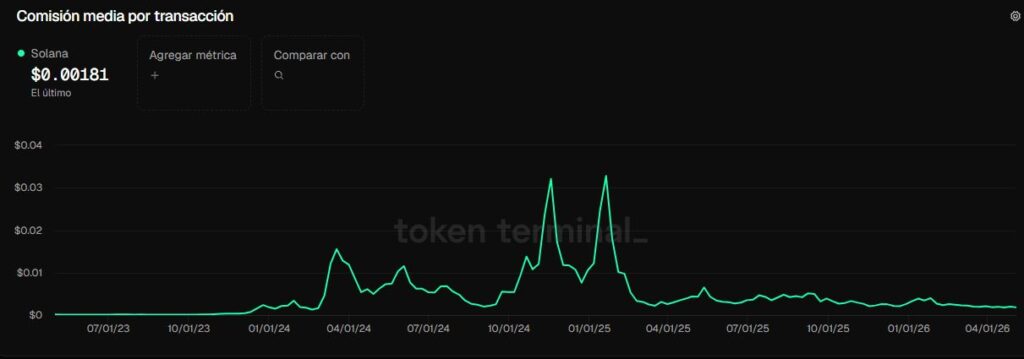
CoinShares compares that scale to traditional payment systems and states that “Solana is operating at the scale of a national payments infrastructure, without a central bank behind it.”
The network also supports around 3,000 transactions per second in real conditions. For CoinShares, the relevant comparison It is not the maximum speed under ideal conditions, but what system can absorb growth without commissions and confirmation times destroy the economics of large-scale settlement.
Although the report does not mention it, a favorable point is the stability of the network. Solana has not recorded an interruption since February 6, 2024, when block production was stopped for about five hours. Since then, the network has gone through periods of high activity without a complete system outage, a fact relevant to CoinShares’ thesis about its use as financial infrastructure.
Institutional validation
Another point to take into account is institutional validation. Circle uses Solana as one of its main networks for USDC; Google Cloud operates validation infrastructure within the network; Meta began implementing stablecoin payments on Solana and Polygon; and Western Union announced the launch of USDPT, a stablecoin issued by Anchorage Digital Bank that lives in Solana.
As CriptoNoticias has explained, Western Union aims to use USDPT as a settlement layer for global partners and agents. The company seeks to enable almost instant payments, available 24 hours a day, and reduce inactive balances within its network.
The Solana Foundation also highlighted the institutional profile of the network. “Solana’s high-performance, low-latency design allows assets like USDPT to move with the speed and reliability needed for real-world financial settlement,” said Lily Liu, president of the organization.
It is for that reason that CoinShares highlights that these movements reinforce the infrastructure thesis. “None of these decisions were made by teams with speculative positions, but by infrastructure teams that evaluate reliability, cost and capacity,” it is explained.
In that sense, the firm’s specialists point out that the value of Solana is in its infrastructure layer. The network does not depend on a single application, but rather the volume generated by payments, stablecoins, settlements and new financial services.
To explain this, the report uses a comparison with highways: the greater the capacity of the network, the more applications can be built on top of it; and the more use it concentrates, the more the value of that infrastructure is strengthened.
“The highway creates its own demand,” says the firm. Under this logic, each institutional adoption validates the network for new participants and it can lead to a cycle of more applications, more transactions, and new infrastructure improvements.
Solana would be offering an investment opportunity, according to CoinShares
The report, although it does not give price targets for the network’s native cryptocurrency, SOL, concludes that there is an investment opportunity appearing in the gap between infrastructure that already works at scale and institutional adoption that is not yet widespread.
Thus, Solana is presented not only as a fast network, but as an infrastructure that is already being used for real payments and settlements.
That difference is key: the thesis is not in speed as an isolated data, but in the ability to sustain digital finance when volume starts to grow.