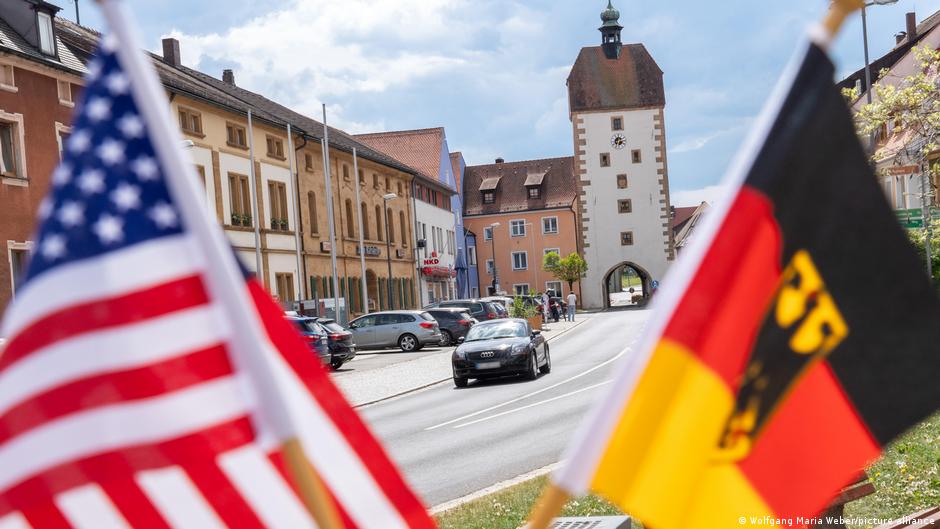
It was a nightmarish start to Thorsten Gredler’s tenure as mayor. In March, the 61-year-old won the mayoral election in the small German town of Vilseck, near the Czech border. Monday, May 4, was his first official day on the job.
And then, shortly after noon, a breaking news alert shocked the town and its 6,500 residents: Thousands of U.S. troops from the local Stryker Brigade Combat Team could return home in the coming months, though official confirmation is still pending.
“People’s initial reaction was fear. After all, we have lived here for 80 years in close friendship with our American neighbors,” a visibly emotional Gredler told DW. The mayor says Vilseck had become his “home away from home.” “They feel at home here, away from their homeland. Americans are integrated into our social life, football and music clubs. Many even stay here after they retire.”
Vilseck: A pawn in a game of powers?
Meanwhile, Thorsten Gredler must feel as if he is caught full force between the grinding gears of geopolitics. US President Donald Trump, clearly angered by the lack of European support in the conflict with Iran and Chancellor Friedrich Merz’s criticism of US actions, announced new tariffs on European automobiles and the withdrawal of troops from Germany.
About 40,000 American soldiers are deployed in Germany and now there is a possibility of impact on Vilseck. This small town is located near Grafenwöhr, where the US maintains its largest military training area outside the United States, covering 233 square kilometers (90 mi). Gredler explains that the troop withdrawal would have dramatic economic consequences for Vilseck and the entire region.
According to Gredler, “The military training area generates an economic impact of €650 to €700 million ($765 to $824 million). It includes construction contracts, major projects, supermarkets, auto repair shops and rental apartments. With 3,000 jobs, it is one of the largest employers in the area.” Furthermore, approximately €800 million is currently being invested in new infrastructure at the military training area, leading Gredler to wonder: “Why expand and modernize the site just to withdraw troops?”
The withdrawal of US forces has been discussed before
Sabine Kederer is the owner of the historic Hotel Angerer, located a short distance from Vilseck’s town hall. She says she’s reminded of “Groundhog Day” at the moment: the famous film in which lead actor Bill Murray remembers the same day over and over again. After all, the head of this 14th-generation family-run hotel remembers going through almost the same experience six years ago.
In 2020, during his first term, Donald Trump also threatened to withdraw thousands of US troops from Vilsack. However, following Joe Biden’s election victory, those plans never became a reality.
This time Sabine Kederer’s first thought upon hearing the news was: “Not again!”
“But I won’t start thinking seriously about it until the decision is actually made,” she says. “I don’t have a plan B yet. After all, 70% to 80% of the guests staying here are here specifically because of the military training area.”
While some residents of Vilseck accuse the German Chancellor of forcing the community to bear the brunt of the dispute between the US and Germany, Kederer has a different opinion: “Maybe he could have been a little more diplomatic, but I think it is important that our politicians speak out from time to time. One should be able to tolerate different opinions.”
many people want to stay
Veronika Varga, owner of “Vrony’s Hundeslon” (“Vrony’s Dog Grooming”) in Vilseck, says her business is going so well that, if necessary, she could even survive without her military customers. Yet, among dog lovers in the United States, Varga is much more than just an insider tip – more than half of her customers are from the US. Their program for grooming Poodles, Labradors and Bichon Frize is fully booked until the end of June.
“I’m getting a lot of calls right now from people who are afraid they’re going to be kicked out,” Varga told DW. “They are now booking appointments for September, October and November because they are worried that if they have to leave suddenly they will not be able to get a slot. We have never experienced anything like this here before.”
Every day around 20 dogs enjoy their care services. When her two assistants, Rebecca and Emily, are on duty, that number can go up to 30. Twenty-year-old Emily is from America and started working in a grooming salon two years ago.
She is excited about Germany and – still with a touch of disbelief – tells her dog’s story: One day, her dog ran away and she put up posters with his photo all over the city, saying that he was missing. It didn’t take long before someone called her to tell her she could take her dog to the town hall. “I love it here – especially the peace, the woods and the hiking trails. The idea of returning to America scares me a little, because although I was born in Florida, I haven’t lived in the United States for very long.”
Vilseck is preparing for ‘D-Day’
Yet perhaps, as many in Vilseck still hope, the municipality will survive another US troop withdrawal. Yet, preparations for the worst are already quietly underway. This is largely due to people like Markus Graf, a career soldier for 25 years, who grew up with military training areas. Now a construction contractor, he stands in front of two excavators at a seven-hectare site near Vilseck, an area due to be completed as a commercial park this August.
“Our goal is to attract industrial and skilled trade businesses here to help mitigate the impact of a potential US withdrawal or loss of jobs,” he explains. He added: “Due to its proximity to Grafenwöhr the site is also of interest to the defense industry.”
This article was translated from German.