May 8, 2026
Hantavirus: What we know so far
Health authorities are racing to contain an outbreak of the hantavirus after the World Health Organization said that five confirmed infections had been identified among people connected to the MV Hondius.
Three people, a Dutch couple and a German national, have died since the cruise ship departed Argentina last month.
What’s the latest?
Singapore’s Communicable Diseases Agency said it isolated two residents linked to the ship.
President Donald Trump told reporters that he was briefed on the virus and was hopeful that it was under control. “It’s very much, we hope, under control,” he said.
Asked whether Americans should be concerned about any spread of the virus, Trump replied: “I hope not.” He also said, without elaborating, that a report on the virus was expected on Friday.
Viruses in the hantavirus family are usually spread by rodents but can in rare cases be transmitted person-to-person.
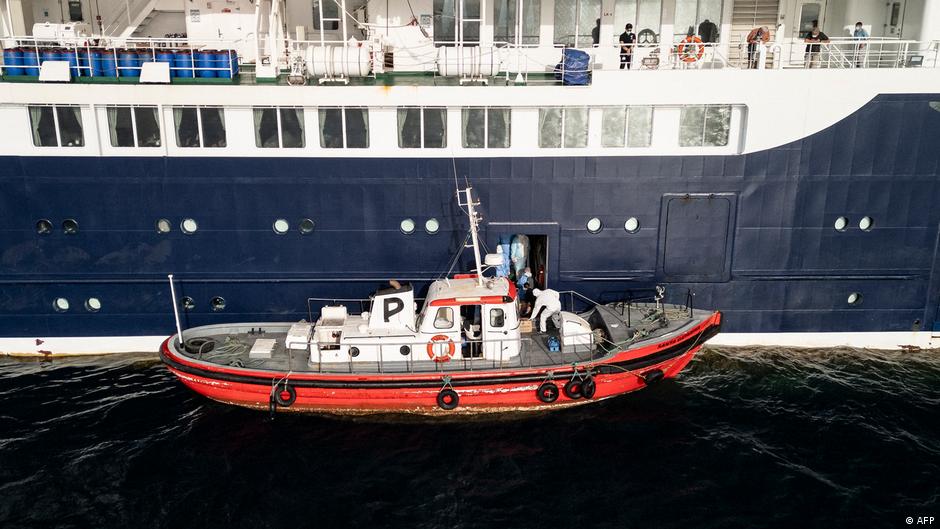
The vessel is now headed to Spain’s Canary Islands.
https://p.dw.com/p/5DSFs
May 7, 2026
Chile says deceased passengers could not have caught hantavirus there
Chile’s Health Ministry has said that two of the deceased hantavirus patients could not have contracted the disease while in the country.
The government in Santiago said that the two people visited the country too long ago for Chile to be a plausible point of infection.
The Dutch married couple traveled first to Argentina, then through Chile and Uruguay, before returning to Argentina on March 27 to board the ship on April 1, according to Argentine officials. They had entered Chile on January 7.
Chile’s Health Ministry said in a statement that the pair traveled in the country “during a period that does not correspond to the incubation time, so exposure to the virus would not have occurred in our country.”
The incubation time — the period between contracting an infection and displaying symptoms — can vary quite considerably with hantaviruses, but the German Institute for Public Health says the first symptoms usually appear two to four weeks after being infected, or in exceptional cases after as many as 60 days.
The World Health Organization (WHO) on Thursday said the incubation period could be up to six weeks.
Chile and Argentina are two of the countries that are home to the particular long-tailed pygmy rice rat that is thought to be the source of the Andes virus strain.
Chile said its last documented case of human-to-human transmission of the Andes virus was in 2019.
https://p.dw.com/p/5DRsW
May 7, 2026
Netherlands health institute: 2 of 3 people who came into contact on a plane tested negative
The Netherlands’ National Institute for Public Health and the Environment (RIVM) has said that it is testing three people showing possible symptoms who had come into contact with a person infected with the Andes strain of the hantavirus on a plane.
“Two of these test results have come back negative. The remaining test is still being analyzed. These three individuals developed symptoms after coming into contact with a person infected with the Andes virus while on board an aircraft.” the RIVM said.
It said the country’s public health service, the GGD, was advising other passengers from the flight on what steps if any they should take, saying it depended on factors like where their seat was and how much contact with the affected individual they had.
“Passengers who had direct contact are being contacted daily by phone by the GGD to closely monitor their health status. Passengers who had close contact are asked to monitor their own symptoms,” it said.
The individuals were on a flight from Johannesburg to Schiphol Airport outside Amsterdam that was carrying a passenger who subsequently died.
One person previously known to have come into contact with the deceased was a flight attendant on that plane who had been admitted to Amsterdam’s UMC university hospital. While it appeared likely, the RIVM did not comment on whether she was one of the three tested individuals.
https://p.dw.com/p/5DRWI
South Africa monitoring 4 people in contact with Hantavirus patients
South Africa is currently monitoring four people who came into contact with one of the hantavirus patients, the country’s Department of Health has said.
The four individuals were passengers on an Airlink flight from St. Helena to Johannesburg, the department said.
Department of Health spokesman Foster Mohale said one of the patients was exhibiting symptoms.
“The individual has undergone clinical assessment and appropriate laboratory testing, with results pending confirmation,” Mohale added.
“We appeal to all those who have been identified as close contacts of those who tested positive for Hantavirus to cooperate with the health officials conducting contact tracing to help us prevent the spread of this deadly virus,” he said in response to questions from DW.
He also urged the public “to stop spreading misinformation and fake news about the virus because this has the potential to stigmatize and deter people from coming forward, especially those identified for contact tracing and those experiencing symptoms.”
https://p.dw.com/p/5DRVO
May 7, 2026
Two Dutch hospitals confirm suspected cases of passengers flown off ship
The Leiden University Medical Center (LUMC) has said that a patient thought to have hantavirus, who was flown in on Wednesday, has tested positive.
“It has now been confirmed that the hospitalized patient has contracted the hantavirus,” the hospital said in a statement on its website. “The patient has been informed of this and has given permission for this information to be shared.”
“We are providing all the support and care the patient currently requires and are taking every precaution to do so safely,” the LUMC said, noting that as always, it would not be disclosing a patient’s personal details.
Slightly earlier on Thursday, the Radboudumc university hospital in Nijmegen said that a patient it had admitted had also tested positive. He had also been flown off the cruise ship a day earlier.
The RIVM said “appropriate isolation measures have been implemented in the ward” and that severe infectious disease specialists were handling the case.
https://p.dw.com/p/5DRKr
May 7, 2026
What did the WHO say was unusual about this hantavirus outbreak?
Asked what was unusual about the current outbreak, Anais Legand, the technical lead on viral haemorrhagic fevers for the WHO responded.
“What is most unusual, obviously, is that we have a transmission in a boat, which I think is the first documented to date with this particular virus,” Legand said. “A boat makes it a very specific environment. We want to make sure that we have a good understanding of how the transmission has happened.”
“But there is no indication to date that there is something further [that is] unusual,” she said.
Legand said that a recent study out of Latin America had noted slight increases in caseloads and lethality in parts of the continent.
“Just to recall that this update covers all hantaviruses that are documented in the Americas, where most countries at risk have good surveillance systems. And the increase can be related to several factors … probably related to incidence in the rodent population, and different ecological and behavioral factors,” Legand said.
However, she said that given that most hantaviruses cannot transmit human to human and only via rodents, these changes were more likely linked to the rodent population and probably “doesn’t relate to this particular virus.”
https://p.dw.com/p/5DR8N
May 7, 2026
Tedros says risk to Canary Islands is ‘low,’ Spain well placed to manage it
WHO Director-General Tedros Adhanom Ghebreyesus described the outbreak as a “serious incident” but nevertheless said his organization deemed the overall risk to the public to be low.
“Given the incubation period of the Andes virus, which can be up to six weeks, it’s possible that more cases may be reported,” Tedros said at the press conference. “While this is a serious incident, WHO assesses the public health risk as low.”
He said the organization was working with “multiple governments and partners” on the response. He voiced thanks to Spanish Prime Minister Pedro Sanchez for accepting a request from him to receive the stranded ship.
“The ship is now sailing for the Canary Islands, and we are confident in the capacity of Spain to manage this risk, and we are supporting them to do so,” Tedros said. “Once again, we assess the risk to the people of the Canary Islands as low.”
The regional authorities on the Canary Islands have voiced dissatisfaction with Spain’s decision to let the ship dock in Tenerife, which is currently planned to take place on Saturday.
https://p.dw.com/p/5DQxC
May 7, 2026
‘This is not coronavirus,’ WHO doctor says
The WHO panel were asked during the session what similarities they saw to the outbreak of the COVID pandemic six years ago, with US infectious disease epidemiologist Maria van Kerkhove saying she wanted to be “unequivocal.”
“This is not coronavirus. This is a very different virus. We know this virus,” she said. “Hantaviruses have been around for a while, there’s a lot of details that we know … I want to be unequivocal here: This is not SARS-COV2, this is not the start of a COVID pandemic, this is an outbreak that we see on a ship.”
She said it was beneficial that the area in question was confined, with just five confirmed cases to date. She said that many steps were being taken to try to limit onward spread and contact.
“We completely understand why these questions are coming and we are trying to provide all the information we can. That’s why we’re having a press conference here: to give accurate information,” van Kerkhove, a member of the WHO’s Health Emergencies Program, said.
“This is not the same situation we were in six years ago. It doesn’t spread the same way. It’s very different: it’s that close, intimate contact that we’ve seen.”
https://p.dw.com/p/5DQrx
May 7, 2026
What do we know about the couple who first died of hantavirus? WHO answers
WHO chief Tedros also gave some extra details on the couple who first died from the virus.
“Prior to boarding the ship, the first two cases had traveled to Argentina, Chile and Uruguay on a bird-watching trip which included visits to sites where the species of rat that’s known to carry hantavirus was present.”
He added that the WHO is trying to track the movement of the couple.
He expressed gratitude for the cooperation of the company, as well as “the passengers and crew who are going through a very difficult and frightening situation.”
Tedros also said he had been in touch with the ship’s captain, who said morale has improved since the ship started moving again.
https://p.dw.com/p/5DQp0
May 7, 2026
Public health risk low, as per WHO assessment
Despite the apparent rising number of cases, WHO chief Tedros said the “WHO assesses the public health risk as low.”
He went on to lay out the agency’s priorities:
- Making sure patients receive care
- Keeping the passengers who are still on the ship safe and being treated with dignity
- Preventing the virus from spreading further
“Investigations into the cause of the outbreak are continuing,” the WHO chief added.
https://p.dw.com/p/5DQoz
May 7, 2026
5 confirmed hantavirus cases, WHO chief Tedros says
WHO Director-General Tedros Adhanom Ghebreyesus held a press conference about the outbreak of hantavirus on the MV Hondius cruise ship.
He said there had been eight reports of hantavirus infections, including five that had been confirmed.
“WHO is aware of reports of other people with symptoms who may have had contact with one of the passengers. In each case, the WHO is in close contact with the relevant authorities,” he said.
https://p.dw.com/p/5DQkI
May 7, 2026
WATCH: WHO briefing on hantavirus cruise ship outbreak
https://p.dw.com/p/5DQh6
May 7, 2026
No passengers with symptoms left on board, cruise company says
Oceanwide Expeditions, the company running the MV Hondius cruise ship, said in a statement on Thursday that all passengers with symptoms had been taken off the ship.
“No symptomatic individuals are present on board,” it said.
The three individuals who were airlifted away “are now in the care of medical professionals,” it added.
The company also said it was working to trace all passengers who had been on board and possibly had contact with the virus.
It said 30 guests had disembarked on Saint Helena on April 24. The Dutch government had reported 40 guests disembarking, with their whereabouts now unknown.
But Oceanwide Expeditions said: “These disembarked guests have all been contacted by Oceanwide Expeditions. We are working to establish details of all passengers and crew who embarked and disembarked on various stops of m/v Hondius since March 20.”
https://p.dw.com/p/5DPLz
May 7, 2026
Timeline of the hantavirus cruise ship outbreak
The outbreak of hantavirus on the MV Hondius cruise ship has garnered global attention and empathy for those trapped on a ship where a deadly virus has already killed several people.
We still don’t know how the outbreak started, but here is a timeline of what we do know:
- March 20: The MV Hondius departs from Tierra del Fuego with 149 people on board, sailing around the Antarctic region before returning
- April 1: The ship departs Ushuaia on the Argentinian side of Tierra del Fuego and heads north
- April 6: A 70-year-old male Dutch passenger falls ill with a fever, headache, abdominal pain and diarrhea
- April 11: The man dies — at the time the cause was unknown
- April 24: The MV Hondius docks in Saint Helena where the deceased body was removed from the boat, along with the man’s wife
- Note: On Wednesday (May 6), the Dutch government said some 40 people disembarked on the island
- April 25: The woman, also Dutch, and her husband’s body are flown to South Africa, but she starts to feel ill on the journey
- Note: The woman tried to board a flight to the Netherlands, but was taken off for being too ill
- April 26: The woman dies in hospital in Johannesburg
- April 27: A British man is airlifted to Johannesburg after falling seriously ill
- April 28: A German woman starts to feel unwell and her condition quickly gets worse
- May 2: The German woman dies — on the same day, tests give the first confirmation on hantavirus following tests on the British patient
- May 3: The MV Hondius reaches Cape Verde with three passengers, including the ship doctor, reporting symptoms — the ship is not allowed to dock and patients are not allowed to disembark
- May 4: Hantavirus is found following tests on the Dutch woman who died on April 26
- May 5: Spain agrees to let the ship dock in Tenerife where the 14 Spanish passengers will be quarantined and the rest repatriated
- May 6: Three patients are evacuated from the ship, two were taken to the Netherlands and one was taken to Düsseldorf in Germany
- May 7: A Dutch stewardess who briefly came into contact with the Dutch woman who later died is taken to hospital after reporting feeling unwell
https://p.dw.com/p/5DPE5
May 7, 2026
Dutch woman in Amsterdam hospital with possible hantavirus symptoms
A Dutch stewardess has been admitted to a hospital in Amsterdam after showing possible symptoms of hantavirus, the Dutch Health Ministry said.
She had been in contact with one of the cruise passengers who died from the virus in Johannesburg, in South Africa.
The patient was put into isolation at the Amsterdam UMC and is being tested, Dutch news site Nos reported.
The deceased woman had briefly boarded a KLM flight to fly back to the Netherlands after her husband died on the cruise but was deemed too sick to fly.
https://p.dw.com/p/5DOnN