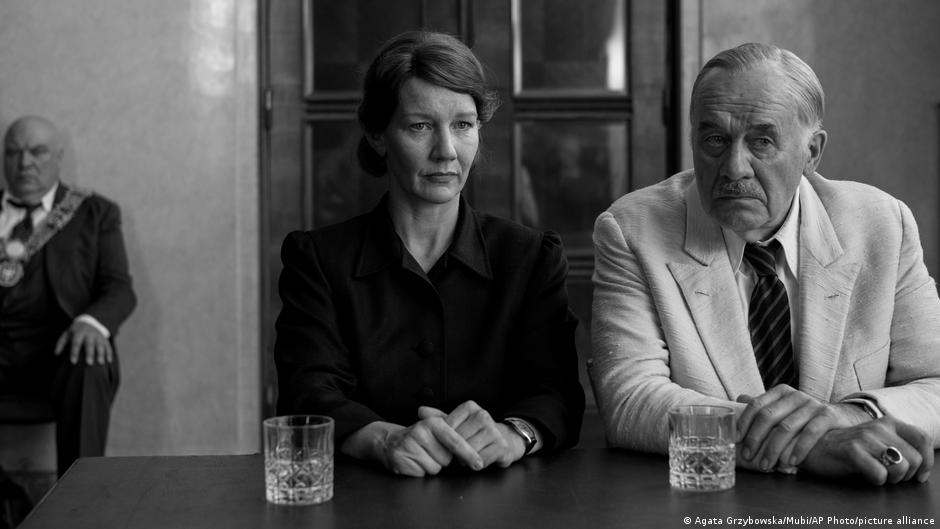
Paweł Pawlikowski’s “Fatherland” is one of the most anticipated films among the 21 titles competing for the prestigious Palme d’Or this year.
The Polish filmmaker returns to Cannes after winning the festival’s best director award in 2018 with “Cold War.” The historical romantic drama set between communist Poland and Paris won top European film awards and earned multiple Oscar nominations.
Pawlikowski’s new film is another exploration of the early Cold War period. It is framed as a road movie made by Thomas Mann (played by Hans Zischler) and his daughter Erica (Sandra Hülser) as they travel in a Buick from Frankfurt, West Germany, to Weimar, East Germany in 1949.
According to the film’s synopsis, “Fatherland” also explores “themes of identity, crime, family and love” amid the turmoil and moral confusion of post-war Europe. The story of the biographical work is renewing interest in the already iconic Mann family.
What defines the relationship between Thomas Mann and his daughter Erica? How did this prominent exile family of intellectuals see postwar Germany – and how did Germans see Mannes? And why was the year 1949 especially important for him?
Thomas Mann’s iconic legacy
Thomas Mann, winner of the Nobel Prize in Literature in 1929, fled Germany in 1933 as the Nazis came to power. During his years of exile (1933–1952), which he spent mainly in Switzerland and the United States.
Having established his fame with novels including “Buddenbrooks” (1901) and “The Magic Mountain” (1924), Thomas Mann became a leading critic of fascism during Hitler’s regime, and secured his legacy as a leading democratic intellectual of the 20th century.
Most famously, Mann’s “German Listener!” (Listen up, Germany!) Series of speeches given via the BBC between 1940 and 1945 during his exile in the US, documenting his resistance work.
He has a special bond with his daughter Erica
When Mann’s first child was born in 1905, he openly expressed his disappointment that it was a girl. A son “would have been more poetic, more consistent, would have been a new beginning for me,” he wrote in a letter to his brother Heinrich Mann.
Irmela von der Luhe, author of a biography on Erica Mann, says, “And yet this daughter, of his six children, became the most important of the father’s poetic and political endeavors.”
Indeed, Erica played an influential role in inspiring her father to actively speak out against the Nazi regime as early as 1936. Although he was a known opponent of Nazism as early as the 1930s, the novelist remained publicly silent on the subject after Hitler took power. Erica threatened to break up with her “liberated father” if he did not give up this cautious attitude.
“She personally clashed with the Nazis very early on,” von der Luhe tells DW.
A child of the Roaring Twenties and a brilliant cultural figure in Berlin, Erica Mann embraced the bohemian and experimental lifestyle of the era – until she realized that her generation should have put more energy into defending the progressive rights and freedoms enjoyed under the Weimar Republic’s democratic constitution.
In 1933, a year before Hitler seized power in Germany, Erica was condemned by the Nazis’ paramilitary militia for publicly reciting pacifist poetry. This influenced his acting career and contributed to the strengthening of his anti-fascist beliefs.
In January 1933, Erica Mann co-founded a political cabaret called “Die Pfeffermühle” (The Peppermill) in Munich. He wrote most of their material; The satirical pieces were often anti-fascist. After two months, the Nazis closed the theater company and forced the artists into exile.
Through their mother Katia Mann, who was from a wealthy Jewish industrialist family, the Mann children were also considered Jewish under Nazi racial laws.
In exile, Erica Mann built a second successful career as a reporter and author, aiming to warn the world about how quickly democracy had broken down under Hitler, despite Germany’s fame as “the land of poets and thinkers”.
“That’s what I’ve always found important about him, and what in my view, unfortunately, is very relevant again today,” says von der Luhe.
what happened in 1949
Just four years after the end of World War II, Germany was still in ruins, and ideologically divided: October 7, 1949 saw the official establishment of the German Democratic Republic (GDR), a new socialist state based on the post-war Soviet occupation zone in East Germany.
After the war, Thomas Mann announced that he would not return to live in his country. He discussed in his publications that all Germans are responsible for Nazi crimes; This theory of German collective guilt alienated those who remained in Germany. After all, didn’t the Mann family spend so many years living comfortably in exile, while so many others suffered under Hitler?
As part of the celebration of the 200th birthday of Johann Wolfgang von Goethe, Thomas Mann returned to Germany to visit for the first time since his exile in 1949. He was invited to receive the Goethe Prize in the West German city of Frankfurt, while the East German city of Weimar offered him honorary citizenship and the Goethe National Prize.
In speeches in both cities, Mann said that he did not recognize any ideological divisions or business sectors. “My journey is for Germany, for all of Germany,” he said.
But Erica condemned the project. Von der Luhe says that this invitation was also at the center of a second major dispute between Erika and Thomas Mann after a disagreement about taking a public stance against the Nazis in 1936. The Mann expert explains that Erica felt her father should not go to “a country where he had been so brutally attacked in the media in recent years”.
Those attacks included threatening letters from West Germans; The 1949 trip to Germany was under police protection.
Complicating matters, this was also the year that Klaus Mann committed suicide. The second child of Thomas and Katia Mann, Klaus was also a committed anti-fascist writer, and Erika was exceptionally close to him.
One of the many factors that contributed to Klaus’s deep disillusionment was the way he was treated in America, where Mannes was suspected of being a communist. Erica felt that Thomas Mann’s famous stop in Weimar would be interpreted as legitimizing communism.
Even though Pawlikowski’s “Fatherland” is based on existing historical figures, its premise is entirely fictional. During his well-documented journey from Frankfurt to Weimar, Thomas Mann was accompanied by his wife Katia. Erica did not join them – as she had deliberately decided to boycott the tour of her former home country.
Edited by: Sarah Huckle