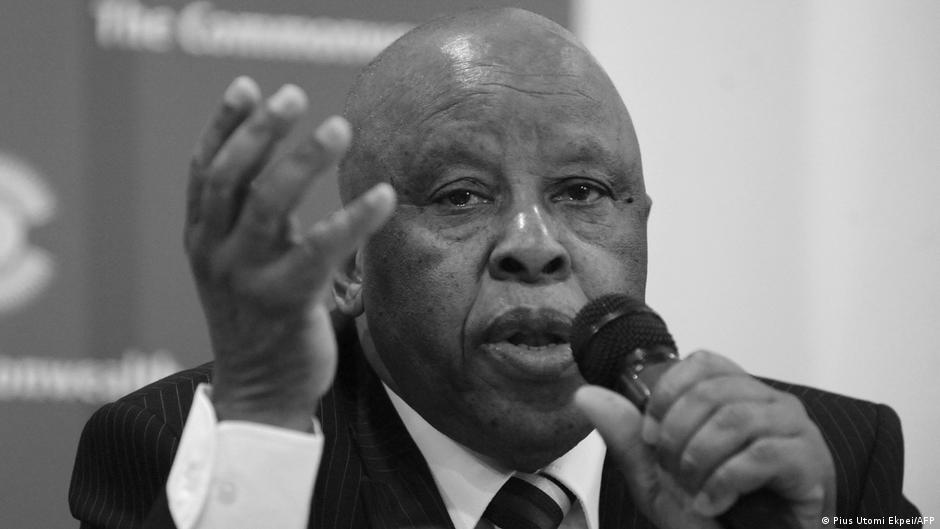
The political career of former Botswana President Festus Gontebane Mogae can be summarized under one heading: “Good governance.”
During his tenure from 1998 to 2008, the southern African country experienced steady economic growth and became one of the most prosperous countries on the continent. It now holds regular elections and is seen as one of the most stable countries in Africa.
Moge grew up in poverty: he was born on August 21, 1939, into a family of cattle herders in Serowe, a village in east-central Botswana. His father was the village head. Moge went to school for the first time when he was only 11 years old.
After training as an economist at Oxford and Sussex Universities in the UK, Festus Mogae took up a post in Botswana’s Ministry of Finance and Development Planning in Gaborone in 1968, where he became Director of Economic Affairs.
He was then appointed Permanent Secretary, Head of the Central Bank of Botswana and later Finance Minister and Vice President.
Determination and hard work characterized Moge’s professional career from the beginning and his success as a politician.
Focus on economic development
Mogae was a member of the Botswana Democratic Party (BDP), the ruling party in Botswana from the establishment of the independent republic until 2024.
On 1 April 1998, he took office as the third President of Botswana, replacing his predecessor Kwet Masire in a peaceful transfer of power. After two terms, Mogae stepped down as head of state for a decade, in accordance with the constitution.
According to experts, Mogae was one of the architects of Botswana’s remarkable economic growth, which has long been considered a model for Africa.
Botswana was one of the poorest countries in the world when it was granted independence by Britain in 1966. However, the discovery of rich diamond deposits along with Moga’s progressive economic policy in the early 1970s led to the country’s economic growth.
Leader in the fight against HIV-AIDS
Mogae’s government also took seriously the AIDS crisis in Africa, which began in the early 2000s: among other things, Botswana was the first African country to launch a program to provide free antiretroviral drugs to all HIV-infected citizens.
The government also campaigned to prevent mother-to-child transmission of HIV and to care for children orphaned by AIDS.
Mogae made the fight against AIDS a top priority, transferring responsibility for dealing with the immunodeficiency disease from the Ministry of Health to the Office of the President to enable “closer and more binding control” – which bore fruit.
He was also the first African head of state to get himself tested for AIDS, and encouraged his fellow citizens to do the same, and became an internationally recognized advocate of public health issues.
Awards and accolades
In 2008, Mogae was awarded the prestigious Ibrahim Prize for his services to African leadership: he had “sustained and consolidated Botswana’s stability and prosperity in the face of a pandemic” that had the potential to threaten the future of his country and his people, the citation said.
This prestigious award is given to former African heads of state and government who have demonstrated good governance, ensured democratic elections and strictly adhered to term limits.
In a speech in 2020, Moge once again emphasized the central role of good governance for stability and development: “Traditionally, many of our leaders behave as if they own their country. But the principle of democracy is that the leader is a servant of the people,” he said at the time.
an impeccable leader
Mogay has often criticized African heads of state and government who refuse to step down.
“Some of them have been really good and brought some economic development to their countries in their first two terms,” Mogae said in a DW interview in 2013.
“But if they remain in office for too long, their performance also declines. They start mixing personal interests with the interests of the nation. As they say, power corrupts and absolute power corrupts absolutely.”
Festus Gontabane Mogae died on the morning of May 08, 2026, at the age of 86, after suffering a brief illness. He left behind his wife and three daughters. Authorities in Botswana have declared three days of national mourning.
Botswana’s outgoing President Duma Boko declared that the country “mourns a distinguished statesman and patriot whose life was dedicated to the service of his country.”
“Under his leadership, Botswana earned international respect for principled governance.”
Edited by: Serton Sanderson