While Venezuela ratifies an absolute veto on Bitcoin mining under the premise of protecting an exhausted National Electrical System (SEN), a group of Venezuelan experts operates from Colombia an alternative that could change the game.
The proposal by Arley Lozano from Horeb Energy, and Carlos from Terawatt LLC, is a business model but also a technical way for Bitcoin mining to stop being classified as a burden and becomes a relief tool. This, by taking advantage of the associated gas.
The proposal comes at a critical moment, after yesterday, May 7, the Ministry of Electric Energy justified the total prohibition of the activity after reporting national consumption of 15,579 MW, the highest figure in nine years.
With a transmission network that loses 60% of its energy Before reaching homes, authorities have identified mining farms as a factor of instability. Hence, they have activated disconnection plans and rewards of up to $1,000 for reporting mining activities in states like Carabobo.
Faced with this blockage, a way emerged documented exclusively by CriptoNoticias, such as Bitcoin mining. off-grid or outside the network.
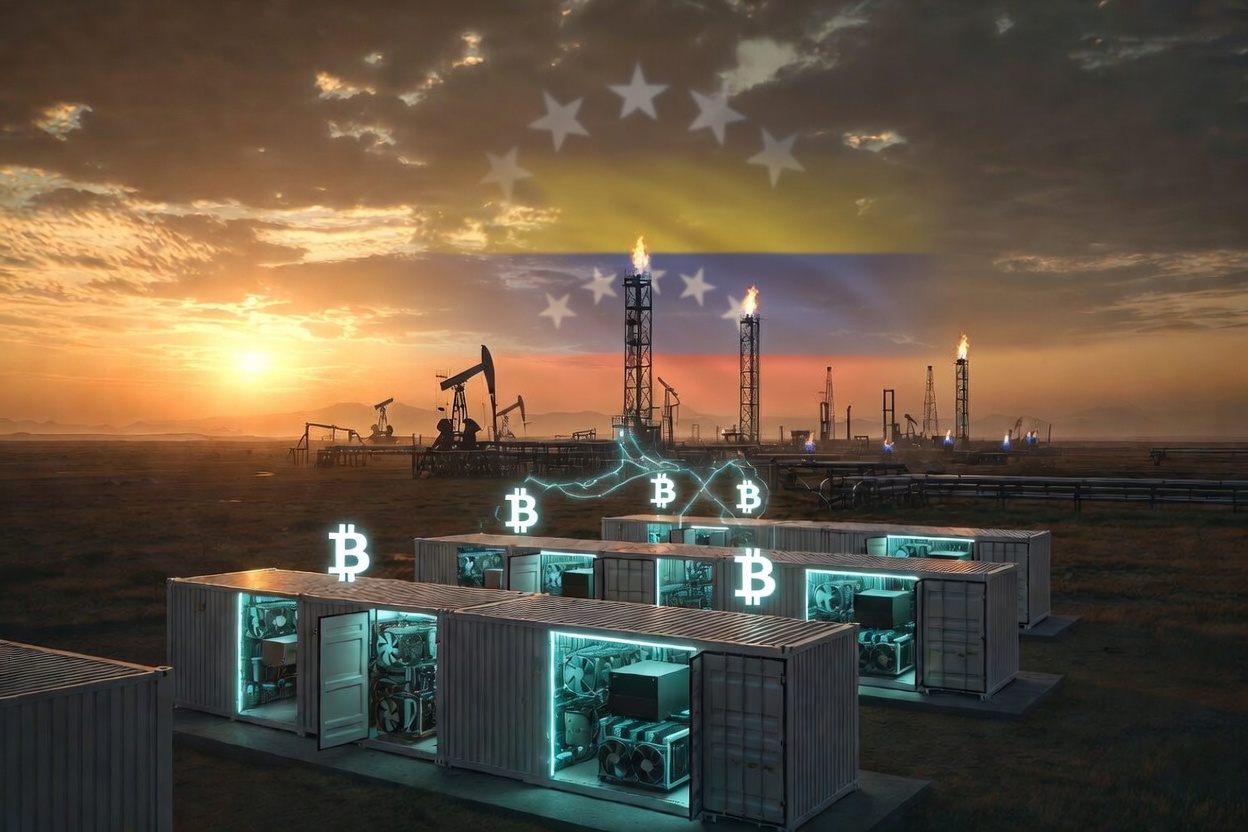
The approach is to capture the associated gas that is currently burned uselessly in the oil wells in the east and west of the country to transform it, on sitein electricity. By creating your own infrastructure, These projects demonstrate that it is possible to mine Bitcoin without subtracting a single megawatt from the national system.
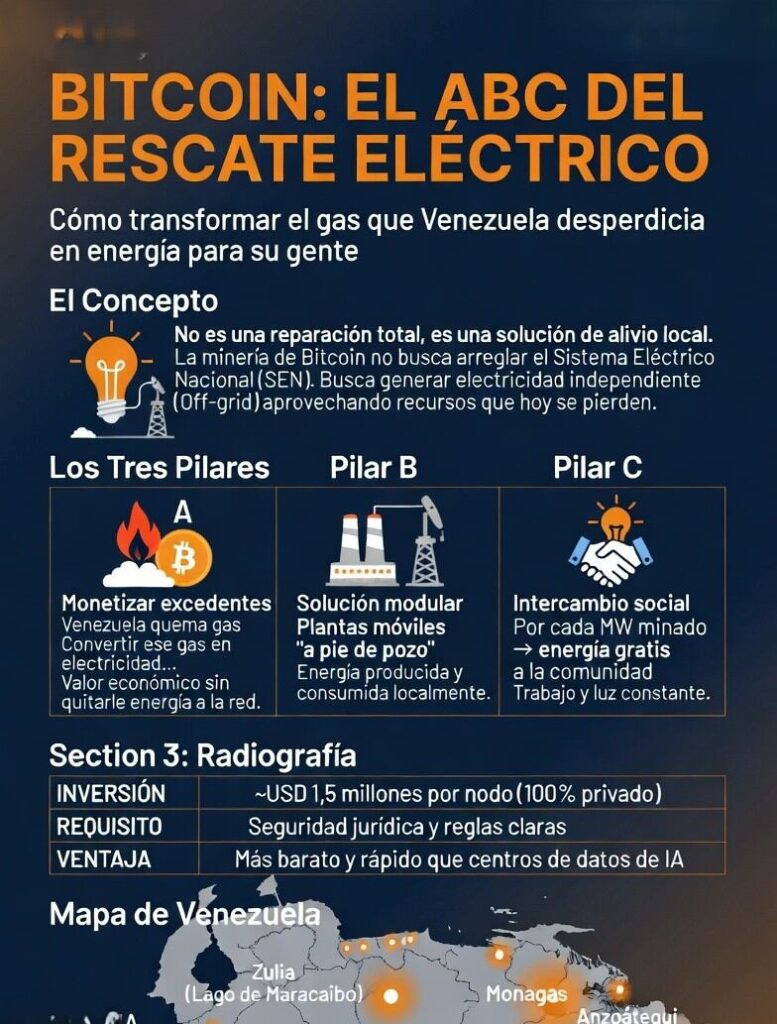
The ABC of rescue: efficiency and social work
For Lozano and Carlos, the “rescue” is not a total repair of the SEN, a task that requires billions of dollars, but a local relief strategy based on three pillars:
- Monetize waste: Mining works as a mechanism to give value to the energy surplus that no one takes advantage of today. Instead of burning gas, it is converted into transportable energy.
- Modular solutions: unlike large dismantled thermoelectric plants, these systems are mobile. “We can locate ourselves in critical areas like Zulia and provide energy to specific sectors,” explains Lozano. It is a way of “sectorizing” the crisis to resolve it by nodes.
- Social sharing: The model proposes a “win-win” scheme. For each amount of megawatts allocated to mining, the project could solve a quota of free energy for the local community neighboring the well.
Energy generation, for example, a social contribution as I had proposed when I won the prize with this oil company. I had proposed: hey, I’m going to mine bitcoins, but I’m going to make a contribution to the community. Well, then Venezuela could take an initiative to say, look, all the miners in the world come, but for every 234 megabytes of mining they are going to solve part of my problem. So, it’s a matter of negotiating.
Arley Lozano.
From the pilot test to reality in Colombia
This technology already has its engines on in Colombia where they reveal an economic paradox. This is because while Venezuela dumps gas, there are Venezuelans using the little that is available in Colombia to strengthen that country’s network.
Furthermore, Bitcoin mining allows you to start with investments from $100,000. A much more manageable figure than the USD 900 million that an Artificial Intelligence data center would require.
We started with a pilot test to check if it was possible to use biogas in a more economical way, since they are systems that are already made in Germany, they are made in the United States. What we did was, as always, tropicalize it and bring it to the market. The project is in Cúcuta. It already went from being a pilot test last year, in August, to a project as such. We are already generating almost 1000 megawatts of energy per hour and with this we power a data center of 220 miners and we continue to test the stability of the system.
Arley Lozano.
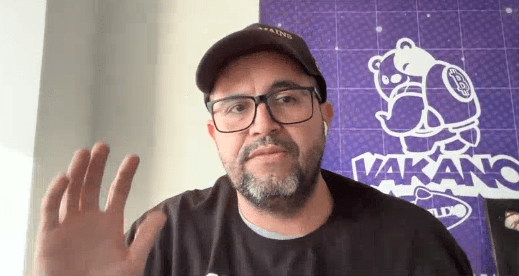
For its part, Terawatt LLC demonstrates that mining can be an anchor for investments in energy infrastructure that, if permits and guarantees exist, could benefit local communities in oil zones in the east and west of Venezuelajust as happens in Colombia.
We have a gas supply agreement with an oil company in the Tolima region and we currently have a generation capacity of about 900 kVA, although we are not using the system 100%. The plan is to add a second and third generator to reach 1.5 MW. But the issue is that in Colombia there is a structural gas deficit, so what the law did and what we are doing is something very difficult to achieve.
Carlos.
The viability of this model collides, however, with a distorted perception of the value of the resource. Although gas in the national system can be quoted at high prices, the reality in the wells is that this surplus is worth nothing as long as it continues to be burned. Even, in many cases, represents a negative cost due to environmental fines in Colombia.
“What we did in Colombia is a very complex business development challenge,” admit those responsible for Terawatt LLC, who see much more natural markets for this technology in places like Texas, Argentina or Venezuela itself.
The interest in returning to the country is shared by both local and foreign capital, but the definitive movement towards the Venezuelan basins remains conditional on the institutional haze clearing.
The wall of distrust
Despite the technical feasibility, the obstacle is institutional. After the intervention of Sunacrip in 2023, the regulatory framework remained in doubt. For investors, the risk is not gas, but legal certainty. “As long as there are no rules of the game respected by everyone, we are going to be expectant,” says Carlos, who admits to feeling fear for the integrity of the equipment and the opacity in the checkpoints and ports.
For my part, I appeal to those who are reading this article that wow, something has to be done and there are people ready to do it. I am ready. I am ready. If tomorrow they tell me to go to Venezuela, I’ll grab my hats and go, but there have to be guarantees.
Arley Lozano.
In that sense, the current official veto responds to an undeniable emergency, but leaves a technical question in the air: if the problem is the consumption of the public networkCould self-generation be the bridge to modernize the system without overloading it?
Venezuela today finds itself sitting on a “gas mattress” while its citizens normalize living in the dark. The technology to change this reality exists and is in Venezuelan hands, but remains in operational exile. As long as the structure of mistrust is not broken and clear guarantees are established, Venezuelan gas will continue to illuminate the sky in an unproductive way, while the engines that could rescue the country continue to burn in other lands.
«It is, perhaps, the most faithful metaphor of our crisis: have the solution in hand and still prefer to watch it burn«, Arley and Carlos pointed out.