When trade ministers from the so-called Group of Seven, or G7, countries met in Paris this week, they were to address the most pressing issues facing global trade, including critical minerals and the impact of the Iran war.
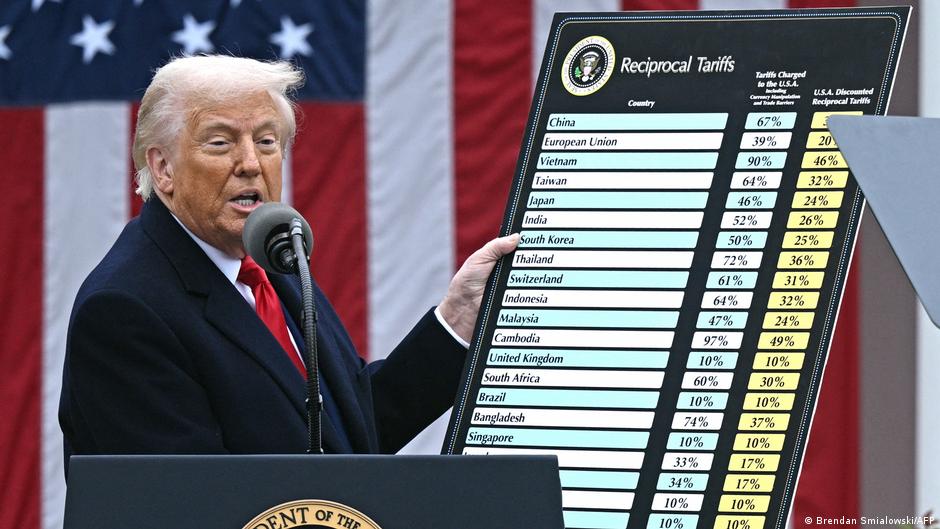
Instead, the meeting was overshadowed by US President Donald Trump’s threat to impose 25% tariffs on European vehicle imports.
Trump made the threats earlier this week and justified them by arguing that the EU – members France, Germany and Italy also belong to the G7 – had not met its obligations under the previous US-EU tariff agreement, known as the Turnberry agreement.
The deal took place at Trump’s Turnberry Golf Course in Scotland and both sides agreed that the US would impose a maximum tariff of only 15% on EU goods, while the EU would eliminate all tariffs on US industrial products. Europeans reject the idea that they have not met their bargaining goals, although they have yet to ratify the agreement in the European Parliament.
Ahead of the G7 summit, EU Trade and Economic Security Commissioner Maros Sefcovic spoke to the US Trade Representative in Paris, Jamieson Greer.
Sefcovic later said that he and Greer “clearly concluded that it is important for both parties to honor Turnberry’s deal.”
That means the EU should reduce tariffs on US exports as agreed and the US should return to the promised 15% tariff, Sefcovic said.
Germany’s Economic Affairs and Energy Minister Katharina Reich also spoke to her American counterparts in Paris.
“It is true that we are making progress in implementing the agreements reached on the tariff agreement,” Reiche told DW. He said the issue of auto exports is a central issue for Germany and he hoped it would be resolved through ongoing talks.
Threat to walk back
In fact, on Friday, Trump backed off to some extent on his threat of 25% tariffs. He said he would be willing to wait until July 4 to decide whether to impose higher tariffs on the EU.
After a phone call with European Commission President Ursula von der Leyen, Trump said he agreed to give them “until our country’s 250th birthday, otherwise, unfortunately, their tariffs will immediately go to very high levels,” the BBC reported.
Making matters more complicated is the fact that just hours before Trump agreed to wait until July 4, a US court ruled against another of Trump’s tariffs, opening the door to further legal pushback.
Should higher tariffs actually be implemented, the German car industry would be particularly hard hit, an analysis by the Kiel Institute for the World Economy found.
The US is the second most important market for German auto makers after the EU. Researchers at the Kiel Institute said the type of tariffs Trump is threatening would cause short-term losses to the sector of about €15 billion ($17.5 billion). In the long term this figure will reach €30 billion. The institute’s analysis concluded that all this would be a major blow to Germany’s currently weak economic performance.
What’s wrong with Friedrich Merz?
Since German automakers would be particularly affected by the threatened tariffs, observers interpreted Trump’s comments as retaliation for comments made by German Chancellor Friedrich Merz about the Iran war.
Speaking to students in the central German city of Marsberg, Merz said the US had been “humiliated” by Iran’s leadership and outmaneuvered at the negotiating table. Shortly thereafter, the US government announced it would withdraw 5,000 US troops from Germany and Trump threatened tariffs.
But Penny Nass, a trade expert at the German Marshall Fund think tank, said Trump may also be considering the damage to the Italian auto industry. Italian Prime Minister Giorgia Meloni has also been more critical of Trump recently, Nass told DW, citing Meloni’s comments about Trump and the Pope as well as the Iran war.
Most of all, however, the US may be genuinely disappointed by the implementation of the Turnberry Agreement. “The process has been delayed, there have been hurdles,” Nass said. “I think the US is just playing out a card that they want to see Europe move a little faster.”
It is true that the European Parliament has already delayed approving the Turnberry Agreement twice – first, because of Trump’s threat to invade Greenland; And then because of the US Supreme Court ruling that some of Trump’s tariffs were illegal.
It seems America’s important message has reached Europe this week. During the closing press conference of the G7 summit, host French Trade Minister Nicolas Fourissier said he understood the US threat of tariffs as a call to accelerate the implementation of the Turnberry agreement.
EU lawmakers are now demanding safeguards if the US fails to adhere to the agreement. When the Turnberry Agreement was made, the EU had emphasized stability and predictability in relations with the US under Trump.
But Nass said predictability is unlikely. She points out that tariffs – or at least, the threat of them – are President Trump’s favorite economic negotiation tool.
This story was originally published in German.