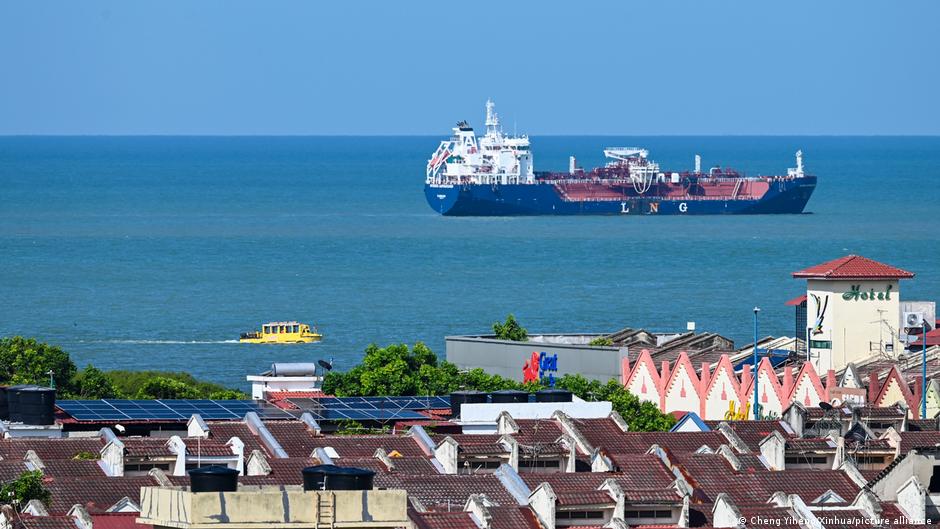
Can charging toll for passage through the Strait of Malacca, the narrow stretch of water connecting the Indian Ocean to the Pacific Ocean, be a profitable business? Indonesia’s Finance Minister Purabaya Yudhi Sadewa floated the idea in late April. “If we split it three ways between Indonesia, Malaysia and Singapore, it could be quite a lot, right?” He said.
He later clarified that he was not entirely serious when Indonesian Foreign Minister Sugiono said that his country supported freedom of navigation and would not impose tolls on ships passing through the strait plying between Indonesia, Malaysia and Singapore.
Nevertheless, the comment raised fears of misuse of maritime traffic for geopolitical gain, not only in the Strait of Hormuz, but in other waterways as well. “The closure of the Strait of Hormuz has forced policymakers in Asia to confront questions about the security of other maritime chokepoints,” Reuters news agency wrote.
The Strait of Malacca is of particular concern. It is the most important shipping route between East Asia, the Middle East and Europe, accounting for about 22% of international maritime trade.
Dangers of geopolitical leverage
But there are other issues of concern besides piracy and regional conflict. In November last year, the Center for Strategic and International Studies (CSIS) had warned about this new threat.
Even non-state actors are now in a position to seriously disrupt global trade flows, the think tank said, citing attacks by the Houthi militia in the Red Sea. Many shipping companies now avoid passing through the Suez Canal, instead taking the longer route around the Cape of Good Hope, which has a significant impact on supply chains and prices.
Political scientist Nikolaus Sholik, a former Austrian army colonel and senior advisor at the Austrian Institute for European and Security Policy (AIES), believes these are signs of a fundamental shift in the geopolitical balance of power.
“We are experiencing today the consequences of that development in which individual states believe they can legally dominate strategically important maritime straits,” he told DW. This would be particularly dangerous, he said, if straits such as the Straits of Hormuz, Malacca or Taiwan became levers of geopolitical influence.
Christian Wirth, Asia analyst at the German Institute for International and Security Affairs (SWP), agrees. “Whether a strait is particularly vulnerable depends essentially on three factors: the transport agreement, possible alternative routes and the political situation in the surrounding region,” he told DW. The more important a route is and the more difficult it is to bypass, the greater its strategic importance.
‘Return of Geography’
The Strait of Hormuz, through which the bulk of global oil and gas exports must pass, looks particularly vulnerable at this time. But Sholik warned that we should not just look to the Persian Gulf. “In such a situation, the Taiwan Strait would be even more important than the Strait of Hormuz,” he says, referring to a potential conflict between China and Taiwan. As he points out, a large portion of Asian trade passes through the Taiwan Strait as well as the Strait of Malacca.
The International Institute for Strategic Studies (IISS) recently wrote that geopolitics is currently experiencing “the comeback of geography”. Straits such as the Straits of Hormuz, Bab el-Mandeb or Taiwan are no longer mere geographical routes; They are increasingly becoming strategic levers of geopolitical power. The IISS argues that the world’s closer interconnectedness has created new dependencies, and thus new means of exerting pressure.
The position is very clear in international law. “The principle of free transit applies to sea straits of international importance,” Wirth said. “This means that ships, even warships, are allowed to pass unhindered through the strait, classified as international waters.”
Such a blockade of an international strait would be a serious violation of international law, Wirth said. The United Nations Convention on the Law of the Sea also guarantees peaceful passage to warships through coastal waters, which are defined as the territories of states bordering the strait. Tolls or fees are clearly unacceptable. These can only be deployed on artificial waterways such as the Suez or Panama Canal.
Fragility of maritime law
But the real problem is political realities, Sholik said: “International law only works if the countries involved are willing to abide by it.” This is certainly not always the case: in a recent case in the South China Sea, China ignored an international court of arbitration ruling in favor of the Philippines.
At the same time, experts warned against overestimating conventional military power. “These days, you no longer need a big navy to seriously disrupt [traffic through] A strait,” Sholik said. Iran has shown how small speedboats, missiles or drones can exert considerable pressure, he commented.
However, Wirth argues that a complete blockade of a strait also carries enormous risks for the blockading state, usually resulting in economic losses. In case of increased tension in the Taiwan Strait or Malacca Strait, China will also be affected on a large scale.
There are some alternative routes into Southeast Asia, such as the Sunda Strait between Sumatra and Java, or the Lombok Strait between Lombok and Bali. Wirth said transportation via these options is longer and more expensive, but global trade would not be completely suspended if Taiwan or the Strait of Malacca were blocked.
maritime chokepoint
Nevertheless, both experts agree that the globalized economy is becoming increasingly vulnerable. Skolick refers to the “just in time” principle of modern supply chains. Companies rarely keep any goods in stock, which means even mail-related disruptions are capable of causing economic losses around the world.
For this reason, the Center for Strategic and International Studies warns that the Strait of Hormuz is a symptom, not an exception: the modern global economy depends on a handful of maritime chokepoints, with the potential for global consequences if any one is disrupted.
This is why the impact of the Malacca debate extends far beyond South-East Asia. The strong reaction of Singapore, Malaysia and Indonesia to the transit fee proposal demonstrated how attractive it has become to use geographical control as a political or economic advantage, but also that questioning freedom of navigation represents a serious threat to the world economy.
This article has been translated from German.