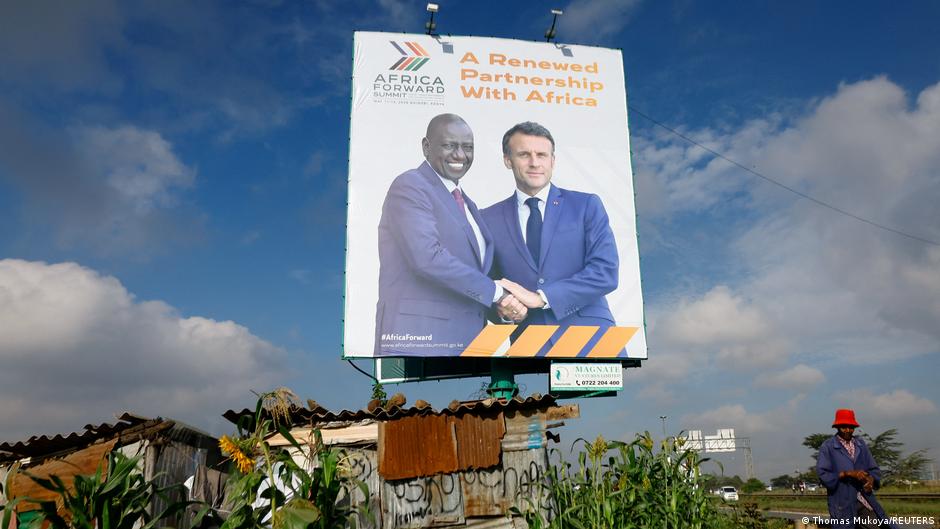
When the foreign ministers of France and Kenya inaugurate the “Africa Forward Summit: Africa-France Partnership for Innovation and Growth” at the University of Nairobi on May 11, the focus will be on trying to find common ground.
The two-day meeting in Kenya is the first summit of its kind that France is hosting in an English-speaking African country that is not among its traditional partners.
There is a reason for this: According to analysts, President Emmanuel Macron wants to send a signal and initiate a change in West Africa from France’s previous Africa policy.
Why does France make changes?
“France has lost a lot of prestige and influence in francophone African countries, especially in the Sahel region,” Ulf Lessing, head of the Konrad Adenauer Foundation’s Sahel regional program in Mali, told DW. “It is now making a strong effort to expand into other Anglophone countries – South Africa, Kenya, Nigeria – to re-establish itself and present itself as Africa’s most important partner.”
Macron and Kenyan President William Ruto will showcase their new partnership as co-chairs of the summit. The focus will be on increased security, economic investment and green energy.
Ruto also intends to discuss making the global financial system more equitable for indebted African countries. France has promised to support this campaign. About 30 heads of state and government as well as international guests are expected to participate.
The summit aims to signal a shift in Paris’ Africa strategy. “There’s a clear connection,” Lessing said. “It aims to compensate for the loss of influence in Francophone Africa by gaining greater influence in Anglophone countries.”
Although France may also seek to expand into its former colonies later, military rule in the Sahel should ultimately fall, Lessing said, noting that criticism and prejudice toward France remains strong in Francophone countries.
“Africa has a very young population; for example, in Mali, the average age is 15 years old – they no longer have any connection to France,” the analyst said. “Malians have been deeply disappointed and manipulated, including by elites linked to France.”
not welcome in sahel
Since 2022/2023, there have been mass protests against French influence in West Africa, particularly in the Sahel region, with protesters accusing France of neo-colonialist policies and interference in internal affairs. Mali, Burkina Faso and Niger have ended military cooperation with France and forced the withdrawal of French troops.
These new military junta leaders in the region are exploiting anti-French sentiment to assert their sovereignty.
The CFA franc – a relic of the colonial past – has also long been a source of irritation for many West Africans.
In early 2020, some West African countries initiated currency reforms with the approval of France to eliminate the CFA franc. But the change process is proving difficult.
According to experts, given this loss of influence in West Africa, the Africa Summit in East Africa provides an opportunity to highlight the commitment of France, Kenya and other African countries.
“After withdrawing from the Sahel, France wants to realign its partnership towards more diverse, economically-oriented relations, primarily in fast-growing regions such as East Africa,” Yves Akoue Amazo told DW.
The Togolese analyst is director of the Vienna-based Afrocentricity think tank. Instead of focusing on the extraction of raw materials, France is looking for stable investment opportunities in the areas of infrastructure, energy—especially renewable energy—the digital economy and logistics, he said.
“And projects involving the private sector also ensure long-term impact without depending on security concerns,” he said.
Fierce competition in East Africa
Competition with existing trading partners in the region is likely to be fierce, as France will have to compete with alternative financing offers from China, India, the United Arab Emirates, Qatar and Saudi Arabia.
France is already doing successful business in Kenya: According to the French Ambassador to Kenya, France is the fifth largest foreign direct investor in the country, supporting 46,000 jobs. Trade, which the Kenyan Trade Ministry estimates at about $300 million (€255 million), is also growing.
Kenya exports fruits, coffee, tea, flowers and spices to France and imports pharmaceutical and cosmetic products, chemicals and machinery.
However, ahead of Monday’s summit, President Ruto made it clear that Kenya is also keen to play a role as a global player: “Every item on the agenda, every conversation and every commitment is aimed at the same thing: an Africa that is at the forefront of global affairs, shaping its destiny, determining its future and influencing the global discussion,” he said, according to Kenyan media outlets. star.
According to Amaizou, East Africa’s geopolitical influence is growing. “Paris is signing new defense and investment partnerships with countries such as Kenya, Rwanda and Tanzania. Such agreements strengthen their position as strategic hubs between Europe, the Indian Ocean and the entire African continent,” he said.
For Kenyan economist James Shikwati, the decision to hold the France-Africa summit in Nairobi comes as no surprise. Kenya wants to build strong alliances with major global powers. “The French government may have felt that this Kenyan policy provides it with a better entry point back into Africa,” he told DW.
“In this case, in Anglophone Africa, where France is not necessarily viewed with hostility,” he said.
Furthermore, Kenya is attempting to position itself as a gateway to other African countries.
After all, within the East African Community (EAC), along with the Democratic Republic of the Congo, Rwanda and Burundi, there are at least three countries that are largely francophone – another advantage for France.
According to Shikwati, France’s new approach also shows how the tense global situation with the crises in the Middle East and Ukraine is putting pressure on traditional markets.
“Established players are finding themselves in a new, difficult situation in which they must realize their global business strategy,” he said. That is why the attention is shifting towards emerging economies which also want to operate at the global level.
This article was translated from German.