The project is built on Nostr, the decentralized communications network.
Nmail, the reference client, is open source and encrypts messages end-to-end.
Renaud Lifchitz, computer security expert and developer linked to the Nostr ecosystem, announced on May 10, 2026 the launch of Nostr Mail, a decentralized email protocol inspired by the principles of Bitcoin: that the user controls their own keys, their identity and their inbox, without depending on any central authority.
«The first decentralized email protocol powered by Nostr. Own your identity, your passwords and your inbox. No central authority. Without intermediaries”, Lifchitz wrote.
Currently, a Gmail or Outlook address does not belong to the user but to the company that provides it. That company can scan the content of the messages to display advertising, share data with third parties or unilaterally close the account.
Bitcoin solved that problem for money more than fifteen years ago by allowing each person to custody their own funds using cryptographic keys. Nostr Mail applies the same logic to mail.
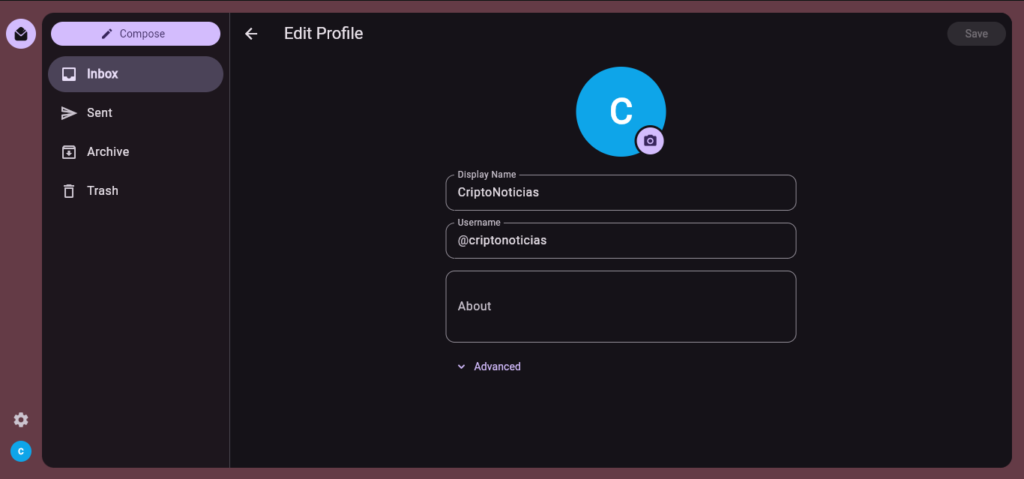
Features of Nostr Mail
This new protocol is built on Nostra decentralized communications network based on public key cryptography. In Nostr, each user generates a pair of keys: a public one, which functions as a contact address, and a private one, which signs and encrypts messages.
There is no central server that can lock an account or intercept a conversation because the identity lives in the user’s keys, not in any company’s infrastructure.
On that basis, Nostr Mail proposes replacing traditional mail with a system where the user is the sole custodian of his or her inbox. Nmail, the reference client developed with Flutter (a programming environment that allows you to build applications for multiple platforms from the same code), offers, according to the Nostr Mail website, the following features:
- Automatic end-to-end encryption: Only the sender and recipient can read messages.
- Portable identity: the user’s address cannot be canceled by any central authority.
- Sync across devices: Folders and settings are replicated across web, mobile, and desktop.
- Open source: any developer can audit or contribute to the project.
- Interoperability: allows you to write to both Nostr users and traditional email addresses using SMTP bridges (the standard email sending protocol).
Linked interoperability with SMTP bridgesNostr Mail’s documentation exposes an area of friction, as it does not detail who operates those bridges or what level of trust they require. When a Nostr message must cross to a Gmail or Outlook address, it necessarily passes through a centralized infrastructure (the bridge), where typical Nostr encryption can be broken.
Therefore, the promise of decentralization and complete privacy is held only within the Nostr network, and is partial when communicating over SMTP bridges.
Other limitations and challenges in Nostr Mail
Since Nostr Mail is built directly on top of the Nostr protocol, inherits some of its limitations:
- Spam and abuse: Anyone can send messages with no upfront cost, which could lead to overcrowded inboxes. The project mentions economic solutions (charging sats), but it is not yet tested at scale.
- Dependence on relays: Message delivery depends on the sender and receiver sharing active relays. If there is no overlap, emails may be lost or delayed.
- Account Recovery: Does not exist. Losing your private key (nsec) means losing permanent access to your inbox.
- Scalability: Relays can become saturated with intensive use of attachments or high volume of emails.
Nostr Mail represents an interesting step towards digital sovereignty, but it does not solve all the problems of decentralized email. Its success will depend on how the community addresses these technical and usability challenges in the future.