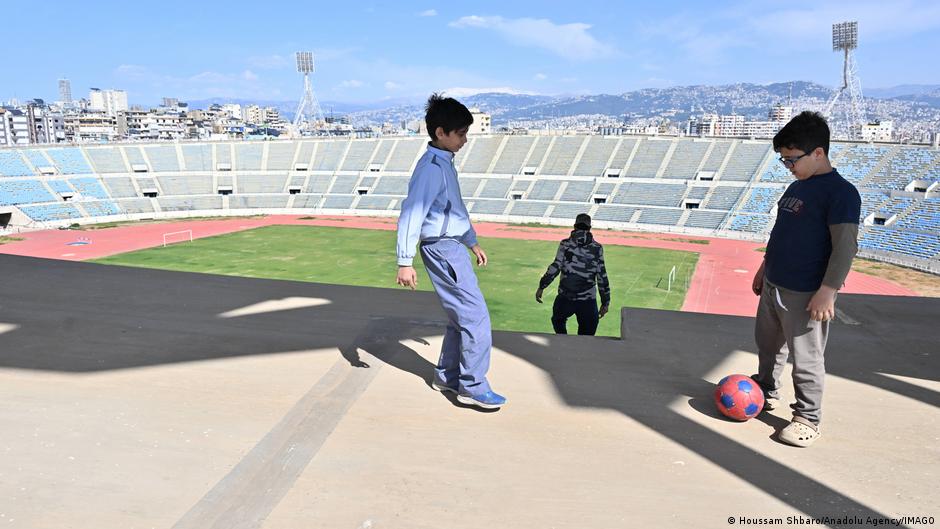
Hassan Seif al-Din never imagined that at the age of 65 he would be teaching martial arts to children in a football stadium in Beirut. But these are not normal times.
Koch along with thousands of others fled to the Camille Chamoun Sports City stadium in Dahiyah, one of the capital’s southern suburbs. He now lives in one of several rows of tents set up at the venue.
The Middle East was again plunged into fighting on February 28 when the United States and Israel attacked Iran and the conflict spread to Lebanon a few days later. In April, the Office of the High Commissioner for Human Rights at the United Nations said more than one million people had been displaced in Lebanon as Israel bombed Hezbollah targets in the country. Hassan is one of them.
“There was a lot of bombing going on around us, so we escaped and got displaced here in Sports City,” Hassan told DW. After arriving, he was determined to maintain his martial arts routine.
“I was training here alone for two to three hours every day,” he said.
As soon as he did this, he noticed that the children nearby were looking at him.
“I thought to myself, ‘Let me bring them together, train them, and bring some joy into their lives through this sport, help them forget what’s happening in the city, teach them how to switch off for a while and build their strength – physically and mentally.'”
Adnan is one of those kids who is learning a new skill.
“I really like how the coaches teach us, especially how to defend ourselves and how to build confidence,” he told DW. “If someone attacks me on the street and tries to kidnap me, I will know how to defend myself.”
games to distract
For Hasan, there is more to it than self-defense. It’s about giving young people something else to think about about bombs, the homes they’re missing and their lives in general. It’s about giving them something to look forward to.
“The displaced people living in tents have their own plight,” he said.
“(During training) they are away from everything going on outside, enjoying being together and training with me. Having a coach and a team is something they never had before, so they naturally embrace it. They have become like family.
“Forgetting the pain and everything that happens outside this pitch means a lot to them. They are happy. Sometimes they come and wake me up and say, ‘Let’s go, coach, it’s time to train.'”
Football clubs contribute to support
The stadium has long been home to the Lebanon national team and the venue has witnessed some of the country’s greatest sporting moments, such as the famous victory over South Korea during World Cup qualification in 2011. Older residents still talk about 1975 when Pelé played a friendly match there in front of more than 35,000 fans.
The stadium reflects the country’s turbulent history to some extent. It was destroyed during the 1982 Israeli invasion and rebuilt in 1990 after the end of the 15-year-long civil war. In 2024, it hosted the funeral of Hassan Nasrallah after the Hezbollah leader was killed in an Israeli strike.
Football is the most popular sport in the country and clubs are working hard to help those in need.
“I’m happy that the stadium is able to shelter people,” Wael Chehayeb, a member of the Lebanese Football Association’s executive committee, told DW.
“It’s also sad that this, a place that normally brings joy and invites people out of their stressful lives to watch sports, is being used this way.”
Some football clubs in the country are busy helping.
“Players and officials from second division club Akha have volunteered in public schools, where some displaced families were sheltered,” Cheheb said.
“Clubs like Safa and Nejmeh sheltered some families in their stadiums and provided food. Other clubs like Ansar helped with food parcels.”
Despite being unable to use dressing rooms and other facilities, some players are still training as clubs feel that being around players and interacting with families helps boost morale.
‘Sense of togetherness’
Anything that makes life at the stadium easier is welcome for its temporary residents, such as the family of Howayda Amin Mazannar, who fled Aitaroun, a village in southern Lebanon. It had become so dangerous that families forced to flee in the past were unable to bring any of their possessions.
“We have been suffering from the situation at the border for a long time,” Mazannar told DW. “Now we are here but it is very difficult, not knowing where you will be tomorrow, there is psychological pressure because of the uncertainty of the future.”
The only comfort they find is in others, their new and unexpected neighbors.
“There is a feeling of solidarity among people; everyone is helping each other,” Mazannar said.
“Life is simple and follows daily routines: cleaning, organizing, sitting together, and the children are trying to create a sense of normal life.”
Hassan plans to continue helping in that regard.
He said, “I never thought that one day I would get displaced and become a coach at the same time. It is God’s will – a coincidence that brought me here.”
“I’m really happy here. Believe it or not, I feel like I want to stay here and train them for one, two or three years. In a year and a half, I can make national champions out of them.”
Sarah Hettit in Beirut contributed to this report.
Edited by: Chuck Penfold