Thailand has formally terminated a 2001 agreement with Cambodia, which was intended to provide a bilateral framework to resolve overlapping maritime claims in the Gulf of Thailand, as well as help the countries jointly manage offshore resources.
THIS AGREEMENT, KNOWN AS “MOU” [Memorandum of Understanding] 44,” has largely failed to deliver results since its signing, despite five rounds of negotiations spanning more than two decades. Nevertheless, it remains one of the few permanent mechanisms for dialogue between the two countries on the disputed maritime territory.
Both Thailand and Cambodia claim ownership of the waters surrounding several islands in the region, including Koh Kood. The popular tourist destination, controlled by Thailand, is believed to sit on top of substantial – and hitherto untapped – oil and gas reserves.
Government changed in Bangkok due to Cambodia conflict
The expiration of MOU 44 “marks a significant deterioration in bilateral relations, signaling a shift from cooperative resource management to a unilateral nationalist stance,” Kyoto University professor Pavin Chachavalpongpun told DW.
Under MOU 44, Bangkok and Phnom Penh agreed to share any energy plunder in return for either party aggressively asserting its claimed sovereignty over the area.
However, since last July, the two countries have been locked in a deadly land conflict over ownership of several pieces of territory along their 800-kilometre (500-mile) border, with clashes that have killed at least 150 people and displaced hundreds of thousands.
The conflict has sparked a political crisis that has ousted Patongtarn Shinawatra’s government in Thailand, with his critics accusing him of being too deferential to Cambodia’s Hun Sen. Thailand now has a new prime minister, Anutin Charnvirakul, who took power as a caretaker leader in September before being voted in as official head of government in March.
Anutin’s government insists that the cancellation is not linked to the border fighting. Instead, they argue that MOU 44 failed to move forward after 35 years.
Nationalism rewards radicals
The conflict over territory between Cambodia and Thailand has become a test of the patriotic credentials of both sides.
In Thailand, this emboldened the military in a power struggle with civilian authorities. The ruling Cambodian People’s Party (CPP) in Cambodia has portrayed Thailand as the aggressor while presenting itself as a defender of sovereignty.
“The Thai military benefits from the ongoing tensions between Thailand and Cambodia by fostering pro-military nationalism among the Thai people, which helps provide the Royal Thai Army independence and security from any pressure from the Thai civilian government,” Paul Chambers, associate fellow at Singapore’s ISEAS-Yosof Ishak Institute, told DW.
“Anutin has shown that he will not try to oppose giving the Thai military free rein on any issue,” Chambers said.
Donald Trump’s interest was short-lived
In December, the Thai military attacked Cambodian casinos and hotel complexes, which Bangkok claimed were being used as scam centers and by the Cambodian military, charges that Phnom Penh rejected as a pretext for violating Cambodian sovereignty.
Bangkok has also used its military and economic advantages to put pressure on Cambodia.
“Cambodia’s position largely depends on international support because Phnom Penh’s strongest arguments are legal and diplomatic rather than military,” Sophal Year, an associate professor at Arizona State University, told DW.
“As a small state facing a strong neighbor, Cambodia has an advantage when disputes revolve around treaties, maps, international law and third-party mechanisms,” he said. “That’s why Cambodia is more willing than Thailand to internationalize this dispute.”
US President Donald Trump helped broker a ceasefire last year after threatening to end tariff talks with both countries unless they stopped fighting. However, this reality lasted less than a few weeks, and Washington has not taken much interest in the conflict since.
Cambodia is struggling with its bad image
Phnom Penh has already applied to the International Court of Justice and appealed to the US and China to pressure Thailand into accepting international arbitration.
Cambodia has previously been successful against Thailand in the International Court of Justice over a disputed temple, Preah Vihear. The court ruled in 1962 that the temple belonged to Cambodia and in 2013 clarified that Cambodian sovereignty extended over the entire area on which the temple stands.
Last week, Phnom Penh said it would launch a mandatory conciliation process under the United Nations Convention on the Law of the Sea (UNCLOS) after Bangkok withdrew from MOU 44.
However, Cambodia is trying to fight in the court of international opinion while suffering from “reputational liabilities,” Eyre said.
US, EU condemn Cambodia’s democratic decline, crime networks
The CPP, in power since 1979, forcibly dissolved the country’s main opposition party in 2017 on false charges of plotting a US-backed coup, effectively turning the country into a one-party state.
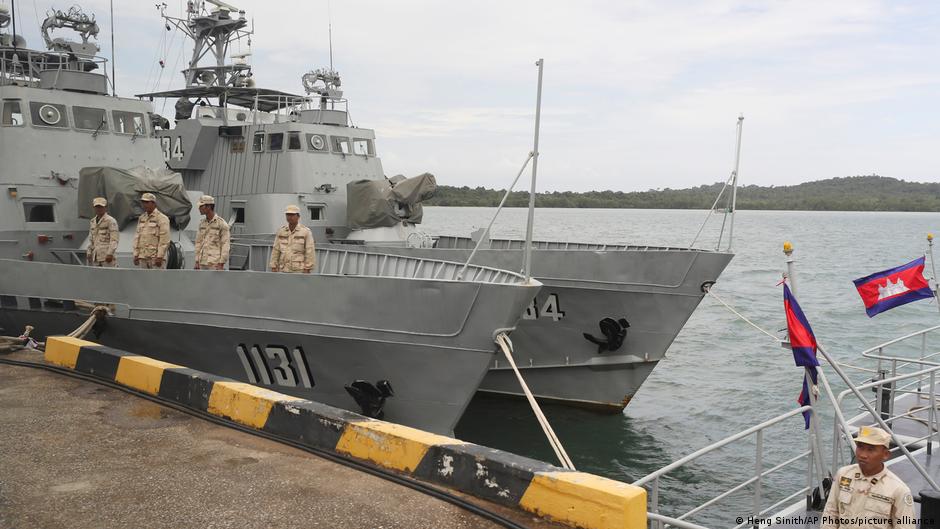
The US subsequently severed relations with Cambodia, while the EU partially suspended Cambodia’s trade preferences. Washington was also irritated by reports that the Chinese Navy was operating from Cambodia’s Ream Naval Base after Beijing funded the reconstruction of the site. Cambodia has repeatedly refused to grant special access to China.
Today, even those diplomatic issues are overshadowed by Cambodia’s involvement with cyber-scam compounds.
Analysts say Cambodia has become a major hub for international scam operations, with reports suggesting the illicit industry could be worth $12.5 billion (€10.6 billion) annually, about a third of the country’s formal GDP.
Last year, the US and Britain imposed unprecedented sanctions on Prince Group, one of Cambodia’s largest conglomerates, and its chairman Chen Zeyi. The Chinese-born businessman previously served as an advisor to Prime Minister Hun Manet and his father, veteran leader Hun Sen.
phnom penh’s soft power problem
last month, wall street journal Anger sparked outrage in Phnom Penh after a headline about cybercrime used the word “Scambodia”, prompting Cambodian officials to demand a retraction and apology. WSJ article remains online As of the time of publication, including the “Scambodia” reference.
“The mix of scandals and criticism of Cambodia’s restrictive political environment is hurting Cambodia’s ability to call out Thailand’s aggression internationally, as Cambodia’s soft power is probably at its lowest in decades,” Virak Ou, founder of the Cambodia-based think tank Future Forum, told DW.
Bangkok claims that many of its military attacks on Cambodia are aimed at fighting scammers, not aggressively seizing disputed territory.
Cambodia has tried to push back through diplomacy and lobbying in the United States. However, its room for maneuver in the West is limited, particularly because of its poor image and strong ties to China.
Edited by: Darko Janjevic