The agreement includes the use of BENJI, Franklin Templeton’s tokenized fund platform.
Franklin Templeton currently manages $1.74 trillion in assets.
Payward, the parent company of the Kraken exchange, together with the investment company, Franklin Templeton, announced this May 12, 2026 a strategic alliance to expand the offering of tokenized financial products.
The initiative aims to combine tokenized shares, custody, performance products and access to institutional liquidity through the services of Kraken, xStocks, OTC and Prime.
One of the main axes will be xStocks, the tokenized stock platform developed by Payward which, according to the company has already processed more than 30,000 million dollars in volume since its launch in 2025.
Through this infrastructure, Franklin Templeton to explore launching tokenized investment strategiesallowing products managed by one of the largest asset managers in the world to be traded on digital infrastructure.
“Payward and Franklin Templeton are building a financial model where the distinction between traditional assets and digital infrastructure no longer makes sense,” said Arjun Sethi, co-CEO of Payward and the Kraken exchange.
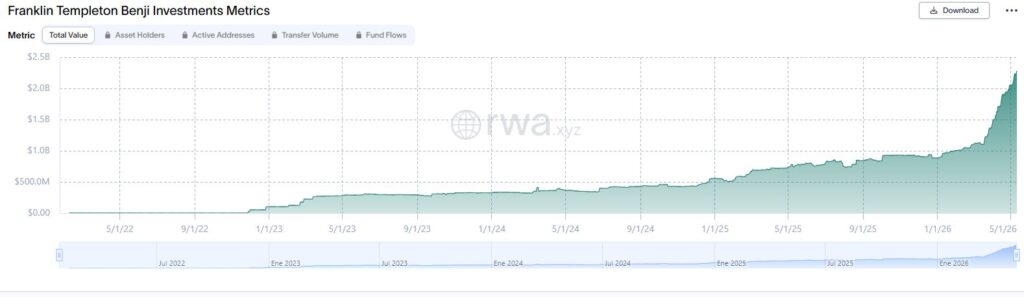
This agreement also considers integrating BENJI, Franklin Templeton’s platform aimed at tokenized monetary funds. As CriptoNoticias has explained, through BENJI, users can manage and trade tokenized assets 24 hours a day, in addition to accessing the distribution of returns linked to the OnChain US Government Money Fund (FOBXX).
Currently this platform concentrates more than $2.28 billion in distributed assets.
However, the companies They have not yet detailed what the first specific use cases of BENJI will be. nor how exactly the integration will work for institutional or retail clients.
“The goal should be to make assets on the blockchain more functional for all market participants,” said Sandy Kaul, director of Digital Assets and Innovation at Franklin Templeton.
Franklin Templeton currently manages $1.74 trillion in assets and operates in more than 35 countries. The firm has been developing products linked to digital assets since 2018.
The alliance appears in a context of growing interest in the tokenization of traditional financial assets, a segment where banks, managers and exchange platforms seek to create instruments with greater liquidity, programmability and global access.