For centuries, tiny Aachen has been seen as a symbol of a united Europe.
It was from here that Charlemagne (circa 748–814) ruled Western Europe’s largest empire after the fall of Rome, a legacy that later led him to be considered the medieval “Father of Europe”.
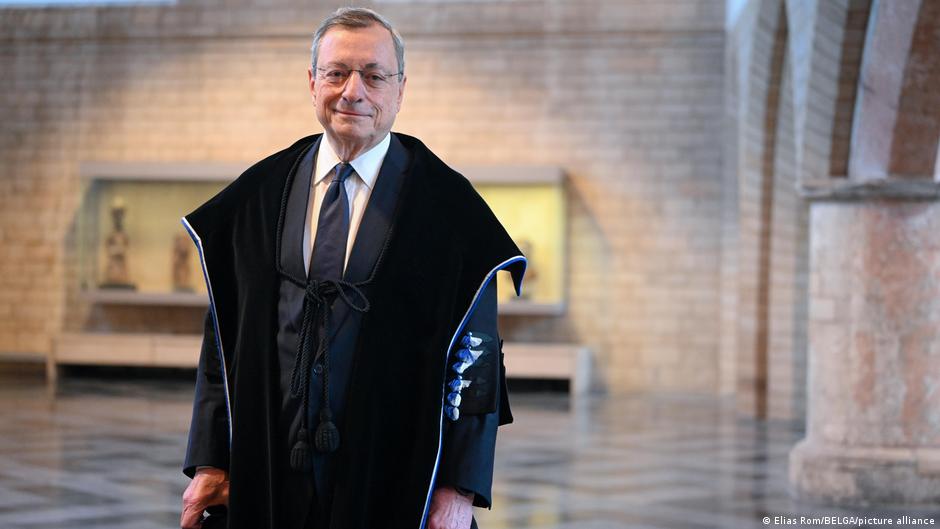
The Charlemagne Prize honors those who strive for European unity in a more modern way. It will be presented to Mario Draghi in a ceremony on 14 May.
Who is Mario Draghi?
Draghi is probably mostly remembered as the head of the Frankfurt-based European Central Bank (ECB), who stabilized the eurozone during turbulent times; But his career faced many other obstacles along the way.
Draghi started out as an economics professor in Italy. He later worked at the World Bank and Goldman Sachs. Over the years, he served on the boards of several Italian banks and companies.
From 2006 to 2011 he was Governor of the Bank of Italy, the country’s central bank.
During his stay there, problems began to emerge in the US subprime mortgage market. By 2008, the situation turned into a global crisis after the collapse of the investment bank Lehman Brothers wreaked havoc on economies around the world.
President of the European Central Bank
Amid all this turmoil, Draghi was chosen to run the European Central Bank in 2011.
By this time, the global financial crisis had turned into a European debt crisis. This led to austerity measures and bailouts in some Eurozone countries, notably Greece.
Draghi tirelessly defended the single currency and was known for saying that the ECB would do “whatever it takes” to prevent the euro from failing. This was seen as a turning point in the Eurozone crisis.
In 2015, the Bank began buying large amounts of bonds to inject money into the economy. The program, called “quantitative easing”, was intended to combat low inflation and weak economic growth.
Critics argue that these policies kept interest rates low for too long. The Bank’s quantitative easing program expanded its scope and meant that some governments had less incentive to work on structural reforms.
“While not every single decision of Draghi can be seen as successful in hindsight, the overall balance is strongly positive,” said Francesco Papadia, a senior fellow at Bruegel, a Brussels-based think tank.
Papadia, who also held senior positions at the Bank of Italy and the European Central Bank, said he “served Europe well by letting him lead the ECB at a very difficult time.”
Prime Minister and Competitiveness Guru
After leaving the European Central Bank in 2019, Draghi was called home to Italy, which was going through a COVID-19 and government crisis.
He stepped down, formed a government and was prime minister for 20 months in 2021-2022 before losing parliament’s support, resigning and handing the reins to Giorgia Meloni.
For many it would have been the pinnacle of a long career, but Draghi was not finished.
In 2024, he published a harsh report on the EU economy that many saw as “drawn report.” The paper included 383 recommendations to reverse declining productivity and narrow the competitive gap with the US and China.
“This report becomes a blueprint to help the EU overcome its economic limitations and find new strength and vitality in the current difficult circumstances,” Papadia told DW.
Among other things, it called for greater cross-border cooperation, investment in advanced technologies such as AI and semiconductors, reducing high energy prices, integrating capital markets, and more EU-level governance. Above all, it calls for decisive action.
What is the selection committee saying?
“Draghi is being honored for his exceptional achievements, his important role in stabilizing the European Economic and Monetary Union and his efforts to promote European competitiveness,” the board responsible for the award wrote in a January press release.
“He has proven his extraordinary leadership skills in saving the euro with his famous ‘whatever it takes’ promise, stabilizing Italy during the pandemic and now setting the future agenda for the entire continent.”
The Board sees the “Draghi Report” as a call to action “to secure Europe’s place in the world for future generations.”
With the ongoing wars in Ukraine and Iran, and strained relations between the US and much of the world, this award is a timely reminder that European unity is inevitable.
What is the Charlemagne Award?
The International Charlemagne Prize of Aachen has been awarded almost every year since 1950. Its purpose is to honor a person or institution that has made an outstanding contribution to European unity.
After the devastation of World War II, the prize’s founders wanted to use it to promote peace, cooperation, and European integration.
Previous winners include Winston Churchill, Helmut Kohl, Bill Clinton, Angela Merkel and Popes John Paul II and Francis. In 2023, the Charlemagne Prize was awarded to Ukrainian President Volodymyr Zelensky and the Ukrainian people.
Edited by: Andreas Becker