
Transactions grew from 110 to 2,500 bytes and blocks from 110 KB to 2 MB with the new schemes.
For the BNB Chain team, the quantum threat is between 10 and 20 years away.
BNB Chain published a report on May 14 in which it evaluated the viability of migrating the network to post-quantum cryptography and found that, although the migration is technically possible, it reduced performance by between 40% and 50% in the tests carried out. The team also clarified that the quantum threat is between 10 and 20 years away.
BNB Chain tested two cryptographic schemes potentially vulnerable to a quantum computer. The first is ECDSA (Elliptic Curve Digital Signature Algorithm), which protects the signatures of each transaction. The second is BLS12-381which adds the signatures of the validators at the consensus layer. Both can be compromised by the algorithm Shor.
To replace them, the BNB Chain tried ML-DSA-44 for transaction signatures and the system pqSTARKbased on zero-knowledge proofs (ZK), for the aggregation of validator signatures.
According to the document, ML-DSA-44 was chosen because it is the only standardized signature scheme at NIST and the most deployed in production currently. Compared to the SLH-DSA scheme, or another alternative approved by NIST, ML-DSA-44 produces smaller signatures and verifies fasterwhich makes it more suitable for high transaction volume environments, the BNB Chain team warned.
Despite these benefits of ML-DSA-44 compared to the rest of the NIST variants, after the tests executed on BNB Chain each transaction passed from 110 bytes to approximately 2,500 bytes (more than 2,000% larger), and the blocks grew from about 110 kilobytes to about 2 megabytes (more than 1,700% larger).
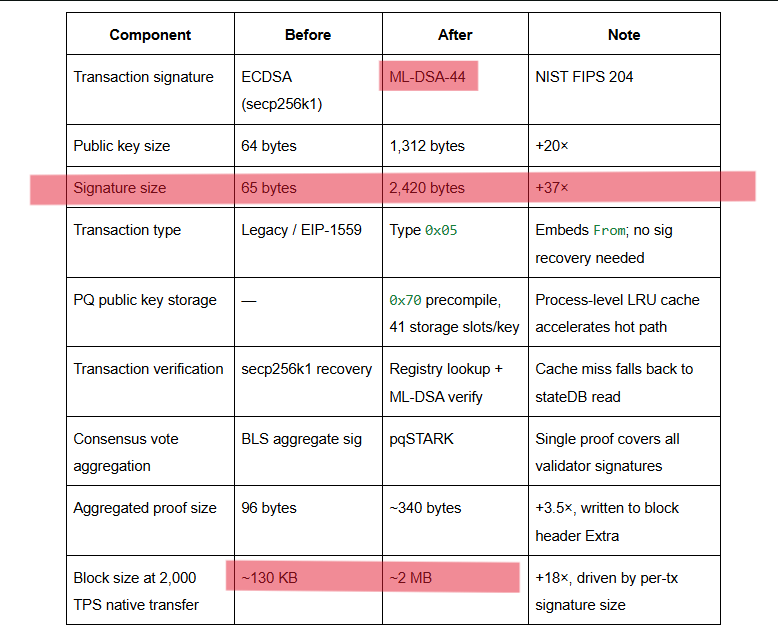
That increase in size is the bottleneck that reduces performance by 40% to 50%. The heavier the operations, the less they can be included in the block space and with an increase in demand for the use of that block space, if fewer transactions are possible, the commissions would increase.
ML-DSA-44 is also the smallest variant of the three available standard: higher security variants would increase signature size by an additional 36% to 90%further reducing performance without a proportional benefit given the estimated time horizon, according to the same document.
The consensus layer resists change better
The aggregation of validator signatures had a better margin on the BNB Chain. Currently, six validators produce signatures that together weigh 14.5 kilobytes.
With the proven system pqSTARKthose signatures are compressed into a single 340-byte probe (a reduction of 43 times its original size) which is written in the block header. This compression allows the consensus layer to absorb the change without significantly increasing the load on the validators, according to the report.

A tension that already appeared in Solana
The BNB Chain discovery reproduces a tension documented in other networks. In April, Alex Pruden, CEO of Project Eleven, a company that develops anti-quantum solutions for crypto asset networks, reported that it is testing post-quantum signatures on a Solana test network. showed a performance drop of approximately 90%.
The new signatures were between 20 and 40 times heavier than current onesas stated by Pruden, who worked on these tests together with the Solana Foundation, as reported by CriptoNoticias.
In this way, both cases illustrate the same underlying problem: migrating to post-quantum cryptography is not only a technical challenge but a design decision with direct consequences on the capacity of networks to process transactions.