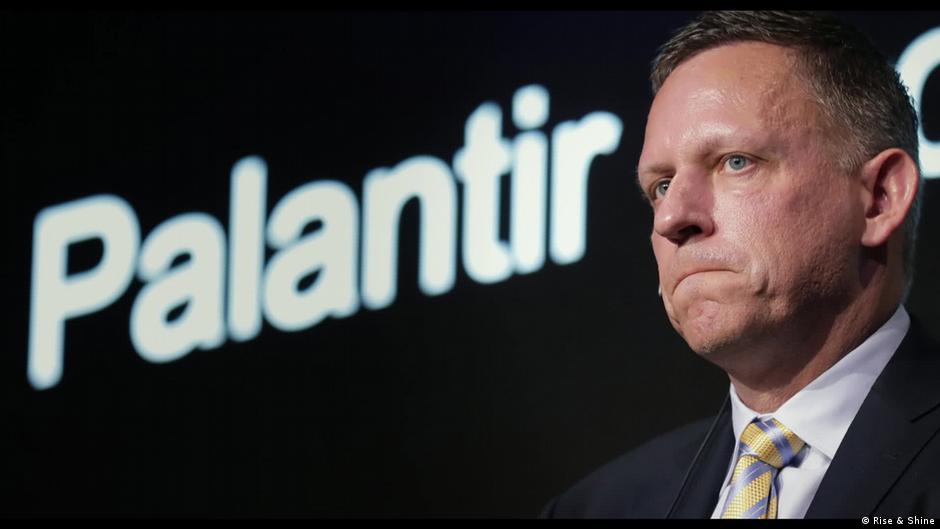
Palantir has long divided opinion. In the eyes of its supporters and opponents, the analytical tools made by a publicly traded American company that are in demand around the world are either a silver bullet or the work of the devil. In this background, a media report has come out in Germany: According to the information south german newspaper The newspaper, as well as the public broadcasters NDR and WDR, the country’s Federal Office for the Protection of the Constitution (Federal Office for the Protection of the Constitution, BfV) have decided not to use Palantir.
No official confirmation or denial
According to reports, Germany’s domestic intelligence agency has instead settled on a product from French company ChapsVision. However, there has been no official confirmation of this – neither from the software company nor from the BfV. A spokesperson for the German Interior Ministry told DW that the BfV generally does not comment publicly on operational matters, arguing that “this could pose a security risk that would allow conclusions to be drawn about the BfV’s functioning methods.”
The spokesperson further said that the decision on which software to use is based on the available technology. “There is no focus on any particular manufacturer.”
Software for counter-intelligence and counter-terrorism
Rather, the capabilities of the analytical tools offered depend on who is awarded the final contract. The BfV says it needs such powerful AI-based programs for counter-intelligence and counter-terrorism, as well as monitoring any form of political and religious extremism..
To fulfill these duties, the homeland security agency is looking to expand its “toolbox”, in the words of its chairman Sinan Selen. Other German security agencies are also pushing for it, notably the Federal Intelligence Service for Foreign Intelligence (Bundesnachrichtendienst, BND) and the Federal Criminal Police Office (Bundeskritikamt, BKA).
The federal government is planning law reform
To enable agencies to expand their technical capabilities and operational efficiency, comprehensive legal reforms are still needed. The federal government of Germany has long been drafting laws to be brought before the Bundestag, Germany’s parliament. Elected MPs will have the final decision on this matter.
Controversial elements include the use of artificial intelligence (AI) and facial recognition software. The opposition Left party strongly rejects any such plan. “Swapping Palantir for CheapVision is false marketing,” Clara Bunger, the left’s internal affairs spokeswoman, told DW.
Left warns against strengthening intelligence agencies
“The real problem is not where the software comes from, but the logic behind it: namely, the automated merging and scanning of huge amounts of data by an intelligence agency.” Bunger, referring to relevant rulings of the Federal Constitutional Court (Bundesverfassungsgericht, BVRFG), advocates clear legal rules with strict limits and effective oversight. “Otherwise, fundamental rights are violated,” she said.
The Left party MLA said that “which is being publicized as”.digital sovereignty“Today can become a weapon of authoritarian forces tomorrow.
successful constitutional complaint
The German Society for Civil Rights (GFF), a Berlin-based non-profit organization, has already initiated legal proceedings against the unrestricted use of Palantir software by German security agencies. The group’s constitutional complaint against amendments to the Hessian Police Act Police Act and Constitutional Protection Act law in the state of Hesse was successful in 2023, when the Constitutional Court declared essentially indiscriminate automated data evaluation unconstitutional.
The law was later reformed, but GFF thought it did not go far enough. That is why the organization filed a new constitutional complaint in 2024. The following year it filed another complaint against the state of Bavaria. Both cases are still awaiting a decision from the Constitutional Court.
Lack of transparency: ‘These devices are black boxes’
Franziska Görlitz is a lawyer and case coordinator for GFF. She supports the alleged refusal of the domestic intelligence service BfV to use Palantir. In an interview with DW, the lawyer welcomed the idea of German authorities taking digital sovereignty into account when examining potential software products.
But the same applies to other software manufacturers as well. “These devices are black boxes,” Gorlitz said. “We don’t know how they reach their conclusions. To us, it is not clear what they are capable of doing. How much do they encroach on fundamental rights?”
Avoiding opposition out of fear?
“Regardless of the software provider, data analysis is a serious encroachment on fundamental rights,” the GFF expert said. For example, new knowledge can be generated by creating personality profiles or evaluating specific situations with the help of AI. “This is a huge risk, because people can be targeted by authorities because of mistakes or discrimination.”
The analysis tools can also have a scaring effect, Gorlitz warned, “It can cause people to change their behavior for fear of ending up in the database. This could mean that they may not attend a particular protest, or they may break off contact with certain people if they fear that perhaps they are being monitored by the BfV.”
Palantir CEO angry over German decision
America-based company Palantir, which has faced criticism from many sides, is paying close attention to the ongoing debate in Germany. In an interview with a German tabloid Picture, Palantir CEO Alex Karp talked about a mix of restraint and rejection. He commented how he did not believe Germany could function without his company’s expertise, and said that the significant German debates on AI-powered software sounded to him “as if they were talking about witchcraft.”
On the other hand, critics such as Dutch political scientist Cass Mude have accused Palantir of practicing a form of technofascism. The reason for this allegation is Karp’s book, The Technological Republic. Mudde considers it a manifesto that promotes a world controlled by surveillance companies led by an authoritarian US. Therefore, in a post on LinkedIn, Mudge appealed to Europe to end all cooperation with Palantir.
This article was translated from German.