
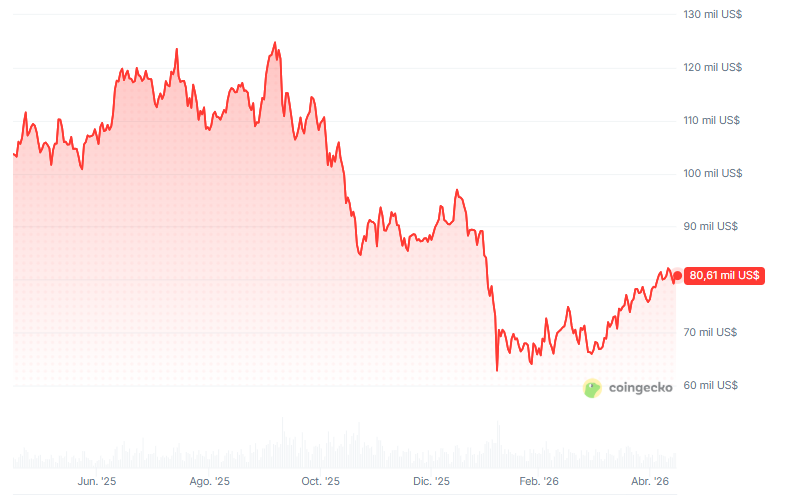
The 35% drop in the price of bitcoin (BTC) from the all-time highs of $126,000 reached on October 6, 2025 would not have been able to dampen the enthusiasm of the largest investors. Nuri Chang, product director of the digital asset custody firm BitGo, said that he has noticed that “there is overflowing optimism and ambition from many business teams” towards bitcoin.
This was expressed during his intervention at BitGo’s High Roller Summit in Las Vegas, last May 11, 2026. At the event, the executive described a scenario where companies are ignoring the price volatility of the digital currency and they continue to accumulate BTC, thinking about the long term.
The chart below shows how the price of bitcoin has moved over the last 12 months. There it is clear that bitcoin is not at its best (as far as price is concerned):
Despite this scenario of falling prices, the manager highlighted the maturity achieved by the industry. “Despite the decline from highs, institutional adoption and the general rigor and pace of the industry have been better than ever,” he said.
The BitGo representative’s analysis was based on several factors. “The first are the flows of bitcoin exchange-traded funds (ETFs) in the United States,” the executive detailed. Regarding the magnitude of these financial instruments, Chang specified that “there are 1.3 million BTC in these products, which represents around 6% of the circulating supply in products that did not exist a few years ago.”
Platform data BitcoinTreasuries They are even more optimistic, as they show bitcoins held by ETFs around the world, not just the United States. According to this record, there are 1.63 million bitcoins in the hands of these financial instruments.
This phenomenon has caused a significant part of currencies in circulation move from exchanges to investment vehicles regulated and long-term.
According to Nuri Chang, “that alone is an absolute testament to the work of people who are building these fundamental financial products.”
Traditional finance joins the bitcoin party
Chang emphasized that the entry of traditional finance is no longer a promise, but an operational reality. According to his vision, “the second thing I would highlight is that traditional finance is definitely here to stay in bitcoin and cryptocurrencies.”
This integration becomes evident with the opening of cryptoasset services in the largest brokerage firms in the United Stateslike Charles Schwab, which enabled early access to Schwab Crypto on May 13 so that its clients can operate with bitcoin and ether (ETH).
Chang highlighted that this movement is also followed by the Morgan Stanley bank, which “is hiring and building cryptocurrency trading directly within its applications.”
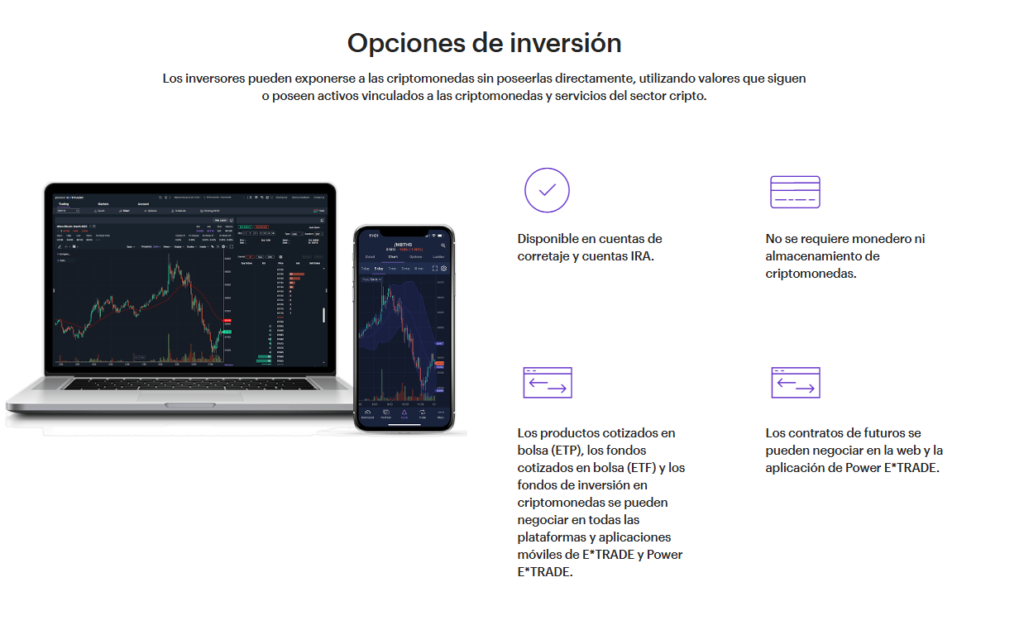
Morgan Stanley, one of the largest financial entities in the United States, has just issued its own bitcoin ETF a month ago, as reported by CriptoNoticias.
The executive insisted that financial institutions “are not just pilots: they are creating complete products. That is a notable difference compared to a few years ago.”
For Chang, the phase of simple proofs of concept is behind us in favor of permanent banking infrastructures.
A new legal horizon in the Senate
Regulation in the United States has taken decisive steps to eliminate the legal uncertainty that held back large capital. Chang mentioned the GENIUS Act, a framework for stablecoin management. Likewise, on May 14, the United States Senate Banking Committee approved the Digital Asset Market Clarity Act.
Regarding this legislative advance, the manager admitted that Technical implementation will be the next great challenge for the authorities. This law “has a more difficult task because it must define what is a security and what is not, and the jurisdictions between the Securities and Exchange Commission (SEC) and the Commodity Futures Trading Commission (CFTC). Of course, the missing piece is implementation,” he explained.
On the future of the bitcoin and cryptocurrency industry
At the same discussion table, Igor Istratov, executive of the financial institution Fifth Third Bank, described what – in his opinion – future access to the digital asset market will be like. “Retail and institutional clients will access via the platform they already know, with traditional and digital assets side by side,” he predicted.
Under this scheme, Users could trade cryptocurrencies from regular banking applications like JPMorgan or Fidelity. The technical infrastructure, however, will remain specialized.
“The winners will be the infrastructure providers that fuel that institutional adoption, that are fully compliant with regulations, with auditing, risk management and enforcement,” Istratov added.
For his part, Matt Hougan, chief investment officer at Bitwise, agreed on the potential of bitcoin ETFs. “They haven’t seen anything yet. It’s just starting to accelerate,” he declared. Hougan anticipates sustained growth. “We will see flows accelerating substantially in the next 3-5 years,” he predicted.
According to his estimates, These products could attract up to $100 billion annually in the near future.. These interventions reflect a consensus among executives: price correction does not slow down the structural progress of the industry. The combination of institutional adoption, regulated products and legal clarity fuels the ambition of those building in the sector.