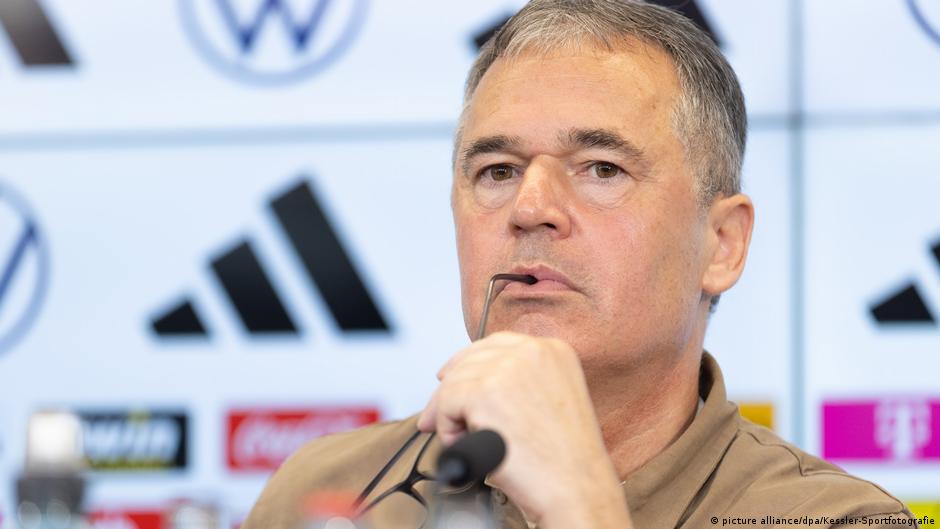
Despite there being no fans at the 48-team World Cup this summer, Andreas Rettig admits anticipation is very high as Germany enter a decisive phase of their preparations. After two consecutive World Cup campaigns in which Germany failed to get out of their group, the German Football Association (DFB) director of football knows the target in 2026 is clear.
“The goal for us would be to eventually be among the top five countries in the world. If we perform better than our current FIFA world ranking [ninth]”It will be successful,” Rettig told DW.
Rating: ‘The value-based system has gone haywire’
The 63-year-old enjoys talking about the Germany team, but like the last World Cup in Qatar four years ago, this tournament has been overshadowed by non-football topics.
Increased ticket prices, entry restrictions for the five participating countries, extremely high local transportation costs, and geopolitical tensions in the major host country, the United States, are causing great concern among fans. The war launched by the United States and President Donald Trump against Iran over World Cup participation, as well as the domestic political debate resulting from the overly harsh tactics of US Immigration and Customs Enforcement (ICE) are in particular focus.
“We live in a time when we are faced with things every day that hurt,” Rettig said. “There are a lot of illogical things going on that have nothing to do with football, things that make you shake your head. Our value-based system has gone haywire.”
players will not be silenced
Critical comments and outspoken stances on issues outside football have become the exception, which makes Rettig’s comments a bit vague. But the director says the DFB, the world’s largest sports federation, has learned a lesson from Qatar.
At that time, the controversy over the ‘One Love’ bracelets and the Germany team photo, where the players were holding their hands over their mouths, sparked great discussion. Especially because, following the political protests, the team’s performance on the field was disappointing to say the least. This time the plan is to do something different.
Rettig explained, “The team should mainly focus on the game. Issues like this don’t happen in the locker room.” “But that doesn’t mean we’re silencing players,” Rettig said, adding that players are very thoughtful and always free to express their opinions on anything. “But I think it’s disruptive and distracts from our focus. We need our strength and energy for what really matters. We are first and foremost a football team and are judged by our performance on the field.”
It is the job of officials, such as DFB president Bernd Neuendorf and senior leadership like Rettig, to speak out on political issues. Rettig avoided expressing explicit criticism, saying, “It would be naive to say that I have no interest in any of this. Of course we have an interest in it, of course we care about it and of course there are some developments that we don’t like.”
Former Germany goalkeeper criticizes DFB
It is this lack of assertiveness on the part of the DFB that was recently condemned by former Germany goalkeeper Almuth Schulte.
“I understand that it is difficult for the DFB to take a stand because the vast majority of the global football community stands behind it [FIFA President] Infantino and his decisions,” Schulte said in an interview with the daily newspaper Frankfurter Rundschau. Schulte said, “The DFB is happy to support diversity and other values. It would be nice if they could represent them not only nationally but also internationally. Unfortunately, choosing not to communicate on this issue is also a statement in itself.”
Rettig is not a fan of the Peace Prize
The DFB is not alone in pushing back. Other major confederations have also refrained from criticizing the US or FIFA President Gianni Infantino. Schulte praised Norway’s federation president, Lise Klevnes, as the only official who has taken a clear stance in recent years. Klevnes had strongly criticized the awarding of the FIFA Peace Prize to Donald Trump, calling it illegitimate and a violation of political neutrality.
“I hope that the award given to the US President will serve as an encouragement to him,” Rettig said. “But whether such a prize is awarded in the World Cup draw is a matter of opinion. I didn’t like it.”
Rating: The ethical guidelines have changed
It is not only the hastily made peace prize, but also the close relationship between Infantino and Trump that is causing discontent. After all, the often-cited independence of sport from politics is now a thing of the past.
Rettig said, “Of course, you can’t separate sports and politics. I am constantly at a loss by the speed and strength of decisions as well as the geopolitical consequences of what is happening now.” He said that traditional principles and certainties had become absurd. “Who would have thought that we would develop such a critical attitude toward country A or B?”
Rettig is critical and believes that the moral compass has changed, in the end, we no longer know friend and foe.
This article is taken from German language.
Edited by: Janek Speight