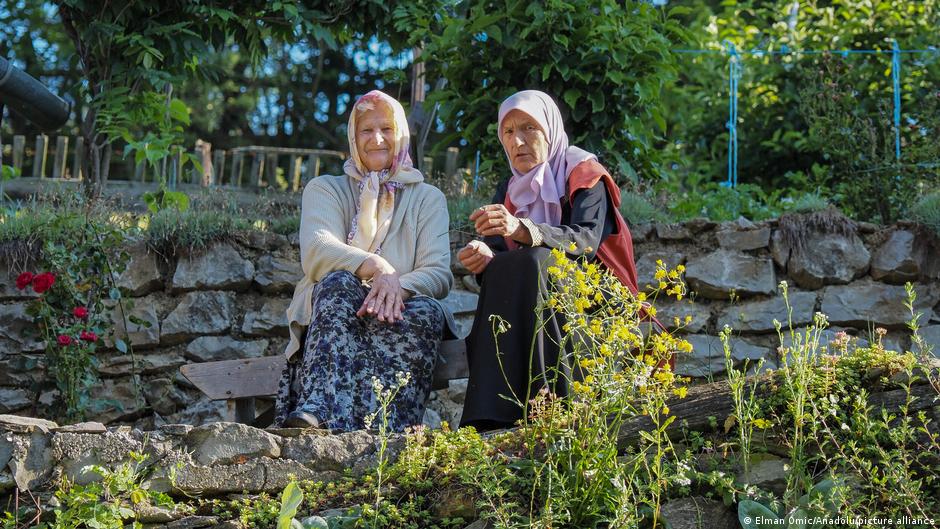
Generally, it is Muslim men who go to mosques in Bosnia and Herzegovina to pray on Fridays. As is the custom in Islam, women are not required to go to the mosque to pray on the holiest day of the week. However, more and more devout Muslim women in the Western Balkan country also want to attend mosque.
In the secular state of Bosnia and Herzegovina, men and women are equal before the law. In recent decades, the state has made significant efforts to eliminate gender-based discrimination and protect women from violence. However, in some religious communities, whether Muslim, Orthodox or Catholic, social and cultural norms continue to stand in the way of equality.
Since the end of the Bosnian War (1992–1995), religion has played a larger role in all communities in the country, especially among Muslim Bosniaks, Orthodox Serbs and Catholic Croats. In some families, very stereotypical notions about gender roles prevail, according to which women are expected first and foremost to be mothers and take care of the family.
“Muslim feminists are fighting for women’s rights within the Islamic framework,” Bosnian sociologist Dermana Kuric of the University of Zaragoza told DW. He said they are doing this by playing an active role in society without openly challenging misogynistic interpretations of the Quran.
She said university-educated Muslim women were deliberately wedded to traditional Islamic scholarship, which sought to confine women to a subordinate role in the family and wider community. “Muslim feminists are concerned with gender relations based on autonomy and personal responsibility as opposed to control or dominance,” Kurik said.
Bosniaks are part of the broader Muslim feminist movement.
Bosnian Muslim feminists are part of a broader movement that has been gaining influence in the Islamic world since the 1980s. They interpret the Quran from a female perspective and see it as a source of empowerment in their struggle for greater rights. With her translation of the groundbreaking book “The Forgotten Queens of Islam” by Moroccan sociologist and pioneer of Islamic feminism Fatima Mernissi (1940 – 2015), gender studies scholar Zilka Spahic-Siljak of the University of Bosnia and Herzegovina has made a significant contribution to raising awareness of the ideas of Islamic feminism in Bosnia and Herzegovina.
“Like other religions, Islam has been shaped by male scholars’ interpretations of their sacred texts, based on their own experiences,” Spahic-Siljak told DW. “With a few exceptions, women’s experiences have not been represented. But justice is a central principle in the Quran, and there can be no justice if women are not treated equally.”
In 2021, the academic founded the Feminism and Religion Online School with Catholic nun Jadranka Rebecca Anić to offer courses in religion and feminism to interested students.
The Quran should not be used to justify domestic violence
While in 2023, Spahić-Siljak participated in a campaign against domestic violence, criticizing Muslim scholars who legitimized violence by husbands against their wives by citing Sura An-Nisa 4:34, a chapter of the Quran. The influential imam Senad Zjimovic presented his arguments and expressed openness to a new interpretation of the surah. He issued a theological statement, emphasizing that the Quran should not be used to justify male dominance and violence against women.
“Over the past few decades, we have seen Muslim women making more space for themselves within the Muslim community,” Couric said. These may be small steps, he said, but progress is being made. For example, regarding women attending Friday prayers at the mosque: “Their participation was never formally prohibited; it was simply a consequence of the male-dominated culture that they were not there.”
In April 2026, the Islamic Community’s Council for Religious Affairs in the city of Zenica, which is located about 70 kilometers (about 43 miles) north of Bosnia and Herzegovina’s capital Bosnia, encouraged women to attend Friday prayers at all mosques in the district. Two mosques in Sarayevo also explicitly welcome women, who pray in a separate room from men or on the balcony.
The situation is changing in the educational world also. Although there are still no female professors of theology in the country’s Islamic theology departments, there are many female research assistants, and it is expected that they will eventually become professors.
There is no female imam in Bosnia and Herzegovina yet
There are still no female imams, even though these now exist in other countries, for example, in France and the US, where Amina Wadud caused a worldwide sensation in 2005 by leading Friday prayers in a mixed congregation in New York City.
Islamic institutions in Bosnia and Herzegovina today are more or less the same as those established under Austro-Hungarian rule (1878–1918). After the Habsburg authorities took over Bosnia, they established an organized religious structure for Muslims that was based on the Christian churches, modeled on the Islamic community in Bosnia and Herzegovina. He also introduced the office of Risu-l-Ulema, or Grand Mufti, which remains the supreme representative of Bosnian Muslims.
“It is still difficult for women to achieve positions of power and influence in the Muslim community,” political scientist Zevada Garrick told DW. “For example, we have many female teachers in Islamic schools, but there are no women in the Riyasate or the Mufti Council, the highest decision-making body. There are only 11 women out of 87 representatives in the Parliament of the Islamic Community.” Garrick herself was one of the first women to hold a leadership position, as advisor to the Islamic Community for international relations.
Kurik wants to focus on the positive aspects. Today, for example in the Parliament of the Islamic Community, there are more women who have the confidence to run for office, she said. Additionally, she pointed out, the current Grand Mufti, Hussein Kavazovic, has established a department dedicated to the advancement of women. Female Islamic theologians now have career prospects and the opportunity to become familiar with Islamic institutions and their structures.
“There is no resistance from Muslim men against the advancement of women in the sense of saying, ‘You’re not allowed to be in leadership positions,'” Couric said, but she acknowledged that there is still a lot to be done. “I think there is a lack of a clear institutional strategy on the part of the Islamic community to seriously advance women as believers and theologians and to better integrate them.”
This article was originally published in German.