
For Drake, the cryptocurrency ecosystem would be the first target of a successful quantum attack.
The Ethereum Foundation set 2029 as a target to complete its post-quantum migration.
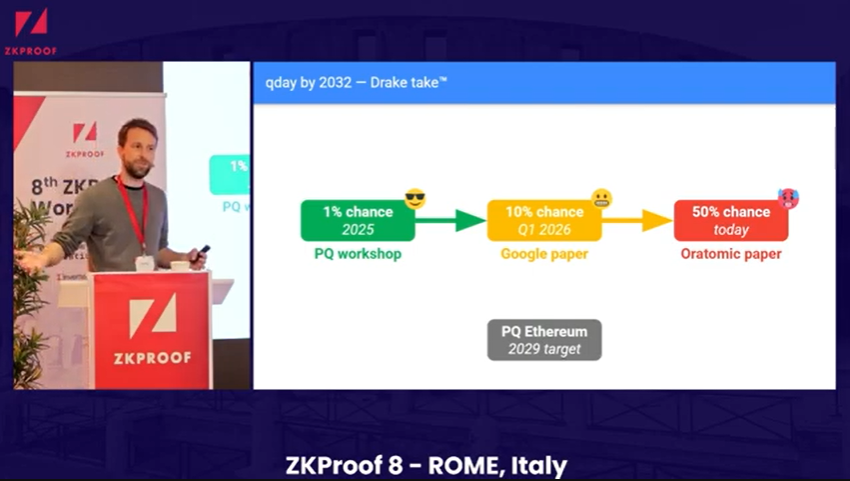
Justin Drake, a researcher at the Ethereum Foundation, raised his estimate of the probability that a quantum computer will be able to compromise current cryptography by 2032 from 1% to 50%, according to statements made at the ZKProof event.
Drake clarified that the figure reflects his personal opinion, not an official position of the Foundation, and that he maintains that ceiling because “there is a lot of uncertainty… 2032 is in six and a half years, it is “very, very difficult to predict the future”. The trigger for the change, according to Drake, was the paper joint Oratomic and Google Quantum AI, reported by CriptoNoticias, on advances in neutral atom hardware.
Regarding that type of hardware, Thomas Coratger, cryptographer at the Ethereum Foundation, back This May 15, Drake said, and explained that unlike superconducting quantum processors (which operate on fixed grids and would require a ratio of 1,000 physical qubits for each useful logical qubit), neutral atoms would allow full connectivity between qubits using lasers, which would improve that ratio to just 10 to 1 and thus facilitate the creation of more efficient quantum systems.
Coratger specified that the physical qubits necessary to execute the algorithm Shor (the quantum method capable of deriving private keys from public keys) against the ECDSA transaction signature scheme used in Ethereum and Bitcoin went from 1 billion in 2012 to approximately 10,000 in 2026. This amount, he noted, “fits into a device measuring one square millimeter.”
The cryptographer further warned that “The race is so critical that researchers are censoring themselves”since the paper of Google demonstrates a massive optimization of Shor’s algorithm using a zero-knowledge proof (ZKwhich proves the existence of a discovery without revealing its content), specifically to hide the quantum circuit from potential adversaries.
The schedule for Q Day is accelerating. The probability of a Cryptographically Relevant Quantum Computer (CRQC) breaking blockchain cryptography by 2032 has increased considerably.
Thomas Coratger, cryptographer at the Ethereum Foundation.
Cryptocurrency networks would be the first to be attacked
Drake, in his statements made on May 9, was direct in pointing out that the cryptocurrency ecosystem would be the first target of a successful quantum attack: “We are the first on the chopping block… we will be the first to break.”
Drake’s rationale is that Shor’s algorithm attacks the discrete logarithm (the mathematical problem on which ECDSA with 256-bit keys is based) more easily than the factorization of prime numbers on which the scheme is based. RSA with 2,048-bit keys, predominant in traditional banking systems.
“Forget factorization and RSA for now,” said Drake, asking the audience to focus exclusively on ECDSA as the immediate threat.
Drake added a piece of information that qualifies the operational urgency. Even in systems of neutral atoms with slow clocks (quantum processors that operate at a lower cycle rate and therefore execute operations more slowly) breaking a key would take about 10 minutes. «That is much slower than the slot (block processing time) of 12 seconds on Ethereum »he noted, referring to the interval in which the network processes and finalizes blocks of transactions, which he considers “reasonably good” as an initial margin.
However, he concluded by warning that that margin narrows with each speed improvement in quantum hardware. For this reason, the Ethereum Foundation set 2029 as the goal to complete the migration from Ethereum to post-quantum cryptography, in line with the deadlines announced by Google and Cloudflare, as reported by CriptoNoticias.
Estimates and other voices from the sector
Vitalik Buterin, co-founder of Ethereum, mentioned 2028 as a possible horizon for quantum computing to compromise ECDSA. Along the same lines, Mikhail Lukin, Harvard professor and co-founder of the Harvard Quantum Initiative, estimated that fault-tolerant quantum computers could be available before the end of this decade, advancing the previous horizon of between 2035 and 2040.
However, Drake’s projection is not isolated and the contrast with previous estimates within the Ethereum ecosystem itself underlines the magnitude of the quantum advance. Last July, Ignacio Hagopian, also a developer at the Ethereum Foundation, placed quantum risk between 10 and 15 years away when consulted by CriptoNoticias.
Faced with this convergence of signals, Drake summarized the position of those working in defense: “My usual job is usually to build cryptography to defend against quantum computers.”