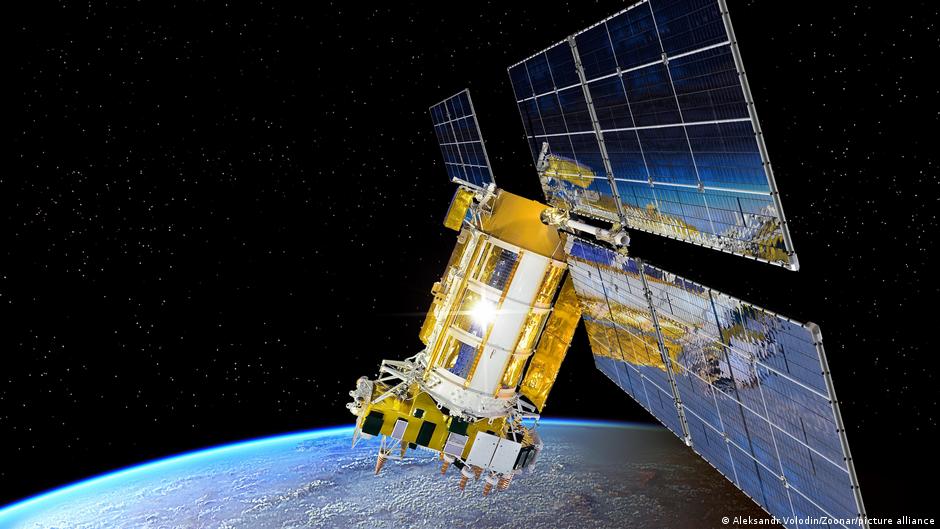
The space industry is a billion-dollar business. According to a study by German consulting firm Roland Berger and the Federation of German Industries (BDI), the market is worth around $600 billion (€516 billion) and growing. Its value is estimated to be $2.32 trillion by 2040. This is almost four times Germany’s federal budget in 2025.
And many people want a piece of the new private spaceflight pie. According to Roland Berger, currently, about $150 billion is flowing into the “upstream market”, which includes “the production of essential infrastructure from launch pads, ground segments and satellites on Earth and in space.” A much larger portion – approximately $450 billion – has been invested in downstream applications, including “space-based solutions – positioning, navigation and timing, Earth observation and satellite communications.”
“New Space is fundamentally a data business,” said Matthias Wachter, managing director of BDI’s NewSpace Initiative and co-director of its Innovation, Security and Technology division.
Space travel goes from state to private
Space travel has changed dramatically since its early days. During the Cold War, it was primarily a race between the United States and the Soviet Union, with state encouragement and funding.
But around 2000, governments started taking on the role of customers. Since then, private companies have been providing rocket launch services and developing satellites. Major players SpaceX and Blue Origin were also born at the turn of the century.
Reusable launch vehicles have made space travel significantly more affordable, opening up new business opportunities and paving the way for a variety of applications. According to the American consulting firm McKinsey, launch costs alone have fallen by 90% in the last 20 years.
It’s not just about SpaceX and Blue Origin
While SpaceX and Blue Origin have captured the public imagination, there are many other companies in the space business, including from Germany, especially since space technology is so versatile.
According to BDI, nearly three-quarters of space companies have customers in traditional industries, using satellite-generated data for smart farming, logistics, Industry 4.0, infrastructure monitoring and autonomous driving, to name a few applications. Customers range from startups to small and medium-sized enterprises and even large systems integrators.
“Services such as communications, positioning, navigation, timing, and Earth observation would be unimaginable without space-based technology,” says Björn Hagemann, a senior partner at McKinsey. “These areas in particular are going to grow significantly.”
German companies make launch vehicles and satellites
In Germany alone, three companies are working on launch vehicles. Isar Aerospace in the Bavarian city of Munich is developing the rocket on which many have pinned their hopes. Rocket factories Augsburg and HighImpulse Technologies in Neustadt am Kocher, both in southern Germany, currently have rockets in the testing phase.
Several German companies are also manufacturing satellites. “We have a large number of downstream companies that are using satellite data to develop new data-driven business models,” Wachter says. These include OHB in the northern city of Bremen, which is developing complete satellite systems and components for the Ariane rocket, for example. The Exploration Company, headquartered near Munich, manufactures reusable space vehicles.
For example, OroraTech offers solutions for monitoring wildfires from space. Constellar’s satellites can detect heat patterns that indicate human activity, infrastructure load, and environmental stress. Berlin-based company LiveEO analyzes satellite and drone data and monitors global infrastructure networks such as Deutsche Bahn’s rail lines.
Private companies want more government support
BDI and the Association of German Aerospace Industries (BDLI) believe that the German government needs to invest more in space to help these private companies thrive, despite the fact that the economy is currently struggling.
Despite the high costs involved, Germany cannot afford to be left behind in space, says Wachter: “Space travel is not a matter of exclusivity or prestige, but rather the key to many future technologies on Earth.”
According to the British consulting firm Deloitte, navigation, communications, timing and Earth observation are essential to modern critical infrastructure, which many believe should include space as a sector. They argue that dependence on other countries for key sectors and critical infrastructure creates significant risks.
America still has the largest share in the global space market
At the end of 2025, Germany will contribute approximately €5.4 billion to European Space Agency (ESA) programs in the coming years – significantly more than in the past.
In addition, €35 billion will be invested in military space capabilities over the next five years. Space-based services are becoming increasingly useful for both military and civilian purposes.
It may seem like Germany is making a huge investment but what about other countries? In 2024, the US will have about 40% of the global space market, while the continent as a whole will have 20% and Europe will have 17%. According to Roland Berger, Europe will need to invest €237 billion more to maintain this share by 2040. And if Europe were to increase its share to 25%, Germany would have to increase its investment from €4 billion to €10 billion.
But Roland Berger says that spending more money will not be enough. The consulting firm says private companies need help to turn innovations into successful business ventures, arguing that there should be less bureaucracy, less regulation and more structural reforms and bolder state contracts.
“We have to do a lot more if we want to keep up with America,” Wachter says. “But we have nothing to be shy about in terms of technology. What the US is doing in many areas, we can also do. This is also evident from the fact that we are already playing a major role in many US programmes.”
This article was originally published in German.