
About 75% of the global Bitcoin hashrate sat down at the same table to adopt a solution to one of the biggest criticisms of mining: the centralization of power in pools. Not out of philanthropy, but motivated by the same game theory inherent to the operation of Bitcoin: economic incentives.
Foundry, AntPool, F2Pool, SpiderPool, MARA Pool, Block (through its Spiral division) and Demand Pool — seven operators that together produce three out of every four blocks on the network — signed a commitment with the Stratum V2 working group to reduce their influence over the transactions included in the blocks and give this power back to each individual mineras happened in the beginnings of Bitcoin.
It is the first coordinated industrial movement towards the adoption of the protocol since it is available, in 2022. Of the seven signatories, only Demand Pool has job negotiation activated by default. The rest signed the will. The date is missing.
Stratum V2, successor to the Stratum V1 standard that has been communicating pools and miners since 2012, introduces three structural changes: end-to-end encryption, greater efficiency in the transmission of work and, above all, the possibility for each miner to build their own block template instead of receiving it closed by the pool.
This last function, called job negotiation or labor negotiation, is the neuralgic piece: it redefines who decides which transactions enter each block. Without it, and with a growing concentration of hashrate in few pools, the risk of censorship and filtering of transactions increases. This is not a theoretical risk. It already happened with Mara in 2021 and with F2Pool, ViaBTC and Foundry in 2023, by not processing transactions sanctioned by OFAC.
Although thanks to the design of Bitcoin they alone would not have been able to prevent other miners from including such transactions in the accounting, the more power the pools concentrate, the more danger there is.
The centralization that criticism did not change in a decade, the incentive changes
In August 2019, when Braiins announced Stratum V2 and CriptoNoticias covered the news in Spanish for the first time, Pavel Moravec, co-CEO of Braiins, summed it up in one sentence: “This should have been done years ago, really.”
Almost seven years have passed since that interview. We have followed the evolution of the protocol, its official launch in 2022, we interviewed Jan Capek from Braiins, and we explained how to mine with the pools that already operated under the standard. In all that time, the question that hovered over each article was always the same: if the technical benefits are so evident, Why don’t the big ones adopt it?
A decade of academic warnings, papers, Twitter threads, and editorials—including our own—failed to move the needle. The decentralization that was not successfully achieved due to a moral argument is now beginning to occur because the proposed architecture is more efficient, secure and cheaper to operate than the current one. In short, what is moving the needle is something that is at the basis of mining itself: economic incentives. In Bitcoin, The changes that last are those that incentives sustain.
According to a study carried out in Hashlabs, Stratum V2 increases miner’s net profits by up to 7.4%derived exclusively from technical improvements. That number is made up of verifiable parts. Block change latency drops from 325 milliseconds to 1.42 milliseconds, a 229x improvement that recovers approximately 4.9 hours of useful hashpower per year that was lost in V1 in stale attempts.
The bandwidth exchanged between pool and miner is reduced between 30% and 70%, depending on the configuration, due to the transition from JSON textual messaging to binary. Block propagation—measured by the Stratum Protocol site— is 28 times faster. And end-to-end encryption eliminates the possibility of hashrate hijackingan attack that under V1 could silently divert up to 2% of a miner’s output to an intermediary attacker.
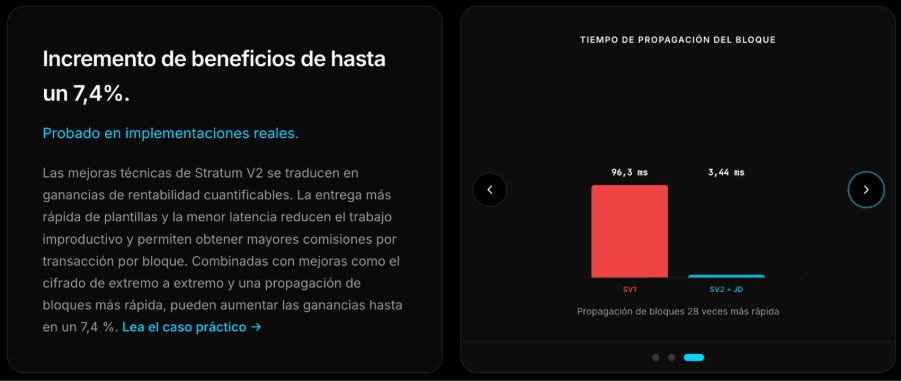
Added together, these improvements draw an uncomfortable conclusion for those who defended the postponement: a miner connected to a pool that operates full Stratum V2 earns more than the same miner connected to the same pool under V1. The difference is not marginal in an industry where the hashprice is around 38.57 dollars per petahash per day and CoinShares estimates that up to 20% of operations operate on the verge of profitability. In this scenario, an additional 7.4% is the difference between turning off machines and keeping them on.
What does the pool lose? Oligopoly over a business that was not theirs anyway. The acceleration of transactions, today reserved for pools—Antpool with BTC.com, ViaBTC with its Transaction Accelerator, Foundry and others—, It stops being exclusive to the operator and becomes an open market where any minerFrom a medium-sized farm to an operator with a single desktop ASIC, you can offer the service, set your rate and define your inclusion policy.
Commission income, which weighs more on total profitability at each halving, stops filtering to the operator by default. That does not make Stratum V2 a mutation of the payment model — pools will continue to pay FPPS or PPLNS for shares valid—but opens a second optional source of income for the miner who decides to exercise it.
But this oligopoly was not free for the pool either. Every censored block, every filtered by OFAC lists, Each public accusation of centralization deteriorates the network on which that same pool builds its business. In section 6 of the white paper, Satoshi closed the security argument with an idea that is rarely cited in this context: an actor with enough computing power “will find it more profitable to play by the rules, rules that favor him with more new coins than everyone else combined, than to undermine the system.” The phrase is intended for the 51% problem, but the principle is more general. Bitcoin is only Bitcoin when cooperative behavior is also the most profitable behavior.
That logic also applies to pools. A network that a few operators can censor is no longer a neutral network, reintroducing counterparty risk to Bitcoin—exactly the problem the network came to solve. If Bitcoin loses its neutrality, it loses its value proposition; and if it loses its value proposition, the pool business loses its substrate. Decentralizing the templates is not only granting the miner a right that corresponds to them by architecture: it is protecting the economic basis of the pool. A more decentralized network is a more valuable network, and a more valuable network makes the mining that supports it more profitable.
Stratum V2 can be partially deployed. A pool can enable encryption, gain efficiency, improve your farm experience, and continue delivering closed templates to your miners. In this scenario, the protocol comes in as an infrastructure modernization: good for operating costs; null for decentralization. But partial implementation is also an unstable position. It captures the technical improvements, but leaves unresolved the pressure that is pushing the sector toward change in the first place, centralization.
It’s a good idea to be precise about what Stratum V2 does and doesn’t do. The protocol does not redistribute hashrate. He pie chart will continue to show roughly the same: Foundry around 30%, AntPool around 17%, F2Pool and SpiderPool around 10% each. The geographic concentration—almost 40% of the world’s hashrate operating from the United States, according to Hashrate Index— is not moved by this announcement either.
What does change is the operational power that this concentrated hashrate exerts on the network. Under Stratum V1, 30% Foundry is 30% effective in transaction decisions: the pool chooses what goes into each of those blocks. Stratum V2 bass with job negotiation activated, that same 30% is atomized among the thousands of miners who contribute hashrate to the pooleach with its own template, its own node, its own inclusion policy. The graph is the same. The ability to censor, filter, and selectively prioritize ceases to belong to the operator and returns, distributed, to those who do the work. That is the decentralization that is on the table.
First the small ones, then the big ones: the pattern repeats itself
As often happens in Bitcoin, real adoption started at the bottom. OCEAN, the pool relaunched by Luke Dashjr in 2023, operates on the DATUM protocol, an implementation that goes beyond the standard Stratum V2 by requiring miners to run their own node. Demand Pool, one of the task force signatories, was born a native in V2 with job negotiation activated by default. Braiins Pool, where the protocol was created, has been operating it for years.
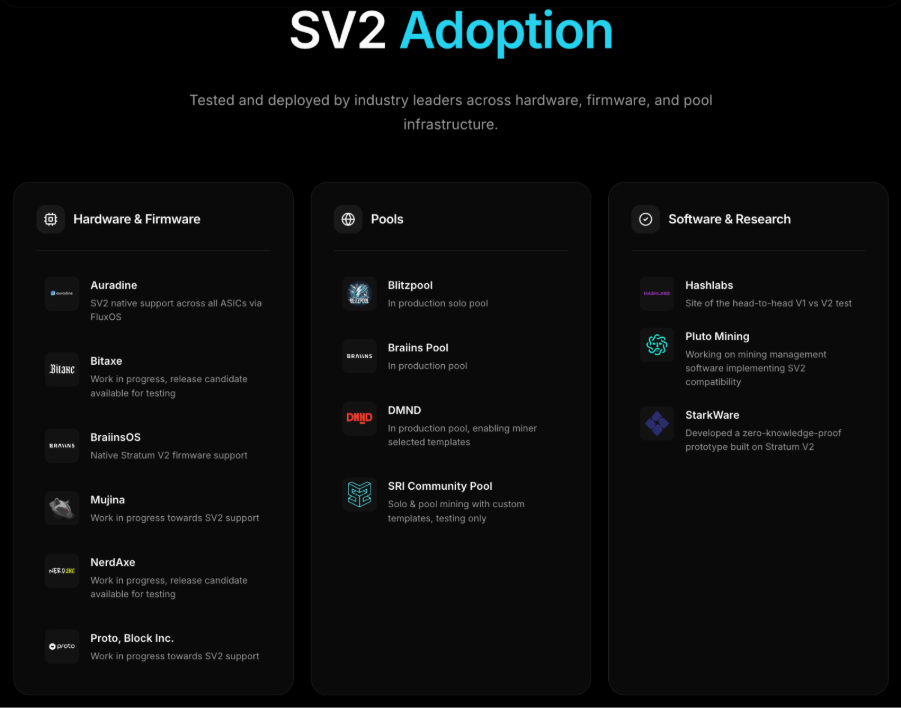
Further down the domestic scale, BitAxe and NerdAxe already integrate Stratum V2 into their desktop mini-ASICs, allowing a hobbyist to build their own blocks from a book-sized console. It’s the same historical pattern as the Lightning Network: years of use among small players, until competitive pressure forced adoption by large exchanges.
We celebrate the working group. It is the first time that the majority of the global hashrate has publicly signed, as an industry, that the correct direction is to cede control of the templates to the miners. After almost seven years covering this protocol and wondering when the big guys would adopt it, this movement is real, and it is worth recording it like this.
The large pools did not sign this commitment out of ideological conviction. They signed it becauseThe accounts, finally, were in favor of decentralization: A miner who stays on V1 earns less than one who migrates to V2, and a pool that retains control over templates weakens the network on which it lives. That double pressure — from below, the miners who can move to more profitable pools; from above, a network whose neutrality determines its value—is not a pressure that can be contained with half-hearted implementation. A massive hashrate migration towards pools that offer full job trading is a real possibility the moment the profitability difference becomes public and measurable. And the difference is already measured.
That is why the question is not whether the seven signatories will activate job negotiation by default. The question is how long it will take them to do it, and how many will do it before competitive pressure pushes them away. The will is already written on paper. The date will be written when the first of the greats announces its activation and forces the rest to follow, under the concrete threat of losing hashrate to a more decentralized and profitable competitor.
If the decision of which transactions go into each block still depends, in fact, on a handful of operators who choose what is included and what is not, Bitcoin looks too much like the system it came to replace. But that’s not the direction the incentives are pointing. Decentralization pays. And in Bitcoin, what you pay, sooner or later, wins.