Chainlink, the main network of decentralized oracles in the market, closes this Sunday, May 17, 2026, a week of strong institutional expansion, with integrations with Kraken, Fidelity International and DTCC, (Depository Trust & Clearing Corporation), the main post-trading infrastructure of the US stock market.
The announcements reinforce the use of its technology in interoperability between networks, tokenized funds and collateral management.
On May 14, the American exchange Kraken announced that it will migrate the cross-network infrastructure of kBTC, your tokenized bitcoin, towards Chainlink CCIP. With this change, you will no longer use LayerZero as an interop provider for your wrapped assets.
kBTC allows BTC to be used in decentralized finance (DeFi) applications and networks specialized in smart contracts. Chainlink CCIP (Cross-Chain Interoperability Protocol) is a system developed to connect different networks and enable secure asset transfers and messages between digital ecosystems.
Kraken justified the decision by noting that Chainlink offers “enterprise-grade infrastructure” with strict security and risk management requirements. Among the highlighted elements are ISO 27001 and SOC 2 Type 2 certifications, architecture described as “secure by default”, 16 independent nodes and native transfer limits.
The change occurs in a context of increased attention on the security of infrastructure between networks. As reported by CriptoNoticias, the exploit suffered by Kelp DAO in April was linked to vulnerabilities in configurations associated with LayerZero. In that attack, the attacker drained more than 116,000 rsETH, generating losses close to $292 million.
In any case, the migration to Chainlink does not completely eliminate structural risks. Although CCIP incorporates additional validation and risk management mechanisms, Kraken will continue to rely on a single provider for the interoperability of its tokenized assetswhich maintains a possible single point of failure.
Other relevant integration happened on May 15, 2026, when Tempo adopted Chainlink CCIP to bring cbBTC to its network. Tempo is a payments-focused Layer 1 network incubated by Stripe and Paradigm, while cbBTC is the tokenized bitcoin (BTC) of the Coinbase exchange, with more than $5 billion in circulation.
With this integration, BTC becomes available for the first time on Tempo through cbBTC. CCIP will reportedly act as an interoperability bridge between networks, allowing Institutions and users use that asset in DeFi applications, payments, loans, guarantees, trading and performance strategies.
The expansion also reached Fidelity International. On May 13, 2026, the manager launched its first native tokenized fund, the Fidelity USD Digital Liquidity Fund (FILQ), developed on Ethereum with Chainlink infrastructure and the Sygnum tokenization platform.
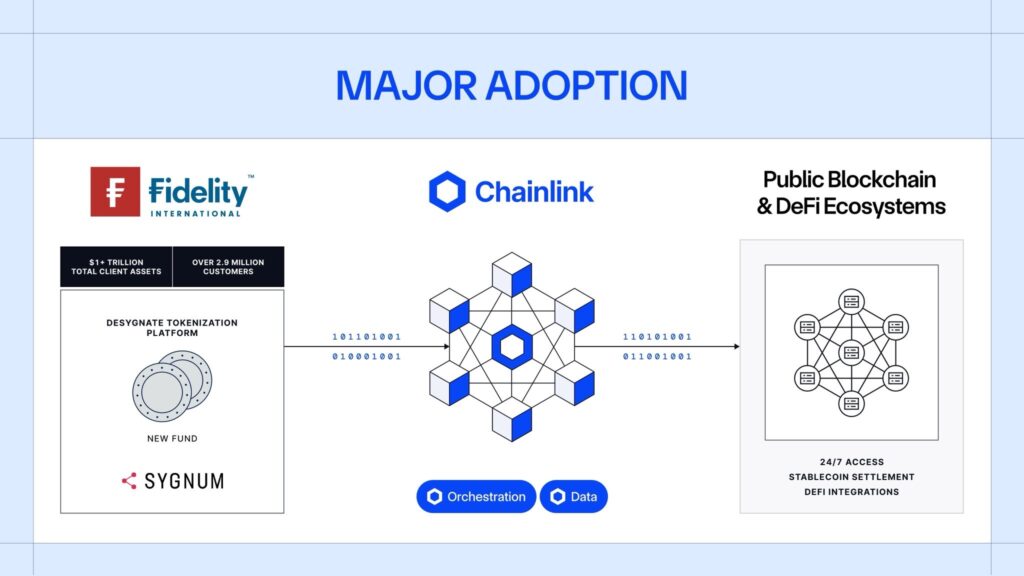
In that product, Chainlink provides net asset value data, known as NAV, a key metric for investment funds because it reflects the value of the underlying assets. Unlike traditional funds, where the NAV is usually calculated during closed hours, this model allows this information to be published within the digital ecosystem in a more transparent and accessible way.
A day earlier, on May 12, DTCC integrated Chainlink technology into its Collateral AppChain digital platform. Post-trade infrastructure plays a central role in the US financial market because it participates in post-trade processes, such as clearing, settlement, and custody of securities.
With the integration of Chainlink, it seeks to modernize collateral mobility and allow near real-time management of collateral, prices, valuations and asset movements.
The Collateral AppChain platform is scheduled to go into production during the fourth quarter of 2026. According to DTCC, The initiative aims to improve capital efficiency and reduce operational limitations inherent to systems that do not operate continuously.
This expansion of Chainlink among corporate players and financial firms raises expectations about LINK, its native token. As reported by CriptoNoticias, financial analyst Ted Stamas believes that LINK could outperform the S&P 500 in the next four years.
Despite these announcements, the price of the token shows another dynamic. The asset fell from $10.49 to $9.79 in the last 7 days, representing a drop of close to 6.7%.
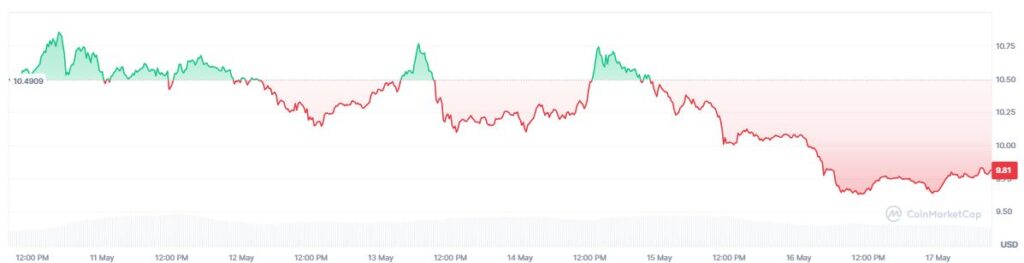
The contrast shows that institutional adoption of infrastructure does not always immediately translate into price increases. Still, these integrations reinforce a trend: Chainlink is expanding its role beyond oracles and gains presence as an infrastructure provider for tokenization, interoperability and financial data within digital and institutional markets.