
The World Health Organization (WHO) declared yesterday, May 16, 2026, a “public health emergency of international concern” due to the Ebola outbreak caused by the Bundibugyo variant in the Democratic Republic of the Congo and Uganda.
This statement revived fears in global markets due to the memory of the COVID-19 pandemic, although the agency advised against border closures or general travel restrictions.
According to Bloomberg, the outbreak reached the highest level of health alert from WHO for cross-border transmissionpockets of deaths without a clear explanation and strong uncertainty about the true size of the epidemic.
The WHO noted that Ebola disease caused by the Bundibugyo virus in Congo and Uganda “constitutes a public health emergency of international concern,” but clarified that “it does not meet the pandemic emergency criteria” defined in the International Health Regulations.
He ebola It is a serious viral illness that can cause high fever, severe weakness, vomiting, diarrhea and bleeding. It is transmitted mainly by direct contact with body fluids of infected or deceased people, not through the air like respiratory viruses. In this outbreak, there is concern that the Bundibugyo variant does not have specifically approved vaccines or treatments.
To date, the WHO reported eight laboratory confirmed cases, 246 suspected cases and 80 suspicious deaths in the Congolese province of Ituri. In Uganda, two cases, including one death, were confirmed in Kampala in people who had traveled from Congo.
The health agency called for international coordination, epidemiological surveillance, contact tracing and reinforcement of response systems. Besides, recommended not closing borders and instead applying isolation, monitoring and cross-border controls.
This episode—or, rather, the possible consequences taking into account recent history with the COVID-19 pandemic—is adding pressure on the bitcoin market, which was already operating with greater risk aversion due to tensions between the United States and Iran. Proof of this is that, in this context, the price of bitcoin (BTC) plummeted to $78,000 as reported by CriptoNoticias this morning.
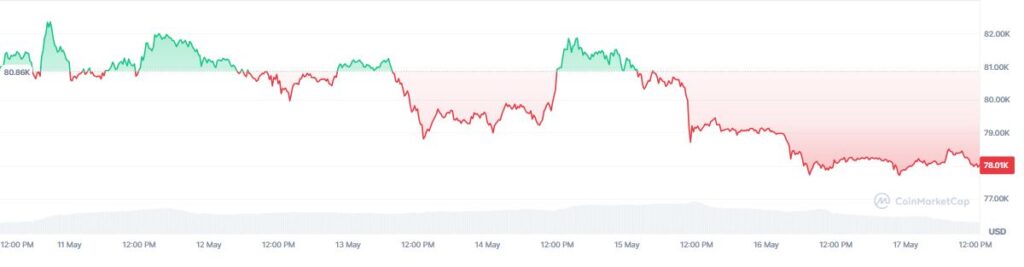
The current scenario configures two negative factors for assets considered risk: health uncertainty and energy tension.
The topic also reached Polymarket, a cryptocurrency-based prediction market where users bet on future events. There, the implied probability of an Ebola pandemic in 2026 reaches 10%, with a volume traded for $45,247.
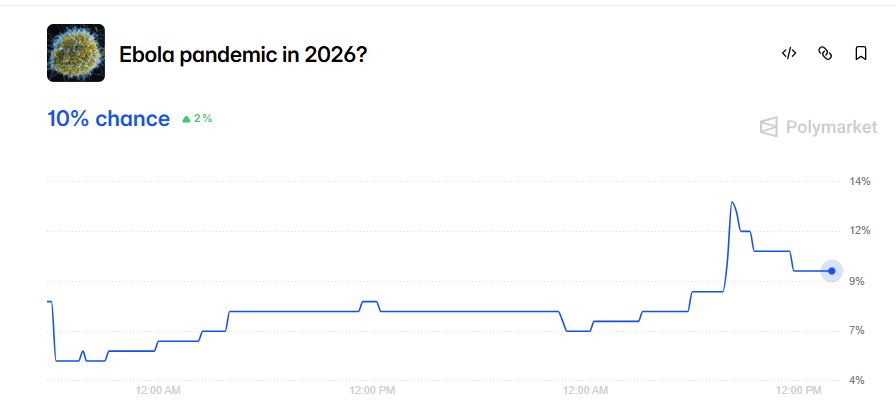
In short, fear involves a possible chain of effects: lower appetite for risk, fall in volatile assets, search for refuge in more conservative instruments and additional pressure on sectors sensitive to mobility, commerce and raw materials. Therefore, although the outbreak does not imply global restrictions on mobilization (at least, for now), Health uncertainty adds to an already tense macroeconomic scenario.
The WHO makes a key difference regarding COVID-19 and that is that the outbreak requires urgent international coordination, but not a response based on widespread border closures.