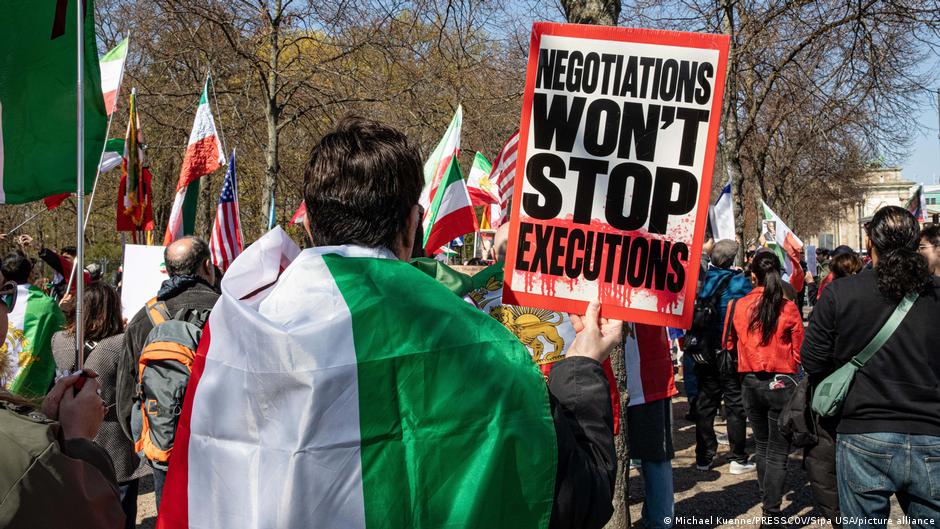
Amnesty International said the number of executions worldwide was set to reach its highest level in more than four decades in 2025, driven mainly by a sharp increase in Iran.
It is known that at least 2,707 people were given death sentence, According to the rights group’s annual review. This represents an increase of 78% compared to 2024 and is the highest figure recorded by Amnesty since 1981, when 3,191 executions were recorded.
The figures do not include China, which Amnesty believes has executed thousands of people, making it the world’s top executioner. The country refuses to disclose the data.
The group attributed this increase to governments using the death penalty to project authority, saying they “have placed this cruel punishment at the center of flawed public safety and ‘tough on crime’ narratives to exert control, project state power, and score political points.”
Key facts from Amnesty’s ‘Death Penalty and Executions Report 2025’
Amnesty does not rely on any single data source. Instead, it collects information from official statistics, court decisions, individuals sentenced to death, their families and representatives, media reports, and other civil society organizations.
- Excluding China, 2,707 executions recorded in 2025
- 2,159 hanged in Iran alone
- Death penalty still exists in 54 countries
- 2,334 new death sentences recorded in 2025
- 25,508 people were under death sentence at the end of 2025
- Executions recorded in: China, Iran, Saudi Arabia, Yemen, United States, Egypt, Somalia, Kuwait, Singapore, Afghanistan, United Arab Emirates, Japan, South Sudan, Taiwan, Iraq, North Korea, Vietnam
- Decapitation, hanging, lethal injection, shooting, and asphyxiation with nitrogen gas were used as methods of execution in 2025.
In many countries data on executions are not published, Amnesty says its statistics are minimally recorded.
“The true overall figure is likely to be higher,” the group said.
Amnesty was able to confirm that executions had taken place in North Korea and Vietnam, but there was insufficient information to determine reliable minimum figures.
China, Iran and Saudi Arabia dominate global executions
The largest number of executions were carried out in Iran, with at least 2,159 executed. This represents about 80% of the global total.
This figure more than doubled from the previous year and is the highest level of death sentences in the country in decades.
Amnesty said, “Iranian authorities continued to weaponize the death penalty, often after extremely unfair trials, to instill fear among the population and to punish those who oppose, or challenge, the establishment of the Islamic Republic of Iran.”
A significant increase was also recorded in Saudi Arabia, where at least 356 people were executed, many of whom were linked to drug-related crimes.
Global figures Amnesty believes do not include thousands of executions that took place in China.
capital punishment in the united states
The United States recorded its highest number of executions since 2009, with 47 people put to death, Amnesty reports.
Amnesty said almost half of those executed were in Florida alone.
The number of people on death row in the United States has fallen below 2,000 for the first time since Amnesty began collecting data, due to commutations and natural deaths.
Signs of progress toward eradication
Despite the grim statistics, Amnesty saw signs of progress towards abolition of the death penalty.
By the end of 2025, 113 countries had completely abolished the death penalty for all crimes, up from only 16 in 1977.
Reforms during the year included the abolition of the death penalty for many crimes in Vietnam and legislative steps to further restrict or eliminate its use in countries such as Gambia, Liberia, and Nigeria.
Courts and governments in some countries also worked to block efforts to expand the death penalty. In Kyrgyzstan, the Constitutional Court ruled that reintroducing the death penalty would violate the constitution, while Zimbabwe commuted all existing death sentences.
UN High Commissioner for Human Rights Volker Turk said, “Only humanitarian and rights-based justice systems can truly deliver justice… I hope that we will soon see universal recognition – reflected in the law – that the way to protect societies is not through executions, but through strong institutions and accountability.”
Edited by: Shawn Sinico