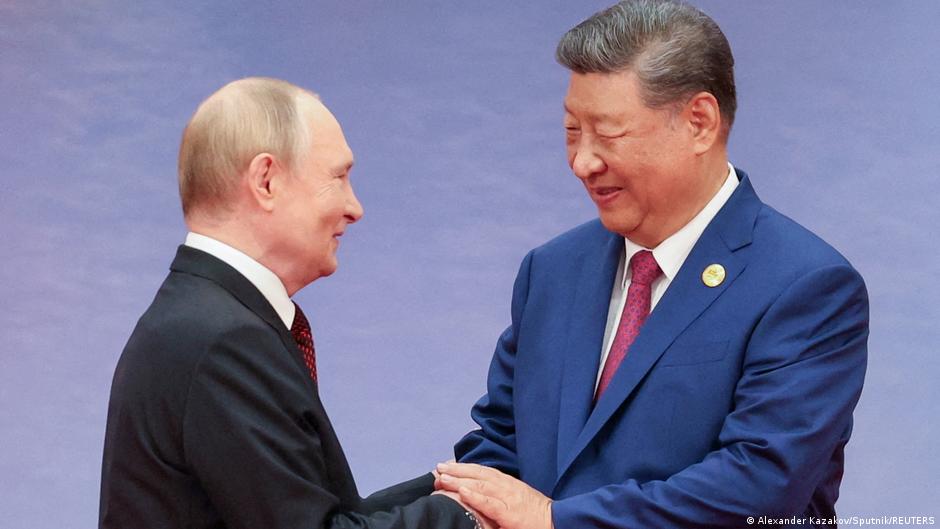
Apparently, Russian President Vladimir Putin’s visit to China this week to meet his counterpart Xi Jinping coincides with the 25th anniversary of the 2001 Sino-Russian Treaty of Good-Neighborhood and Friendly Cooperation.
But the timing of the visit – just days after US President Donald Trump’s state visit to Beijing – is noteworthy, and highlights China’s influential position in a geopolitical landscape that is increasingly fragmented and marked by great power rivalry.
What’s on the agenda of the Putin-Xi summit?
It is expected that the topics of the meeting will include bilateral economic and trade issues as well as international and regional matters.
Amid Moscow’s isolation from the West due to its invasion of Ukraine, China has become Russia’s largest trading partner by far, supplying more than a third of its imports and buying more than a quarter of Russian exports.
But this partnership reportedly also has military dimensions. A Reuters investigation in July 2025 said Chinese companies allegedly used shell firms to send drone engines to Russian weapons manufacturers as industrial cooling equipment – allegations Beijing denies.
Ahead of the Putin-Xi summit, Klaus Soong of the Mercator Institute for China Studies (MERICS) in Germany told DW that the current geopolitical landscape puts Beijing in an advantageous position.
Both the United States and Russia need China at this time, albeit in opposite ways: Washington wants a strategic rival while Moscow wants a partner with overlapping geopolitical and energy interests.
Meanwhile, Beijing does not need to balance the US or distance itself from tensions between Russia and the West, Sun said.
What does Putin want from Xi now?
Xi welcomed Trump warmly and left Beijing with an optimistic attitude. Putin’s visit may be partly aimed at seeking assurances that any progress in China-US relations will not come at Moscow’s expense.
For Putin, the immediate priority is to reaffirm his close ties with Xi and assess Beijing’s current thinking. Soong suggested that a more forward-looking question is who might act as a credible mediator if Russia wanted to end the war in Ukraine.
Recent signs – including more restrained Victory Day parades and continued Ukrainian attacks on Russian oil infrastructure – suggest that Moscow is experiencing war fatigue. Putin even suggested that the conflict may be nearing a conclusion.
Putin has been meeting Xi frequently since Russia’s full-scale invasion of Ukraine in February 2022. For Beijing, the relationship remains a strategic priority, Soong said — although the balance of power is skewed, Russia is now more dependent on China than the other way around.
Facing growing pressure in Ukraine, Putin remains dependent on China in many ways, said Ding Shufan, a professor of East Asia studies at Taiwan’s National Chengchi University, including China’s continued imports of Russian energy as well as access to dual-use goods and supply chains.
Whether Beijing can adjust its level of support – “like controlling a water tap,” as it may soon be called – is unclear.
What does Beijing want from Moscow – and what can it get
“China does not want war; it is not in China’s long-term interests,” Soong told DW. Therefore, China is unlikely to exert much influence in the current war zones.
“It may not be in China’s interests to continue the Ukraine war,” he said, “but it would pose a greater risk to China of regime collapse.” Beijing would view regime collapse in both Iran and Russia as a negative outcome.
Sun argues that a weak or unstable Russia would pose an immediate strategic risk to Beijing. The two countries share a long border and Moscow remains an important strategic partner for China. This means that Beijing would not want Russia to lose too badly, even if it avoids playing a more direct role in the war.
China has also been affected by tensions around the Strait of Hormuz and the resulting disruption in oil supplies. Given domestic challenges such as industrial overcapacity, China cannot easily export its goods if key regions are disrupted by conflict.
Analysts say turmoil in the Middle East could make Russian energy more attractive to Beijing. Russia accounted for about 18% of China’s oil imports in 2025, compared with about 13% from Iran and about 42% from other Gulf countries.
Western sanctions have prompted Moscow to redirect exports eastward, while the US-Israeli war against Iran has raised concerns about maritime traffic through the Strait of Hormuz. Russia needs the Chinese market, while China can secure Russian energy at a discount.
Putin-Xi summit: what to see?
“China and Russia are like a couple sitting on the same bed with different dreams,” Soong said. He described their interests as aligned but not identical.
For China, a key objective is to secure more reliable and sustainable energy supplies – without becoming overly dependent on Russian oil, which would give Moscow an advantage.
Although the agenda of the meeting is not yet clear, Sun says there could be signs of a possible thaw in relations.
Such agreements could be signed, but the expert cautioned that for countries like China and Russia, such deals are often the beginning rather than the end of a process.
He gave the example of the Shanghai Cooperation Organisation’s proposed development bank: first introduced by China in 2010, it languished for more than a decade and, despite a renewed push at the 2025 Tianjin summit, has yet to become a fully operational institution.
“There is no such thing as unlimited partnership,” Soong said, referring to past rhetoric about China-Russia relations.
When Putin and Xi met in Beijing in early 2022, just before Russia invaded Ukraine, they declared that their “friendship between the two states has no limits.” However, Chinese officials have since downplayed that statement, with China’s then-ambassador to the EU Fu Kang describing the phrase as “nothing but rhetoric”.
Still, this does not mean that Beijing and Moscow are not united. “If China is considering its options between Europe and Russia, Russia still has a lot to offer,” Soong said.
Edited by: Carl Sexton