
In this way, a stock market operating 24 hours a day could be allowed.
Settlement times would be reduced, favoring investors.
The United States Securities and Exchange Commission (SEC) would this week propose a new flexible regulatory framework through an “innovation exemption” to allow the trading of tokenized stocks on decentralized platforms. This measure seeks to accelerate the integration of traditional securities into cryptocurrency networks.
According to reported Bloomberg Law Yesterday, March 18, 2026, the proposal represents a “surprise move” by the regulatory agency. The initiative has the potential to “reshape the landscape of the American stock market” by authorizing digital versions of publicly traded stocks under looser operating rules.
One of the great advantages of this proposal is that transaction settlement times would be drastically reduced (which traditionally take 1 or 2 business days), which can directly benefit investors.
This decision by the SEC would mean one of the United States’ biggest advances towards cryptocurrency infrastructure to date. The regulatory change coincides with accelerated growth in the real-world assets (RWA) sector, which currently registers a total active market capitalization of $27,387 million.
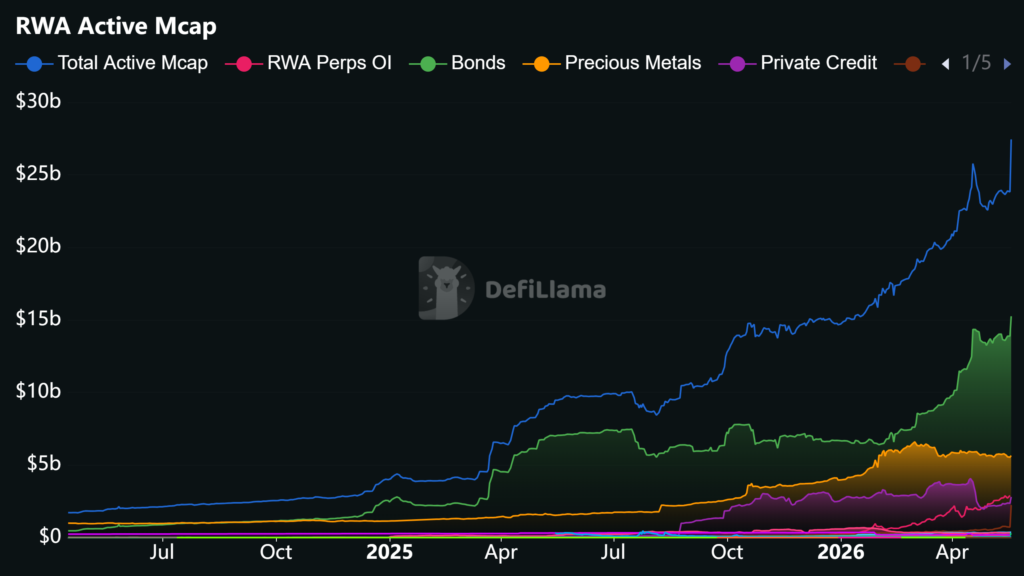
The dynamism of the private sector has pushed for these changes. For example, the JPMorgan bank presented on May 12, 2026 its tokenized monetary fund on the Ethereum network, aimed at functioning as a reserve infrastructure for stablecoins in the United States, under the Genius Law.
For its part, the financial asset manager Fidelity International announced on May 13, 2026 the launch of its first tokenized native fund. The so-called Fidelity USD Digital Liquidity Fund (FILQ) was developed directly on the Ethereum network. This instrument uses the infrastructure of the Chainlink oracle network and the Sygnum tokenization platform..
In tune with these innovations, the Depository Trust & Clearing Corporation (DTCC), the main post-trade market infrastructure in the United States, announced on May 12, 2026 the integration of Chainlink technology into its native digital platform Collateral AppChain, as reported by CriptoNoticias. This technical collaboration seeks, according to the official statement, to “modernize collateral mobility and improve capital efficiency” through the use of the Chainlink Runtime Environment (CRE) and its data standard.
Although the SEC proposal has not yet been made official or public, its possible approval would generate a clearer framework for banks and asset managers. continue to advance the tokenization of traditional assets.