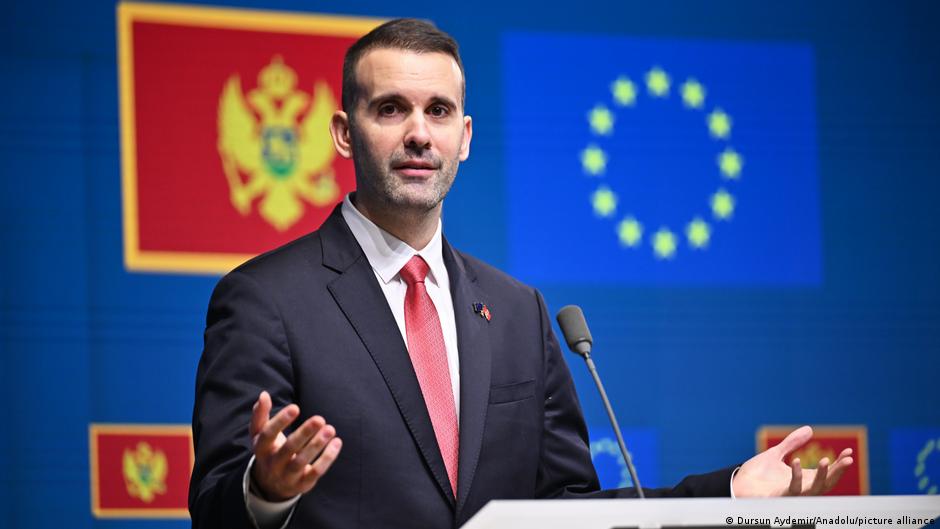
On May 21, Montenegro will mark two decades since the historic referendum that led to its separation from its state union with Serbia.
The anniversary will be celebrated in an atmosphere built on the country’s reputation as a “high achiever” of the Western Balkans in the process of joining the European Union.
Over the past few years, Podgorica has managed to kick-start its stalled EU accession talks, speed up reforms and establish itself as a leader in the region to join the EU at a time when Brussels has renewed its interest in bringing new members into the bloc.
“It’s easy to become a star student in a class of bad students,” Deliborka Uljarevic of the Center for Civic Education in Podgorica told DW.
His comments reflect the broader regional context. While much of the Western Balkans has stalled, or moved back, on the path towards the EU, Montenegro has managed to take advantage of the geopolitical momentum generated by Russia’s invasion of Ukraine and the EU’s renewed focus on enlargement.
referendum on independence
Montenegro declared independence from Serbia in 2006 after a closely contested and overwhelmingly voted referendum, in which 55.5% of voters supported leaving the union with Serbia.
For the next 14 years, the country was ruled by the Democratic Party of Socialists (DPS), led by longtime strongman Milo Djukanovic.
Over the years, Djukanovic’s government faced repeated allegations of corruption and links between the political elite and organized crime, while critics described Montenegro as an “occupied state”.
The DPS ultimately lost power in 2020 after months of mass protests and church-led rallies against the controversial religious property law, becoming the first democratic transfer of power since independence.
“Montenegro is one of the rare countries in the region that had enough democratic capacity to change the person in power for so long without any major upheaval,” said Alexander Popov of the Center for Regionalism in Novi Sad, Serbia. “If we look at Serbia, it will be very difficult to achieve,” he told DW.
division over identity
Montenegro’s political landscape is still marked by the pro-sovereignty/pro-Serbian divide that has shaped the country since independence.
One side emphasizes a distinct Montenegrin national identity and statehood, while the other sees Montenegrins as part of the broader Serbian national body and favors closer political, cultural and religious ties with the country’s northeastern neighbor.
According to the latest census of 2023, about 41% of citizens identify as Montenegrins and about 33% as Serbs – a balance that strongly shapes elections and coalition politics.
Pro-Serbian parties are among the major political actors in the country and are widely seen as the main channel through which Belgrade maintains influence in the domestic affairs of Montenegro.
Officially, these two political camps have reached consensus on the goal of Montenegro joining the European Union.
Unofficially, Alexander Popov says, that balance remains delicate and sensitive to Belgrade’s influence.
“Pro-Serbian forces […] “Signals from Belgrade can always create obstacles in the European path – and this is already happening,” says Popov.
‘We loved you more than you loved us’
Relations with Serbia therefore remain one of the most sensitive political issues for Podgorica.
This was clearly illustrated by the reaction of Serbian President Aleksandar Vucic to the invitation to attend the independence anniversary celebrations of Montenegro.
Vucic began by saying that participating in the festivities would be like “spitting in the face of yourself and your people.”
Later he addressed Montenegrin citizens directly in an opinion: “You did not bother us. We saw you as sisters and brothers and wanted to be in the same position with you. I admit, we are guilty – forgive us for loving you more than we loved you,” Vučić wrote.
How belgrade sees montenegro
Both Uljarević and Popov believe that official Belgrade never fully accepted Montenegrin independence. According to Uljarević, Serbia still behaves towards Montenegro “as if it were temporarily lost territory.”
Popov believes that for this reason, Belgrade will continue to make every possible effort to slow down Montenegro’s progress on the way to the EU.
“Serbia does not want Montenegro to join the EU because it would undermine Vucic’s main argument that ‘Europe does not want us.’ “If Montenegro enters the union, it will become clear that the real problem lies elsewhere,” Popov told DW.
They argue that EU membership would put Montenegro beyond the reach of Belgrade in political, legal and security terms and remove it from Serbia’s sphere of pressure and influence.
same old problems
Nevertheless, Uljarević warns that beyond the positive image of Montenegro as a regional success story lie many of the same problems that have plagued Montenegro since independence.
“Corruption is still everywhere,” Uljarevic said. “Some would even say it’s more expensive now than ever,” she says, “because there are so many more actors in power who are trying to satisfy their own party and special interests.”
At the same time, he believes that Montenegro should use the current pace of EU integration as an opportunity for deep institutional and social change, and not simply as a geopolitical shortcut into the bloc.
“Our entire interest is to become an EU member state as soon as possible, but it is equally important that the process goes smoothly and that we do not enter the Union as a defected state,” he said.
Edited by: Angiel Flanagan