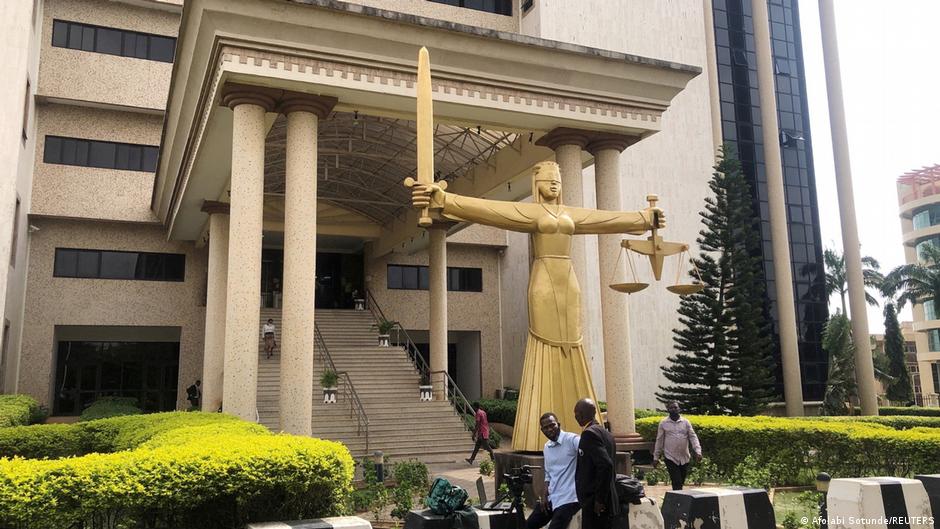
Nigeria’s former electricity minister Saleh Mammen was arrested on Tuesday, days after being sentenced in his absence to 75 years in prison for embezzling 33.8 billion naira ($24.6 million), in what was widely described as a rare high-profile conviction.
Prosecutors said the funds were the proceeds of illegal activity linked to Nigeria’s government-funded hydropower projects, including the Mambilla and Tangaru power plants.
Ola Olukoyede, head of the Economic and Financial Crimes Commission (EFCC), said Mamman, who had been in hiding since his conviction on May 7, was arrested in the northern Nigerian city of Kaduna and is now in custody.
Mamman served as power minister between 2015 and 2021, at a time when the administration of then President Muhammadu Buhari vowed to fight corruption. The judge also ordered him to return the outstanding sum of 22 billion Naira to the state.
Does a conviction indicate real accountability?
A few weeks ago, former Acting Accountant General Chukwunyere Nwabuoku was sentenced to 72 years in prison after being convicted of money laundering.
He joins a growing list of former public officials prosecuted on billion-dollar corruption charges.
Nigeria’s anti-corruption agency, the EFCC, recently declared the former Minister of Humanitarian Affairs wanted for alleged abuse of office and misappropriation of public funds.
But beyond that, there are broader questions about who is actually convicted in Nigeria’s justice system.
backlog of cases
Corruption cases against government officials in Nigeria often languish in the courts, sometimes taking years or even decades to be resolved.
according to a Review Of the 393 corruption cases tracked by research organization Datafyte between 2013 and 2026, only 144 have reached a final verdict, while more than 60% are still pending at various stages of trial.
The cases span 14 years and involve alleged corruption amounting to 3.61 trillion naira, $1.33 billion and €26,170 million.
“Further analysis shows that the majority of cases concluded so far involve appointed officials, suggesting that convictions are less common among those elected to office than among those appointed,” Datafight said.
reporting This disparity has been highlighted by Nigerian news portal TheCable. While 33 former governors were prosecuted, only six were convicted. Some convictions were later overturned on appeal or pardoned.
Analysts say recent convictions of senior public officials could be a sign in the direction of greater accountability efforts.
However, David Alechenu, a team leader on the Nigeria Anti-Corruption Agencies Strengthening Project, warned that “individual convictions alone are not enough to conclude that the anti-corruption fight has been fully effective.”
“The real test is whether these efforts are being systematic, preventive or institutionalized,” he said.
Why do corruption cases stop in Nigeria?
DataFight’s analysis points to a wide disparity in prosecutions: “324 appointed officials have been charged, while only 35 former governors have been charged, and many high-profile cases have taken 6 to 15 years to conclude,” it says. Said.
Analysts have noted that due to the structure of Nigeria’s justice system, cases involving elected officials are often more layered and rigorous than cases against appointed officials – a difference often exploited to the benefit of the former.
“Where there is clear evidence of a crime, often the strategy is to delay until they reach a settlement or until a friendly government comes into power and provides some form of relief,” said Amina Umaru Miango, a legal expert and project manager at the Center for Journalism Innovation and Development (CJID).
“This is what we see very often,” he told DW. “These individuals can afford top lawyers, are politically exposed, and have the necessary contacts to prolong the process.”
Alechenu, meanwhile, argues that this is more a structural issue than a single institutional weakness.
He said elected officials control large budgets and patronage networks, meaning cases often involve “multiple accounts, agencies and sometimes cross-border transactions and complex asset tracing that naturally increase investigation and prosecution timelines.”
Alechenu said those involving appointed officials are usually more administratively controlled.
Analysts said these loopholes allow continued political influence and undermine overall anti-corruption efforts. He says that this also reduces public confidence in the justice system.
Ahmed Adedimeji Amobi, a writer who lives in the Nigerian city of Osogbo, said corruption allegations involving high-profile government officials often attract attention on social media, but the outcomes of their cases are rarely publicized.
“Indeed, their faces printed on EFCC forums eventually rise to even higher political positions,” Amobi told DW.
massive cost of corruption
According to the , Nigeria loses $18 billion annually to corruption and financial crimes, the majority of which is linked to public procurement. GuardianWhile according to reports almost 90% of corruption cases in this sector are due to contract fraud Nairametrics.
Analysts said addressing endemic corruption in the country will require reforms that address barriers in both the justice system and the broader governance environment.
Alechenu, of the Nigeria Anti-Corruption Agencies Strengthening Project, recommends a special fast-track court for corruption cases with dedicated judges and “streamlined procedures”.
“Such a system will help reduce overcrowding and delays in normal courts, including frequent adjournments,” he said. He said that there is a need to increase the investigative capacity and forensic tools required for financial investigation.
Edited by: Keith Walker