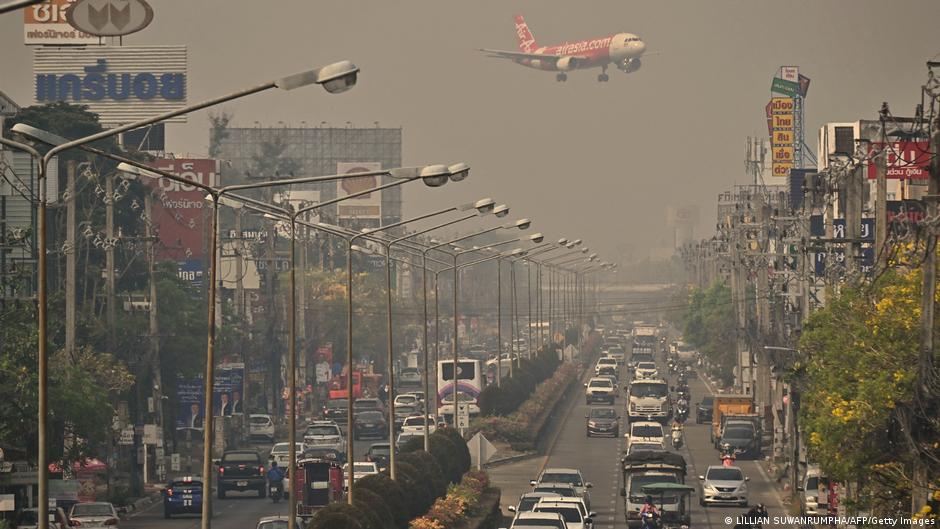
Thailand’s parliament has revived a long-delayed law to recognize clean air as a protected public right, a major step forward in a country where seasonal smog has become an annual health emergency.
Last week, MPs voted 611 to 3 to advance the Clean Air Act, which now goes to the Senate, the upper house of parliament, for scrutiny before being presented to the Prime Minister and the King for support.
The Clean Air Bill began life as a citizen-promoted law, proposed by a coalition of NGOs in 2019, before being taken up by political parties and previous governments. The seven draft versions were later consolidated into a single bill.
The bill would require major emitters in industry, transportation and agriculture to pay fees, fines or compensation for pollution damages. It also seeks to trace supply chains, including agricultural imports, to ensure that products linked to open burning or cross-border haze do not escape scrutiny.
Currently, air pollution in Thailand is regulated by multiple laws, and the new bill aims to bring those fragmented regulations under a more coordinated national framework, while giving local authorities more power to respond to pollution in their areas.
Thailand’s smog problem
Thailand’s air pollution crisis is most severe during the dry season, especially from December to April, when agricultural burning, forest fires, traffic and industrial emissions coincide with stagnant weather.
According to environmental reporting, in 2023, approximately 10 million people sought medical care for pollution-related illnesses. PM2.5, microscopic particles small enough to pass through the lungs and enter the bloodstream, are of main concern.
According to the World Health Organization (WHO), air pollution causes more than 32,000 premature deaths in Thailand each year, including from diseases affecting the heart and lungs.
What does the law require?
The bill introduces and supports several progressive policy instruments. Authorities need to reallocate budgets to support clean air management and collect pollution taxes. It provides for local ordinances, pollution control zones, and area-specific air quality standards.
The bill would also create stronger air-quality monitoring systems, integrate pollution data between agencies and empower local governments to take action when pollution exceeds safe levels.
This includes measures against open burning, stronger regulation of high-emission areas, and provisions covering cross-border pollution from outside Thailand.
It envisions a Clean Air Fund that would support pollution reduction, public-health responses, and assistance for farmers moving away from burning.
It also promotes evidence-based solutions by encouraging the use of technology, innovation and public data. Citizen monitoring, local monitoring networks, and community sensors will gain greater legitimacy within the clean air system.
Clean Air Bill a political test
The Clean Air Bill came closer to becoming law after a consolidated version was passed in the House of Representatives in October last year. It was then sent to the Senate, where it reached an advanced stage of investigation before Parliament was dissolved in December.
The new government of Prime Minister Anutin Charnvirakul, which took office in April, had only a limited window to ask Parliament to retake bills left incomplete by the previous legislature.
However, many members of Anutin’s ruling Bhumjaithai party opposed the law, arguing that it could impose new costs on businesses and duplicate existing laws.
During a parliamentary debate in early April, Bhumjaithai lawmaker Supachai Jayasmut argued that although he agreed with the principles of the bill, he opposed its sweeping powers for authorities, which could allow searches, seizures, asset freezes and business closure orders without a court warrant.
Economic impact of pollution laws
Business groups and conservative lawmakers have also warned that pollution charges, clean air charges and risk-guarantee mechanisms could raise operating costs at a difficult time for the Thai economy.
Thailand’s 2026 growth outlook remains modest, with the World Bank projecting growth of only 1.6%, while rising energy costs linked to tensions in the Middle East have hit the economy hard.
In mid-April, Anutin vowed tougher action on wildfires and PM2.5 smog, and publicly announced his support for the Clean Air Bill, which also included a ban on imports of agricultural products linked to burning in neighboring countries.
His government later reintroduced the bill, forcing a new vote in the House of Representatives.
“The likely scenario is that the Senate will seek amendments, citing concerns such as overlapping laws, burden on the business sector and the scope of authority of government agencies,” Piyapong Boosabong, associate professor at Chiang Mai University’s School of Public Policy, told DW.
“The bill will not be finalized as quickly as many parties had hoped,” he said.
trouble with enforcement
Piyapong Boosabong, associate professor at Chiang Mai University’s School of Public Policy, told DW that another factor is whether authorities will enforce the law.
“Thailand has many progressive laws that are never effectively enforced,” he said.
Thailand’s biggest clean air problem is PM2.5 pollution caused by agricultural burning and forest fires by individuals or farmers.
Successive Thai governments have reportedly failed to take consistent action, partly because crop stalk burning is linked to rural livelihoods and powerful agribusiness supply chains.
“Thailand’s regulatory system cannot rely solely on self-enforcement of pollution standards, and it remains to be seen whether the Anutin government is actually serious about implementing a potentially clean air mechanism,” Mark Cogan, an associate professor at Kansai Gaidai University, told DW.
On the surface, the “polluter pays” idea works, and it’s common in developed, mature economies like the European Union, Kogan said.
There are some smaller states that have variations in the principle that ultimately fall short, such as Malaysia, where accountability in pollution cases is limited due to weak enforcement and difficulties in identifying polluters.
“A more effective mechanism might be to have additional mechanisms to mitigate public harm by placing a portion of the liability on the government if polluters are not easily identified,” Kogan said.
There is also the problem of geography. The bill can only be enforced within Thailand, while much of the smog affecting the north of the country is transboundary, flowing across borders from burning in neighboring states.
“Based on hotspot data, the Clean Air Bill may only be able to reduce about 30% of overall air pollution,” Busabong said.
Edited by: Wesley Rahn