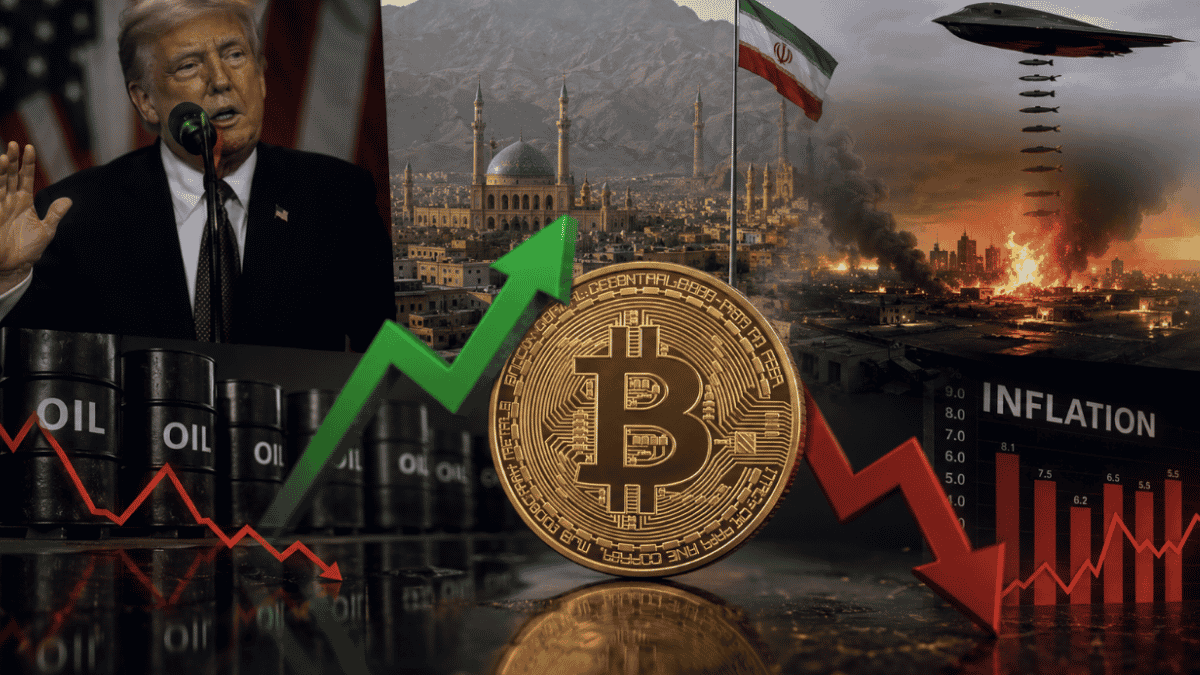
On May 16, 2026, bitcoin (BTC) lost the $80,000 mark and, since then, a bearish sentiment has once again settled on the market.
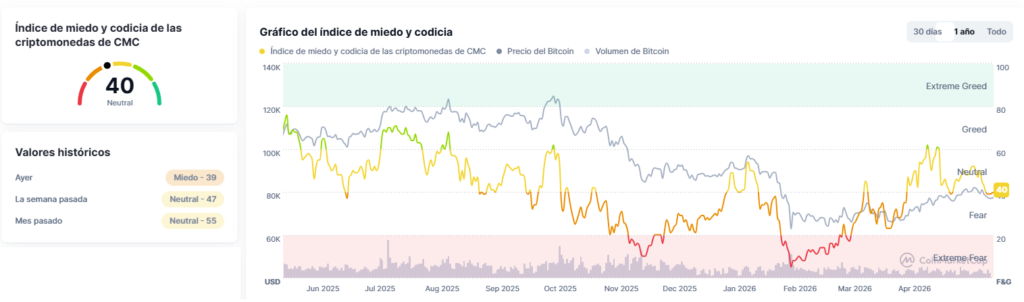
With the price hovering around $77,700 on the morning of this May 21, the fear and greed indexalthough still at neutral point (according to CoinMarketCap metrics) is approaching fear levels again.
In this context, the news about the war in Iranthe delayed opening of the Strait of Hormuz and the impact on global inflation They directly determine the price of the digital currency.
Besides, Investors are still awaiting Kevin Warsh’s first statements as head of the United States Federal Reserve (FED) to forecast upcoming liquidity movements, while the global macroeconomic outlook shows signs of constant deterioration.
The war in the Middle East exerts significant pressure on assets considered “risky” (which usually includes bitcoin).
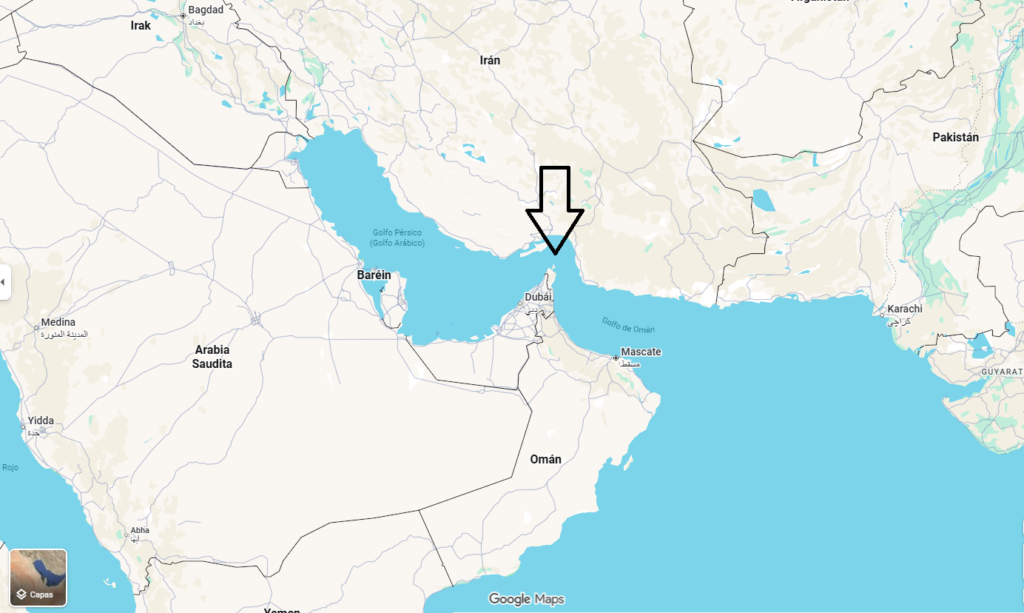
Iran has kept the Strait of Hormuz practically closed since the start of the US-Israeli campaign on February 28, which generated the largest interruption of global energy supplies in history. About 20% of global oil circulates through this maritime passage.
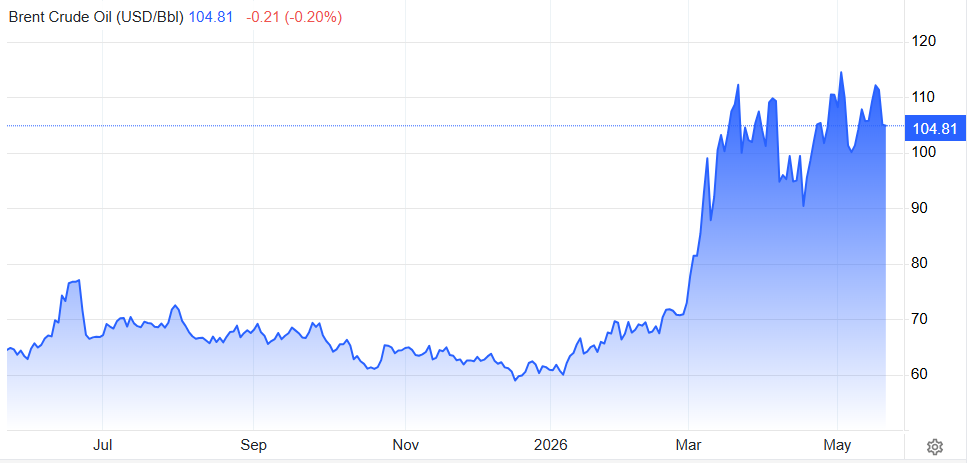
Consequently, oil prices register daily fluctuations and sustained increases. The price of Brent crude oil is around $110 per barrel, an increase that fuels global inflation expectations.
The geopolitical tension shows no signs of immediate resolution. Peace negotiations between the United States and Iran are at a standstill. US President Donald Trump said he was within an hour of restarting a bombing campaign before postponing it to give more time for diplomacy.
However, Iran demands the lifting of sanctions, economic compensation and the withdrawal of US troops, conditions that make an agreement difficult and keep alerts on. The Iranian Revolutionary Guard warned that new aggression will expand the war beyond the region. Furthermore, Iran is increasing its control over the Strait of Hormuz.
According to the opinions of analyst Damir Tokic reported yesterday by CriptoNoticias, the current situation is at a stalemate and an agreement is unlikely without one of the parties being significantly weakened. Tokic believes that the United States seeks to prevent Iran from developing nuclear weapons at all costs, which is why markets must prepare for military escalation that could destroy regional energy infrastructure and skyrocket crude oil prices to unthinkable levels.
This increase in energy prices drives an inflationary crisis from the supply side. Tokic maintains that The Federal Reserve could be forced to raise interest ratesa restrictive scenario for the price increase of volatile financial assets. Higher interest rates dramatically reduce the liquidity available for speculative investments like bitcoin.
Added to this is a particularly fragile US economic outlook. Analyst Daniel Jones points out that US macroeconomic data points to an imminent recession.
Jones highlights the continued loss of jobs in the manufacturing sector since January 2024 and a severe 18.3% drop in private manufacturing fixed investment between the first quarter of 2025 and the first quarter of 2026. In addition, the consumer faces acute stress.
Credit card delinquency rates hit 13.1%, the highest level since 2010, and auto loan delinquencies hit an all-time high of 5.6%. It is worth clarifying that the same thing is being observed in other countries, for example Argentina, as CriptoNoticias has recently reported.
Jones warns that the US government has extremely limited ability to stimulate the economy in the face of a crisis, due to rising deficits and a public debt that has already reached 99.4% of gross domestic product.
remains to be seen how bitcoin would react if this recession were officially confirmedbut—based on history—we can assume that the first movement would be bearishshowing high correlation with the traditional stock market.
Is bearish sentiment “an excellent sign”? Santiment opens the debate
Despite this adverse environment, extreme fear among retail investors could represent a rebound opportunity.
The financial analysis firm Santiment reported that there are currently 0.94 bullish comments for every bearish comment about bitcoin on social networks. It is the first time since April 21 that negative publications clearly predominate.
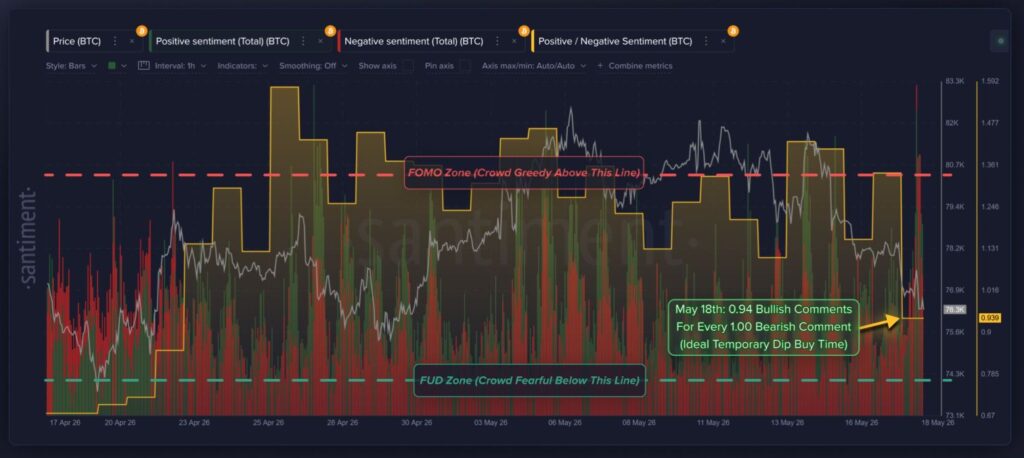
For Santiment, this level of generalized pessimism is “an excellent sign”. Analysts from the firm believe that digital assets tend to move in the opposite direction to the majority’s expectations, so the panic-driven sale of coins by small traders historically increases the odds of an upward jump in price.
However, other analysts foresee an imminent technical worsening if the underlying macroeconomic conditions do not change.
The “ghost of $45,000” for bitcoin appears again
The recent fall reactivated projections that place bitcoin in the $45,000 area. The trader known in internet forums as “No Limit Gains” suggests that a pullback towards $40,000 would serve as a necessary reset to prepare for an upcoming massive bull run, nipping excess leverage and confidence in the bud.
On-chain analyst Willy Woo indicated months ago that the simultaneous deterioration of liquidity in the spot and futures markets could make $45,000 the fundamental floor of a typical bear market.
For his part, financial analyst Rajat Soni observes that bitcoin is operating at the bottom of an ascending channel near $77,000, an area that has served as solid support since March. Soni highlights that the 200-day moving average is currently acting as resistance, complicating any attempt at a quick recovery.
Even the trader Michaël van de Poppe, who until a couple of weeks ago maintained a marked bullish stance, modified his perspective due to the break of supports. Van de Poppe warned that bitcoin lost a key structure around $79,000, the level where a pending gap in the Chicago futures market (CME) is located. If the asset does not quickly recover that area, the analyst considers a cascading fall to prices below $65,000 highly likely.
In tune with this, Glassnode reported a general weakening in market structurepointing to an evident decline in momentum, low spot demand, and an increase in traders’ positions to protect against declines in the options market.
All eyes are on what happens in Iran
In the short term, Hopes for a sustainable recovery for bitcoin mainly depend on a de-escalation in geopolitical tension.
An effective ceasefire in the Middle East or a diplomatic solution that allows traffic to fully reopen in the Strait of Hormuz would alleviate immediate pressure on crude oil prices.
This would reduce global inflation fears and give the FED the necessary margin to avoid more restrictive monetary policies.
As long as uncertainty persists, the immediate future of the price of bitcoin will be tied to the evolution of the war conflict and the economic cooling data in the United States.