
Hougan believes Hyperliquid “still needs to mature.”
HYPE is comparable to shares of Robinhood or the CME Group, the executive says.
The rise of HYPE, the native token of Hyperliquid—a platform that simultaneously operates as a cryptocurrency network and as a decentralized exchange aimed at trading derivatives and perpetual futures contracts—has captured the attention of the financial market.
In this context of accelerated expansion, Matt Hougan, investment director of the firm Bitwise, stated in a special report published on May 19 that “HYPE is one of the worst valued assets in the world of cryptocurrencies today.”
According to the Bitwise manager, This distortion is mainly based on two key conceptual errors of appreciation. by sector analysts.
«The first error is one of categorization», Hougan points out. He explained that the global financial market currently values Hyperliquid simply as a perpetual cryptocurrency futures platform. “However, it should be valued as a global super application that covers all assets: cryptocurrencies, stocks, commodities, currencies, prediction markets, structured products and more,” the specialist explained.
This conceptual difference completely modifies the size of the market that the project aspires to in the long term. The director of Bitwise precisely emphasizes that “its potential universe is not the $3 trillion cryptocurrency market, but the $600 trillion global asset market.” Based on this premise of scale, the executive adds that “these are two completely different businesses. “Current prices suggest that the second is offered at the price of the first.”
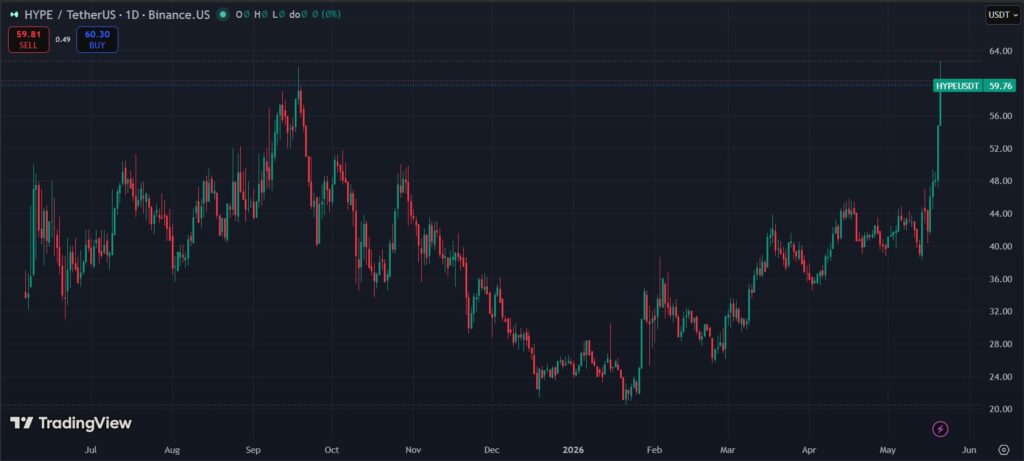
Hougan’s statements They occur in a bullish context for the cryptocurrency. On May 21, the price of HYPE reached a historical maximum of $62.68, registering an increase of 53% in the last week and 45% in the last month.
Distrust remains among market operators
The second problem identified by the investment firm is psychological and technical. “The second valuation error is an anchoring error,” says the analyst, defining the cognitive bias that occurs when traders become tied to past experiences to evaluate a new asset.
“Cryptocurrency investors have been taught (painfully) over the years that tokens do not appreciate,” Hougan says of the history of projects that grew in users while their cryptocurrencies stagnated.
For this historical reason, Market participants tend to distrust modern value capture mechanisms. “They have seen countless projects grow in users, volume, and actual utility, while tokens stagnate, or worse. And even though they hear that HYPE is different, they don’t quite believe it. “So they mentally lump HYPE in with the uniswap token (UNI), when it should rather be compared to Robinhood or CME stock, given its 99% repurchase rate,” he argued.
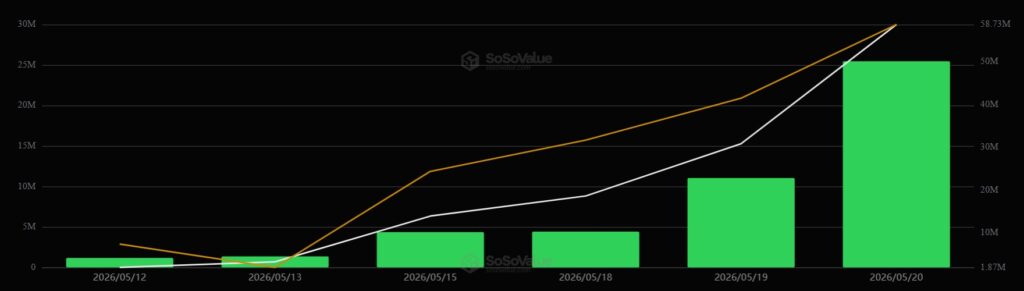
This advance also coincides with a moment of strong institutional traction in the United States. Last week, two exchange-traded funds (ETFs) based on the cryptocurrency came onto the US market, as reported by CriptoNoticias. These regulated products, issued by the firms 21Shares and Bitwise itself, accumulated as of yesterday, May 20, six days of net capital inflows with a total of 47 million dollarsas can be seen in the graph.
At the moment, Hyperliquid’s annual revenue is estimated between $800 million and $1 billionsays Hougan. With a market capitalization of $14 billion, the executive estimates that “approximately 10 to 14 times that buyback flow is paid,” an automatic process where the protocol acquires its own tokens with the profits. “For a fast-growing business, this is incredibly cheap,” said the Bitwise executive.
To illustrate the thesis, the report compares the valuation of the asset with listed Wall Street companies. The Robinhood firm trades with a relationship price-earnings of 37and CME Group He does it with 24, “although none grows at the rate of Hyperliquid.”
This price-earnings ratio is a financial metric that indicates how many dollars investors are willing to pay for each dollar of profit a company generates; A high multiple usually reflects high expectations for future growth.
The comparison with Robinhood (retail brokerage platform) and CME Group (the world’s largest derivatives exchange) is because Hyperliquid shares its same massive financial intermediation business model. Trading at just 10 to 14 times its earnings, the protocol is drastically cheaper than its Wall Street peers.
Geographic limitations may affect Hyperliquid
Despite the positive corporate numbers, the project faces substantial regulatory challenges to consolidate globally.
«Hyperliquid still needs to mature: currently [el exchange] It is not available to US users and needs to be integrated into the US regulatory system. But that has not prevented it from becoming one of the fastest growing financial companies I have seen,” warns the specialist.
It should be noted that the geographical restriction that prevents users in the United States from using this platform significantly affects your decentralized derivatives exchangebut not to the global reach of its network infrastructure or its ETFs.
“The environment for this type of digital innovations has changed after a decade where many projects hid their commercial nature to avoid sanctions from the United States Securities and Exchange Commission (SEC).” Under the new leadership of Paul Atkins at the SEC, the developments were allowed to formally operate “as the decentralized commercial operations they truly are, ending the charade of worthless tokens and opaque foundations,” Hougan commented.
“Hyperliquid is the first major project that took advantage of the authorization and developed it to the fullest,” says the Bitwise manager. Its business model is differentiated by its structural financial transparency. «The product covers all asset classes. Tokens capture real value. The income is real and the buyback is automatic.
At the same time, he warns that none of this guarantees the success of Hyperliquid – competitors will emerge, regulators may change course, among other factors – but “it offers an early and credible vision of what cryptocurrencies can become when they are allowed to fully develop.”
For market participants, the current situation presents an unusual window of opportunity in the pricing of technological assets. The analysis concludes with a clear perspective on the cost of entry to new financial technologies, arguing that “most of the time, waiting for the future to arrive is expensive. From time to time, the market offers a discount.