
EF controls less than 0.1% of total ETH, Feist warned.
Another EF researcher, Jason Chaskin, says he has “never been more optimistic” about the Foundation.
Dankrad Feist, a renowned Ethereum ecosystem researcher and current advisor to the Ethereum Foundation (EF), proposed this May 21 to create an external organization with an initial capital of at least USD 1 billion and financed with staking income with the goal of “saving Ethereum”, arguing that the EF no longer has the resources or economic alignment to lead the development of the network.
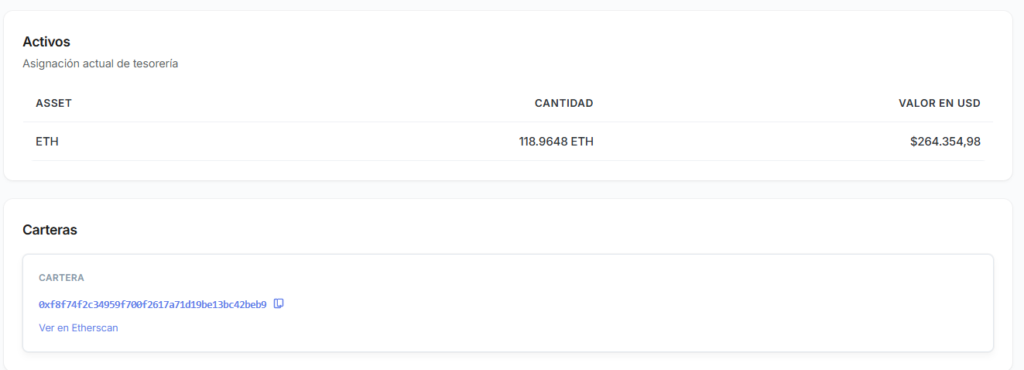
«EF now owns less than 0.1% of all ETH. There is no staking or commission income flow to it,” Feist wrote on X.
This data coincides with what was stated on the official website of the EF, which reports 118,964 ether (ETH) in its treasury out of a total supply of 120.68 million ETH according to CoinMarketCap, which It is equivalent to 0.099% of the total circulation.
Feist’s proposal to replace the Ethereum Foundation
Feist outlined four conditions for his proposed organization:
- Initial financing of at least USD 1 billionwhich he described as “very reasonable for an ecosystem with USD 250 billion in market capitalization.”
- A “competent and willing to fight” leadership.
- A board explicitly aligned with “ETH going up”with an organic charter that makes it responsible for that objective.
- Permanent financing through a portion of the network’s staking income, with a governance mechanism that allows it to be adjusted.
The plan, however, does not detail who would create that organization nor does it identify actors willing to provide the initial capital. Feist himself acknowledged that his idea is “very difficult to imagine now” and that “it could take a long time before it becomes a consensus.”
Feist knows PE from the inside: it was for years one of its main researchersresponsible for the design of the scalability architecture known as Danksharding (by the name ‘Dankrad’) and co-author of improvement proposal 4844 (EIP-4844 – PeerDAS), which drastically reduced fees on Ethereum second layer (L2) networks. Since late 2025, he has been working as a developer on Tempo, a Layer 1 chain powered by Stripe and Paradigm that competes in the same space as Ethereum, while maintaining his advisory role at EF.
Feist’s proposal comes at a particular moment for the Foundation. As reported by CriptoNoticias, developers Pablo Voorvaart and Julian Ma announced their resignations on May 18 and 19, respectively, and before, in February, Tomasz Stańczak had left the executive co-directorship, in the same way as the main developers of the organization.
These departures occur, although without a declared link, after Ethereum co-founder Vitalik Buterin raised last January the “walkaway test” or “proof of abandonment”: the idea that Ethereum must remain useful and functional even if its most relevant members decided to withdraw.
The voice from inside the EF
Not everyone shares Feist’s diagnosis. Jason Chaskin, an EF researcher, responded to the general mood: “I normally refrain from commenting on the topic of the day because it is almost always anger bait. But since everyone seems to say that they are bearish on the direction of the EF, I will say the opposite: I have never been more optimistic«.
According to Chaskin, the Foundation now has “a very clear direction: to make the Ethereum experience, from the protocol to wallets and applications, maximally sovereign, private, secure, resilient and easy to use… The organizational changes are messy. New leadership, clearer direction, some short-term pain. But in the long term, this is exactly what the Ethereum Foundation should be.
What the exchange between Feist and Chaskin leaves open is whether the current rotation in the EF is more like the maturation process that Buterin anticipated with the walkaway test (a Foundation that gives prominence because the protocol no longer needs it) or to a potential institutional crisis that the organization has not yet explained.