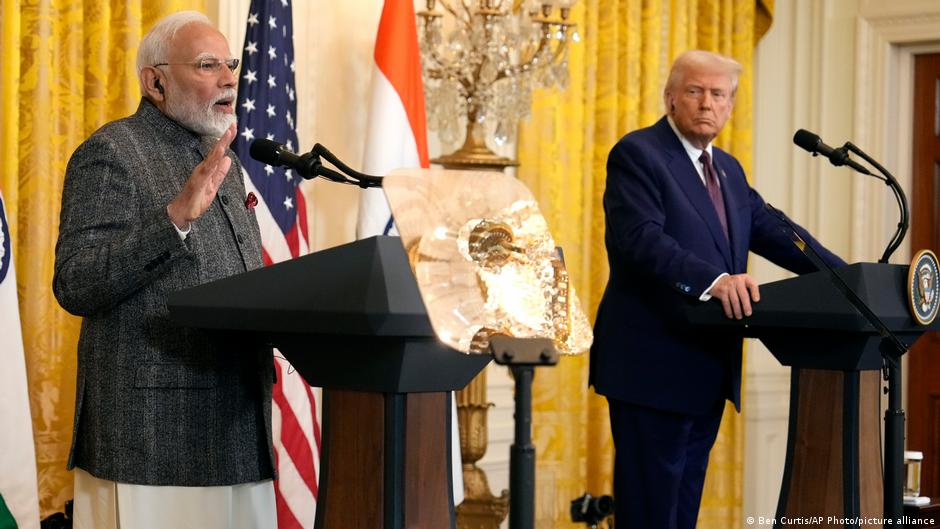
The foreign ministers of the US, India, Japan and Australia – the four nations that make up the quadrilateral security dialogue, known as the Quad – are scheduled to meet in New Delhi for three days from Sunday to discuss Indo-Pacific security, energy supplies and emerging technologies.
The meeting comes as China continues to test geopolitical and security boundaries in the region.
But it is another issue, not on the agenda, that dominated the gathering: how to keep the alliance alive and relevant in a more challenging geopolitical landscape and an increasingly assertive China.
Trump’s tariffs, peace claims raise tensions with Modi
The Quad, which unites four countries in the quest for a free and open Indo-Pacific (FOIP), has not held a meeting of national leaders since 2024, when then-President Joe Biden hosted his counterparts in Wilmington, Delaware.
India was supposed to host the next annual meeting in late 2025, but it never materialized amid tensions between India and the new administration of President Donald Trump.
Trump has imposed tariffs and punitive duties on Indian imports into the US, straining relations with Indian Prime Minister Narendra Modi. The US President further angered New Delhi by claiming to mediate a resolution to the border skirmishes between India and Pakistan in May last year. The US President also criticized India’s purchase of Russian military equipment.
Rubio’s delicate diplomatic mission
A year later, Secretary of State Marco Rubio, who is leading the US delegation to India, has been tasked with smoothing out ruffled diplomatic feathers. With Trump clearly focused on the Middle East and potentially a war in Cuba, Rubio’s mission could be a challenging one.
“The US, Japan and Australia already had an important and effective trilateral security arrangement, but the whole purpose of the Quad was to bring in another power to give India greater influence and reach,” said James Brown, professor of international relations at Temple University’s Tokyo campus.
“Unfortunately, this US administration does not seem to understand or value India’s presence as an ally, which has badly alienated Modi,” he told DW.
While Japan and Australia have made efforts to keep the four-way alliance intact and functioning, Brown suggested that the Quad might actually benefit from Rubio representing the US instead of Trump in India.
I am writing foreign policy magazine, Professor Derek Grossman of the University of Southern California cautioned that if Trump refused to attend the next leaders’ meeting, likely to be held in Australia in late 2026, “then the Quad would be reduced to geopolitical insignificance, and it could even lead to the end of the grouping altogether.”
And analysts say the big winner in that scenario will be China.
Singapore’s S. “Beijing has consistently viewed the Quad with suspicion and has often portrayed it as an effort at containment,” said Joseph Cristanto, a maritime security analyst at the Rajaratnam School of International Studies.
threat to regional security
“A weakened or fragmented Quad will reinforce stories of declining US commitment, allied disagreements and limitations on short-sided security cooperation in the Indo-Pacific,” Cristanto told DW. “More broadly, uncertainty around the Quad could also destabilize smaller regional states that seek a stable balance of power without having to choose sides.”
However, he does not give much credence to suggestions that the alliance is on the brink.
Cristanto said, “I do not think that recent tensions within the Quad indicate a collapse of shared interests; rather, they highlight the growing challenges in managing a partnership between four countries with different strategic cultures, priorities and expectations.”
This is perhaps helped by the fact that the Quad, launched in 2007 largely at the encouragement of then-Japanese Prime Minister Shinzo Abe, is not a treaty alliance with binding commitments on member states. Equally, it was not designed to operate with the rigid discipline of NATO-style institutions, with an informal and flexible structure providing a different kind of flexibility.
The Quad has also faced previous periods of inaction and political hesitation that were similar to the current environment, not least when Australia, under former Prime Minister Kevin Rudd, distanced itself from the alliance over concerns that it would harm Australian business interests in China.
But experts say it is still important to improve US-India relations so that the alliance can survive.
“Despite deepening defense cooperation and growing strategic convergence in the Indo-Pacific, Washington and New Delhi view the partnership from different perspectives,” Cristanto said.
“The US views India as a major strategic partner, expected to play a larger role in the regional balance. At the same time, India is committed to strategic autonomy and is wary of alliance commitments or arrangements resembling block politics.”
Differences over expectations from Russia, trade and political alignment further complicate the relationship, he said, yet it is “underpinned by strong structural drivers, particularly China and shared concerns about long-term Indo-Pacific security.”
Is the Quad in strategic limbo?
Cristanto told DW that the most serious challenge for the Quad may be inaction.
“The bigger risk facing the Quad is gradual strategic divergence, leading to fewer summits, less momentum, weaker coordination and a slow erosion of political relevance,” he said.
If it appears Washington’s focus is changing, DW analysts believe discussions could be restarted on adding other countries to the system. South Korea, New Zealand and Vietnam are all seen as potential future partners under the “Quad-Plus” arrangement.
Right now, all the focus will be on the positions that Rubio takes during his stay in India.
Cristanto said, “The key issue is not whether leaders can overcome all the underlying tensions, but whether they can demonstrate sustained political commitment, maintain practical cooperation and prevent the perception that the group is slipping into strategic limbo.” “The future of the Quad will likely depend less on complete unity among members and more on their ability to maintain cooperation despite disagreements.”
Edited by: Carl Sexton