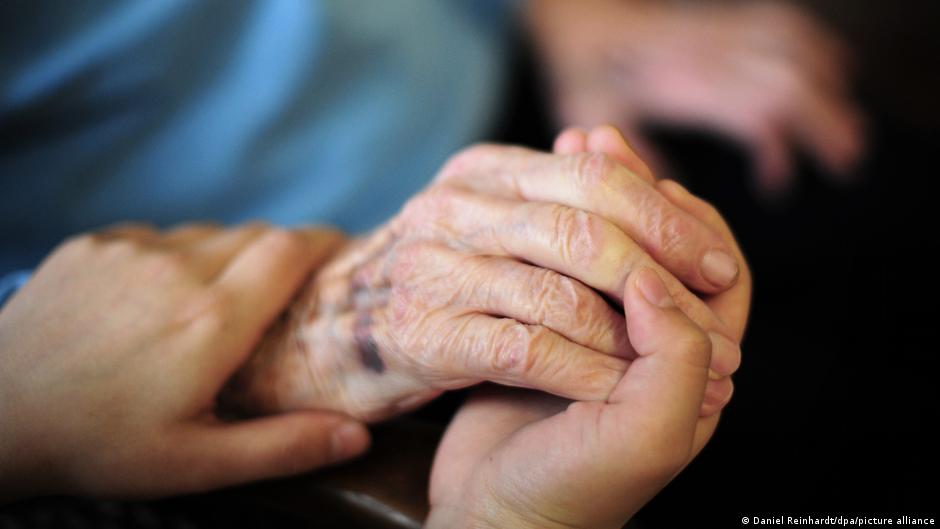
Florence is sitting at the kitchen table. Her husband is there, her daughter too. They laugh together, share food – just like they did before. But there is one difference: both her husband and daughter have been dead for many years. “As if we had never been apart,” she says. Florence had never experienced dreams with such intensity before. She feels no fear – instead, a sense of deep peace, a certainty that she will see her loved ones again. Five days later, Florence dies.
This was not an ordinary dream but a meeting.
Many people have reported similar experiences in the last days of their lives.
Known as end-of-life dreams and visions (ELDV), they often occur as dreams during sleep, and sometimes even as visions while the person is awake.
For those experiencing them, they may feel more vivid and real than normal dreams – and for those observing them from the outside, they may be disturbing.
Medicine long dismissed ELDV as a sudden episode of confusion (delirium) or a side effect of medication. But today the thinking is changing.
Nine out of ten people report end-of-life dreams and fantasies
Christopher Kerr, a neurobiologist, palliative care physician and hospice doctor in the US, is studying dreams and visions at the end of life Since the late 1990s. The ELDV stories described in this article, such as Florence’s, are drawn from Kerr’s documented case reports in palliative care research.
Over a period of about ten years, Kerr and his team interviewed more than 1,400 hospice patients from the time they died until their death – ensuring that they were cognitively intact and not experiencing delirium.
They found that approximately 90% of patients reported at least one such dream or vision.
Kerr doesn’t describe these people as delusional – quite the contrary. “These are clearly patients with heightened acuity and heightened awareness,” he told DW.
Psychologist Alyssa Rabbitti, lead author of N Italian study on ELDVA similar point is emphasized in an email to DW: “End-of-life dreams typically occur in patients who are able to retell them with a coherent narrative while maintaining preserved attention and awareness.”
ELDV recurring themes: journeys, reunions, belonging
Dreams are vivid and meaningful. Many involve encounters with deceased loved ones and pets, who seem to return to provide comfort.
They often revolve around journeys, preparation, and the emotion going somewhere.
Relationships are revisited, conflicts are resolved, guilt and regrets surface.
“As they get closer to dying, their frequency increases. They become progressively more likely to involve the deceased,” Kerr said. Time and distance are losing their meaning.
It makes little difference whether a person is religious or not. According to Kerr, both religious and non-religious individuals report ELDV experiences. What matters instead are these universal themes of love, connection, and forgiveness – but not the belief system.
ELDVs are also distinct from near-death experiences. In acute, life-threatening situations, near-death experiences occur suddenly. In contrast, end-of-life dreams develop slowly over days or weeks and are closely linked to a person’s life story. They are less dramatic – rarely involving tunnels or flashing lights – and focused far more on relationships.
Comfort – or necessary confrontation
Most of these experiences are relaxing. In Kerr’s study, patients described them as extremely calming and meaningful. However, some people found them disturbing.
More difficult dreams can be especially transformative, Kerr said, because they bring unresolved issues to the surface — guilt, regret, unfinished business.
Sierra is in her twenties, has a young child, and is dying from a terminal illness. For a long time, she struggled to accept her diagnosis. Conversations with his doctors fail to make any impact. But then, in a dream, his dead grandfather appears. He tells her that he is proud of her and everything is fine. Something changes. Sierra finds peace. A week later, he did it.
Rabbitti said that while direct conversations about dying can be distressing for patients, dreams may provide a less threatening way of approaching death.
Why do dreams become more intense near the end of life?
There are biological reasons why these dreams occur more frequently in the last days or weeks of a person’s life.
Kerr described dying as a process of increasing sleep. He said, “Nobody dies while awake.”
And as sleep patterns change, our attention turns inward. External demands fade away.
“You reflect on the things that matter most, which are our relationships,” Kerr said.
But biology still can’t fully explain what dreams mean—why they console people, confront them, or help them find harmony in their lives.
What do these dreams mean for loved ones
While ELDVs do not predict death, they can have lasting effects among loved ones left behind after death.
Studies show that relatives who hear about or witness such experiences often find it easier to deal with their loss. Navigate your own grief process.
This was true for Jennifer, who watched her late partner Patrick experience ELDV.
Patrick becomes gravely ill when he dreams of his dead grandmother. She reveals a missing ingredient of the sauce that Patrick feels he will never be able to recreate. She tells him that she has to add a spoonful of sugar. Although he is already very weak, he teams up with Jennifer to create the recipe once again. Soon after, Patrick this.
When such experiences are properly explained, they have value, Kerr said. They can help people see death not only as a biological process marked by decline and suffering, but also as something that holds meaning and connection.
Jennifer later said, “Patrick was at peace.” “If your last dream of life is about spaghetti sauce, there is nothing more peaceful than that.” He was ready to go.
This article was originally written and published in German.