
According to Juan Esteban Sierra, from Colombia, more local and autonomous governance could be accelerated.
Paul Rodas from Ecuador believes that communities should be financed and governed autonomously.
The Ethereum Foundation (EF) is undergoing a profound internal restructuring due to the consecutive resignation of several of its key developers and leaders, a phenomenon that has intensified since the beginning of 2026.
Although this movement has generated distrust among retail investors and pressures on the price of ether (ETH), the cryptocurrency of the Ethereum network, in the digital asset market, representatives of the communities in Latin America They perceive the situation from a different perspective.
Far from describing it as a terminal crisis, leaders in the region assess that this scenario could accelerate more local, decentralized and autonomous governance, forcing the Latin American ecosystem to reduce their institutional dependence on a centralized organization.
The direct trigger for this technical and philosophical debate accelerated after the recent resignations of developers Pablo Voorvaart and Julian Ma, on May 18 and 19, 2026, respectively, as reported by CriptoNoticias.
These departures came on top of the previous departure in February of Tomasz Stańczak, who was serving as co-chief executive of the EF, and the leaves and resignations of high-profile figures such as Tim Beiko, Barnabé Monnot and Alex Stokes.
Data from analysis firms such as Santiment highlight that sentiment towards the Ethereum digital currency has changed drastically due to the distancing of these defenders, leading to retail capital outflows in a period where the asset shows lower performance compared to other markets in the digital economy.
Ideological tensions and the search for obsolescence
Behind this flow of departures lies a historical friction within the organization. The structural tension lies in how to balance the original ethos of the digital currency—based on neutrality, academic research, and cypherpunk philosophy—with the operational demands of a highly competitive global market.
Paul Rodas, representative of Ethereum Ecuador, explains that this rearrangement responds to the fundamental principles of the protocol.
“From my point of view, those who do not believe or stopped believing in the long-term vision of the EF, which is to become ‘obsolete,’ came out,” Rodas tells CriptoNoticias, suggesting that the institution should be gradually simplified to transfer total control to the global community.
For Rhodes, these desertions do not compromise the integrity of technical developmentbut they refine the objectives of the entity:
The technical updates continue as established, these departures for me are due to personal interests and/or a cleanup of people who do not agree 100% with Ethereum. In addition, with Pectra, commissions were drastically reduced and L1’s processing capacity was doubled.
Paul Rhodes.
Likewise, the Ecuadorian specialist highlights that “the EF must tend to disappear, therefore the current approach is to simplify Ethereum without losing security, so that it is easier to maintain it by the community.”
“Developers should forget about grants and begin to design and implement other nonprofit financing and contribution systems,” said Rodas.
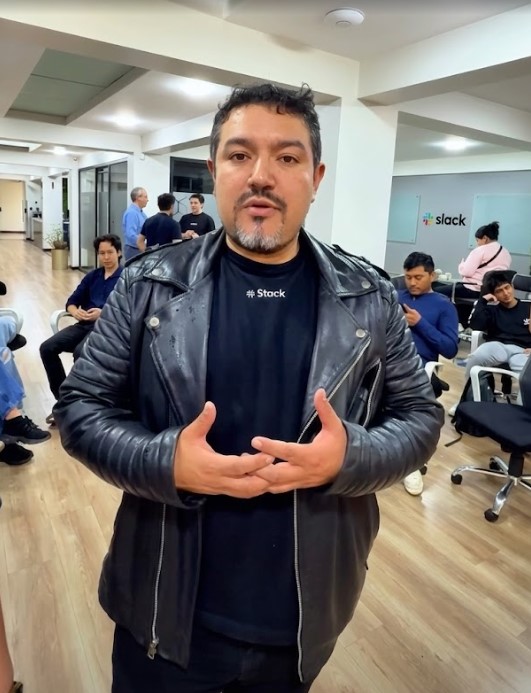
For his part, Juan Esteban Sierra, Head of Growth at Multiplied and active member of Ethereum Colombia, agrees that the phenomenon should not be classified simply as an abandonment of infrastructurebut as a symptom of a necessary operational transition.
“I think that what is happening with the Ethereum Foundation should not be read only as an ‘exodus’, but rather that it is a reaction to a tension that Ethereum has been dragging on for years,” he comments to this medium.
For him, the issue is how to go from being an organization oriented towards research, values and neutrality, “to a foundation that is more active, more operational and more connected to the real needs of the ecosystem, and the external pressures of the foundations of other ecosystems that are more active.”
Real impact and decentralization in Latin America
The analysis of the regional representatives indicates that the loss of centrality of the foundation can be beneficial for emerging countries, by forcing the creation of solid local structures.
Regarding the direct impact in Latin America, Sierra maintains that the ecosystem of this digital asset has sufficient maturity to survive independently:
I don’t think it automatically weakens support for Latin America. It may even accelerate more local and autonomous governance. Latin America should not depend on a single central foundation to push its development. Ethereum is stronger when its ecosystem works through communities, builders, L2s, universities, grants, companies and local initiatives.
Juan Esteban Sierra.
However, the Colombian specialist warns that there is a palpable risk if the institutional transition is carried out in a disorderly manner. In his view, if the centralized foundation loses technical capacity and communication channels, developing geographic areas could face access difficulties.
“If the Foundation loses talent, clarity and coordination, emerging regions may be left with less institutional access, less visibility and fewer direct channels to receive support,” he warns. “I believe that this can be positive for Latin America if it pushes local communities to organize better. But it will only be positive if the new stage of the Foundation maintains clear paths to fundingeducation, research and regional support,” Sierra clarifies.

This argument is joined by the vision of Rodas, who emphasizes that the financing and support of the network must migrate towards schemes that stop depending on the parent entity, adapting to the decentralization that Ethereum technology preaches.
“Institutional support will depend on the vision of each institution; if the institution values integrity between what is said and what is done, it will increase support. Aside from this, communities have to adapt to what they already knew was coming: financing and autonomous governance,” asserts the representative of Ecuador.
Towards a new execution and resource allocation model
The future of the relationship between Latin America and the organizations in the cryptocurrency sector will depend on the transparency with which the capital allocation mechanisms are redefined.
Historically, access to development funds (grants) has been a vital tool to promote educational and technological projects in emerging areas. A restructuring that professionalizes and streamlines these financial processes could transform the regional landscape, as long as it does not introduce bureaucratic barriers or internal political biases.
Given this panorama, the transition towards a foundation with a profile more focused on commercial and operational execution is viewed with caution, but with optimism.
“Everything depends on how it is executed. If a more financial Foundation focused on execution does the grants clearer, more measurable and more accessible, it would be good for Latam. But if he returns funding more closed, more political or more dependent on internal relations, it would be a setback. Latin America needs simple routes to apply, receive feedbackconnect with mentors and demonstrate impact,” argues Sierra.
The organization’s new regulatory and internal framework seeks to legally capture the basic precepts of the network, forcing developers to persist in decentralized construction despite temporary ideological frictions.
The current panorama of Ethereum reflects a period of essential maturation, where the redefinition of its core institutions will dictate the direction of its practical applicability. For Latin America, The diminishing prominence of the Ethereum Foundation represents the opportune moment to consolidate regional structures capable of managing their own technical and financial development.
Of course, the success of this transition will be determined by the ability of local communities to assume autonomous leadership and by the capacity of the new global administration to provide open, agile and measurable cooperation channels, essential in geographies where digital assets solve real economic problems on a daily basis.