
Spot bitcoin (BTC) exchange-traded funds (ETFs) in the United States saw outflows totaling $2.2 billion over the past two weeks. These massive withdrawals were distributed with a leak of $1.26 billion last week and $1 billion the week before.
The largest money leak was concentrated on Monday, May 18, day in which the expenditure of 648 million dollars was reported. This figure represents the worst daily outflow since January 29, when $819 million was withdrawn from these financial instruments.
During the rest of the week, capital outflows gradually decreased but maintained a strictly negative trend, with no days of net inflows recorded. The funds lost $331 million on Tuesday, $70 million on Wednesday, $100 million on Thursday and $105 million on Friday.
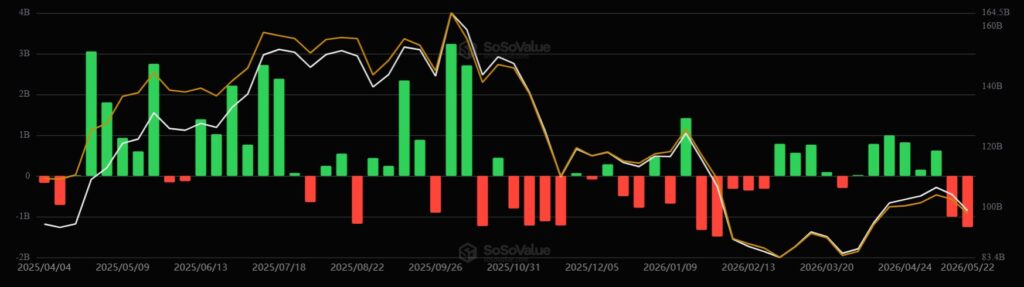
Despite the severe losses suffered in the fortnight, bitcoin ETFs They still have accumulated net inflows worth $57.1 billion. In total, these financial products concentrate $98.9 billion in net assets, where BlackRock’s IBIT fund alone represents 4% of the entire circulating supply of the digital currency.
This divestment scenario contributed to the price of the currency falling by 5%going from an approximate price of $81,200 on May 10 to $76,800 on May 22.
To understand the impact of these withdrawals on the price, it is worth noting that spot ETFs work by buying and holding the currency to back each of their shares on the exchange. This makes them a key and direct factor in the price dynamics of the digital currency. Due to this support structure, when investors decide to withdraw their capital and liquidate their positions, the fund management companies are forced to sell part of their bitcoin holdings to cover these money redemptions. This immediate increase in the supply available in the market, as there is no demand from buyers to counteract it, exerts bearish pressure that pushes the asset’s value down.
In addition to the impact of the funds on the price of the crypto asset, “the main culprits are the skyrocketing Treasury bond yields, which reached 12-month highs, a stronger dollar, and geopolitical escalation,” declared Andri Fauzan Adziima, head of research at the Bitrue Research Institute.
The yield on U.S. government bonds often competes with “risky” assets like bitcoin, attracting investors when they offer higher guaranteed returns. Likewise, the conflict between the United States and Iran remained intense after the president of the United States, Donald Trump, threatened to resume military attacks on Tuesday of that same week, as reported by CriptoNoticias.
Bitcoin’s financial outlook was tied, in part, to the global diplomatic outcome. President Donald Trump declared today, May 24, that will not rush to reach an agreement to end the war that the United States and Israel maintain with Iran.
However, talks continue and both sides are currently talking about a memorandum of understanding that will establish a roadmap to resolve outstanding issues. If this political document is finalized in the coming days, the elimination of geopolitical uncertainty could give a new upward impulse to the price of bitcoin in the market.