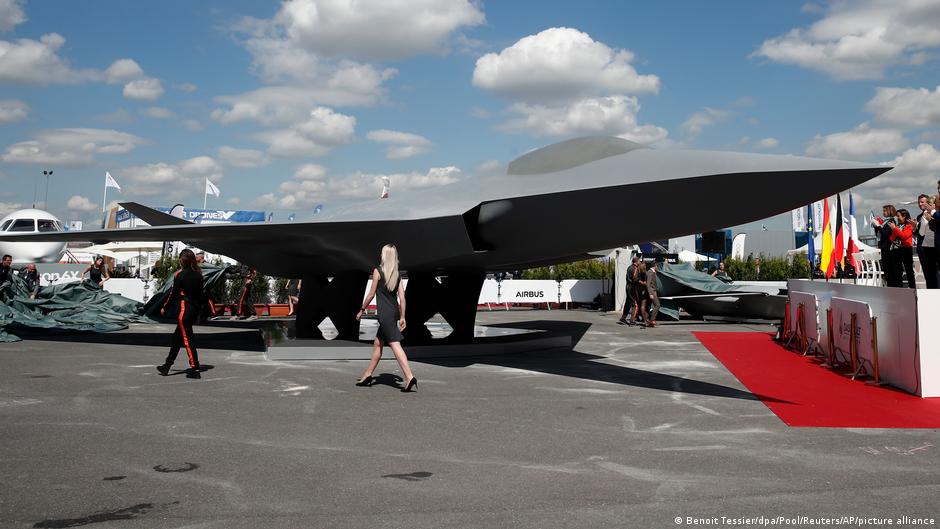
Europe wanted to create a joint next generation fighter aircraft. Instead, the bloc’s biggest defense project can now produce two different warplanes.
Airbus, which represents the German and Spanish sides of the Future Combat Air System (FCAS), told DW it is ready to restructure the program after years of political and industrial disputes.
This could include a “two-fighter solution” that allows France and Germany to develop fighters separately while collaborating on drones, sensors and digital systems that link the battlefield in real time.
The twist: The fighter jet is no longer the most important part of the project.
The proposal marks a serious change for a project that was once projected as a symbol of Franco-German military unity.
Can FCAS still be saved?
“On FCAS, work is ongoing with the French, German and Spanish governments to determine the way forward for the project,” an Airbus spokesperson told DW.
Airbus Chief Executive Guillaume Faury said the broader program still makes sense, even if the fighter jet at its center remains blocked.
“The entire future of this high-tech European capability should not be jeopardized by a single-pillar standoff,” he said, adding that Airbus would support the two-fighter option if governments asked for it.
The dispute now raises a broader question: Can Europe’s greatest powers still build major weapons systems together?
The story behind FCAS
FCAS was launched in 2017 by France and Germany, with Spain joining later. The project, worth about €100 billion ($116 billion), aims to provide a sixth-generation air combat system around 2040.
The program goes far beyond the next generation fighter jet. It also includes drones, remote carriers, engines and a “combat cloud” designed to connect aircraft, sensors and battlefield data in real time.
But the fighter jet itself has become the main source of friction.
Nuclear ambitions divide FCAS partners
France wants future aircraft to operate from aircraft carriers and carry nuclear weapons. Germany, being a non-nuclear power itself, does not share those requirements. Berlin has already decided to buy US-made F-35 fighter planes for NATO nuclear-sharing missions.
German Chancellor Friedrich Merz recently publicly acknowledged the split. He said France needs nuclear-capable next-generation aircraft, while Germany does not currently need a similar capability for the Bundeswehr. He warned, “If both sides cannot resolve those differences, we cannot sustain the project.”
Corporate conflict is slowing down FCAS
Political disagreement is the result of an industrial disagreement.
Dassault Aviation, the French maker of the Rafale fighter jet, wants a clear lead on the new fighter plane. Airbus Defense and Space represents German and Spanish industrial interests and wants a bigger role.
The result is a long-running dispute over leadership, work sharing and technology transfer. Several attempts at mediation between the companies have failed to succeed.
Airbus has now indicated that the answer may be to stop forcing an aircraft to meet every need.
the cloud can survive
For many analysts, the most important part of FCAS is no longer the fighter jet itself.
Combat clouds – digital systems linking aircraft, drones, sensors and weapons – are increasingly seen as an area where European cooperation still has a strong case.
Defense expert Christian Molling told DW that the war cloud matters because Europe is heavily dependent on the United States in the region. Other experts also argue that drones, software and battlefield networking could continue even if the fighter jet element is divided or reduced.
This would be a small political victory from the original point of view. But this may prevent FCAS from collapsing completely.
Europe’s future ‘super tank’ also at stake!
The problem surrounding FCAS is now spreading to another major Franco-German project: the Main Ground Combat System, or MGCS.
The MGCS is intended to replace Germany’s Leopard 2 and France’s Leclerc tanks. It was launched with FCAS in 2017 as part of a broader political bargain between Paris and Berlin.
The division was clear. France will lead the future fighter jet through Dassault. Germany will lead the future of tanks because of its armored vehicle industry.
The idea was not just to make weapons. It was to tie together the two greatest military powers of Europe.
But that deal now looks fragile. If the FCAS is divided, reorganized, or weakened, it could upset the balance behind the MGCS.
MGCS has already faced delays. France and Germany agreed to proceed with the next phase in 2024, but the system is not expected to enter service before 2040.
A test for Europe’s defense industry
Russia’s full-scale invasion of Ukraine has prompted European governments to increase defense spending and reduce their dependence on the United States. From 2022, the EU has called for more joint arms purchases and a stronger European defense industry.
But the turmoil over FCAS shows how difficult this ambition may be in practice.
defense analysts Carnegie Endowment for International Peace say, the results of FCAS could shape the future of European defense cooperation for years to come. If the program is derailed, governments may again become more cautious about undertaking multinational weapons projects on this scale.
Edited by Nina Haase