
Bitmine, the largest ether (ETH) treasury company on the market, appeared on the preliminary list of possible additions to the Russell 1000, one of the most important stock indices in the United States.
The information was published by FTSE Russell, the firm in charge of managing these market indices, and was shared on May 23, 2026 by Tom Lee, director of Bitmine, through his X account.
There are details preliminary inclusions and exclusions of companies that could be part of the next update of the Russell 1000.
The Russell 1000 brings together the 1,000 companies with the largest market capitalization listed in the United States. Being part of this index usually significantly increases the financial visibility of a company and, in addition, can generate automatic purchases by index funds and exchange-traded funds (ETFs) that replicate the behavior of the index.
According to market estimates, between 20% and 25% of the market capitalization of many US stocks typically ends up in the hands of passive funds and index-linked ETFs.
The firm led by Tom Lee appears on that list thanks to a market capitalization of more than $10.15 billion, enough to exceed the estimated minimum threshold of $5.7 billion required to enter the Russell 1000.
However, there is one issue to keep in mind. Despite having reached sufficient size to be close to one of the most relevant stock indices in the US market, the company maintains unrealized losses close to $7.5 billion due to his ETH holdingsas seen in the following graph that shows the profits or losses of cryptocurrency treasury companies:
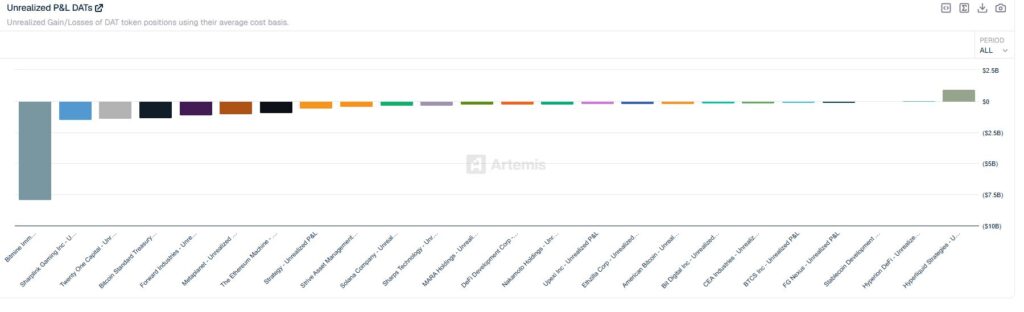
In the image above, the largest gray bar, located on the far left, represents Bitmine. There it is observed that The number of unrealized losses is the highest within the sample.
Unrealized losses are declines in value that They have not yet turned into effective losses because the assets were not soldas explained by CriptoNoticias. That is, the company continues to maintain ETH on balance, but the current value of those holdings is considerably lower than the price at which they were acquired.
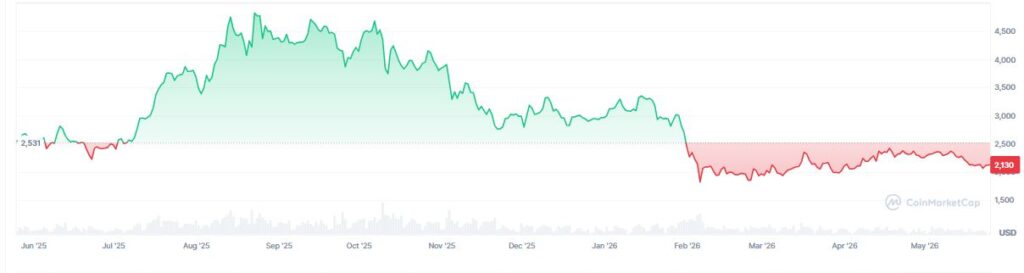
At the moment, Ethereum’s native cryptocurrency trades near $2,127 and accumulates a drop of 15.39% during the last 12 months.
Bitmine uses a corporate treasury model similar to that popularized by Strategy with bitcoin (BTC), but applied to ETH. That is, it uses ether as the main strategic balance sheet reserve, with the expectation that the asset will appreciate in the long term.
Its possible arrival on the Russell 1000 shows that these types of companies are already beginning to gain space within the traditional structures of Wall Street. At the same time, the case exposes the fragility of the model: a company can achieve a relevant market capitalization and still maintain million-dollar losses if the assets it accumulates move against it.