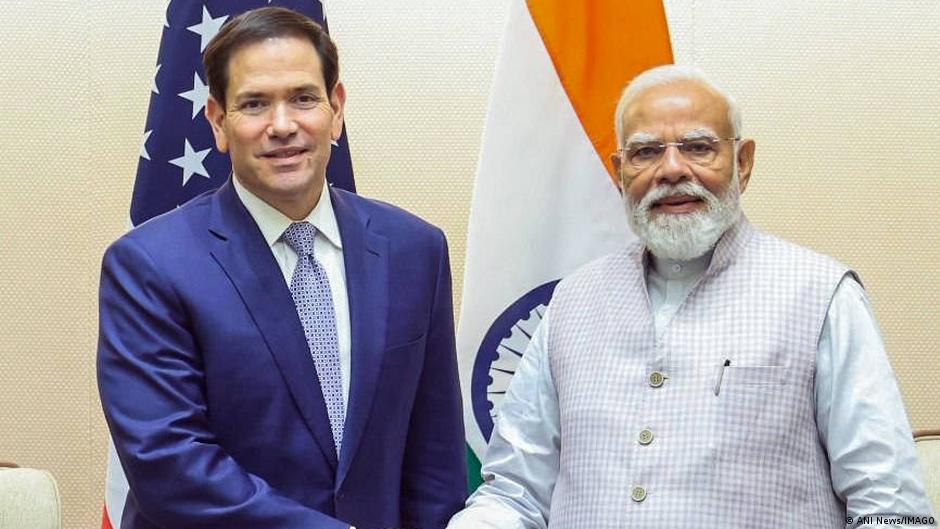
US Secretary of State Marco Rubio’s four-day visit to India last week comes amid tensions arising from Washington’s “America First” approach under President Donald Trump.
Trade friction between Washington and New Delhi, including tariffs on Indian exports and intense pressure on India’s purchases of subsidized Russian oil, has contributed to deep economic and political unease in India.
Analysts say these developments have shifted bilateral relations from a broadly upward trend over the past two decades to a more transactional and competitive phase.
Trust is ‘in deep danger’
Former Indian Ambassador to the US and retired diplomat Navtej Sarna cautioned that a single diplomatic visit cannot reverse the fundamental erosion of trust.
“Trust is at risk, interests are misaligned,” Sarna told DW. “US actions, policies and unpredictability have had a deep impact on our trade, energy, immigration, etc.”
He said that “India’s position in America’s strategic vision – regional or global – is no longer fixed,” and cautioned that New Delhi can no longer take its partnership with Washington for granted.
“A reset will take a lot more work than just one trip,” he said. “We have to see what happens on the ground on our core interests.”
Underlying frictions test bilateral relations
Meera Shankar, another former Indian ambassador to the US, says Rubio’s visit follows “a period of tension in India-US relations, marked by higher tariffs, a strict visa regime and questions in New Delhi over Washington’s credibility as a balancing power in the Indo-Pacific.”
At the same time, US tensions with Iran and its outreach to Pakistan and China have strengthened New Delhi’s concerns about Washington’s stability, while India continues to pursue its strategic autonomy through engagement with multiple partners.
Former Indian High Commissioner to Pakistan Ajay Bisaria said these underlying geopolitical concerns have led to continued irritation behind the scenes.
“A number of issues are impacting the relationship. Washington’s recent outreach to Pakistan’s military leadership after the elections has not gone unnoticed in New Delhi,” Bisaria, who is currently in the US, told DW.
Rubio wants ‘damage control’ in India
During a joint press conference with Indian External Affairs Minister S Jaishankar, Rubio defended Washington’s aggressive trade policies as a global necessity rather than a targeted attack on India.
“The president didn’t say let’s find a way to create conflict with India on trade,” Rubio said. “The President approached this and said we have to rebalance American trade.”
Rubio said he was not speaking about India. “I’m talking more globally,” he said.
Rubio paired this defense with an olive branch, and said the two countries are “on the verge” of finalizing a permanent trade deal “very soon.”
However, the real criterion of success for Rubio’s journey was never a major success – it was merely stabilizing a relationship showing visible tension.
Harsh Pant, vice president of studies and foreign policy at the Observer Research Foundation (ORF), a New Delhi think tank, argues that the primary mission was to correct the growing perception of American disinformation.
“His visit was mainly a damage control exercise rather than a major improvement in relations,” Pant told DW.
“Although core areas of cooperation between India and the US continue, there is growing concern in New Delhi that the top US leadership is not fully committed to the relationship.”
Pant says Washington is now “trying to get the relationship back on track, at least in terms of optics and political signaling.”
“Whether anything concrete comes out of this or not will depend on what happens after that,” Pant said. He stressed that the real test will be “whether the American message remains consistent and whether the trade disputes are resolved.”
Former Indian High Commissioner Bisaria sees Rubio’s visit as a necessary improvement to pull bilateral relations out of a particularly volatile economic period.
“Political signals of reassurance were needed from the US after months of tension over tariffs and concerns in New Delhi about Washington’s approach on key regional issues,” Bisaria said.
He described the visit as both a “reassurance exercise and a strategic reset” after a “nightmare” phase of Trump-era tariffs.
Bisaria suggests that this targeted damage control has managed to establish a temporary baseline of stability, noting that the relationship is now “entering a very positive phase.”
“The rollback of tariffs has helped, and Rubio’s visit was aimed more at stabilizing confidence and signaling intent rather than achieving a dramatic breakthrough,” he said.
Partnerships remain, boundaries remain
Ultimately, Rubio’s visit proved that while the bar in India-US relations may be high, the bar remains low.
Washington wants to sell energy and secure supply chains, while New Delhi wants cheaper oil and technological decoupling without sacrificing its strategic ties with Moscow or Tehran.
Shankar noted that while Rubio’s message was broadly reassuring – reiterating the strategic partnership “not just in the Indo-Pacific but globally” – and pointed to expanded cooperation in areas such as energy diversification, the structural barriers to a formal trade deal remain formidable.
“Both sides have agreed to pursue discussions on an interim trade arrangement, but uncertainty over US tariff policy complicates the scenario,” Shankar said.
“The ongoing investigation under US trade laws and the lack of clarity following recent legal and policy changes in Washington make it difficult to finalize any agreement on anticipated terms,” he said.
Edited by: Keith Walker