
The XRP Ledger (XRPL) network could add two new types of exchange pools if the network’s validators approve the technical standard that the XRP Ledger Foundation published today, May 26.
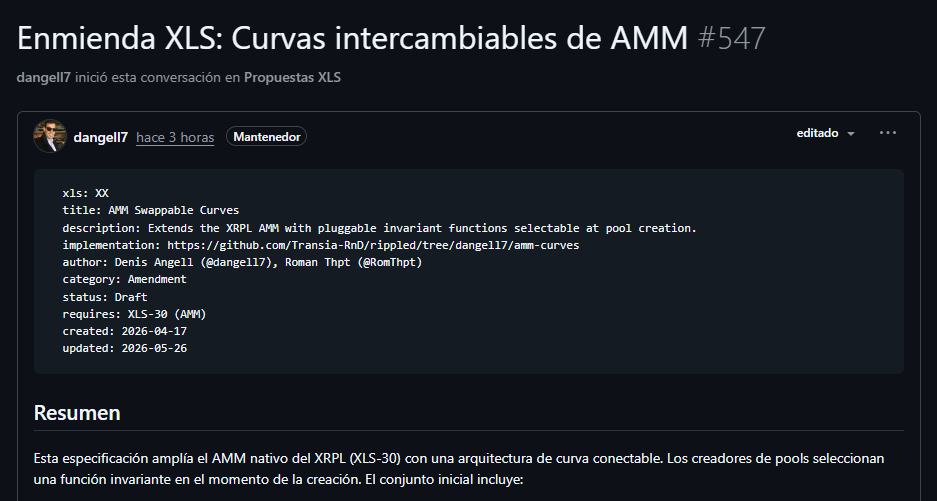
The proposal, called XLS AMM v2, points to the XRPL DEX, a decentralized exchange integrated directly into the protocol where any user can exchange tokens without intermediaries. On that DEX, The integration of XLS AMM v2 would add a concentrated liquidity pool and another called StableSwap. These two pools, according to the XRPL Foundation team, record the majority of volume on established decentralized finance (DeFi) platforms.
In this context, an exchange pool is a common fund of tokens deposited by users who want to earn commissions in exchange for facilitating operations. When someone wants to exchange one token for another on the XRPL DEX, the protocol takes the tokens from the pool and delivers the corresponding ones to the buyer, while Liquidity providers charge a fraction of each trade.
Currently, according to the XRPL standards repositorythe network only offers one type of pool: one that distributes capital evenly across all possible prices, meaning that most of the money deposited remains idle most of the time, available for price ranges that are rarely reached.
The XRP Ledger Foundation noted in its announcement that the new pool types would improve the trading of stablecoins, currency markets and real-world assets tokenized on the network, areas where XRPL has intensified its activity, with the launch of the RLUSD stablecoin as the most visible case in December 2024, as reported by CriptoNoticias.
What changes with each new type of pool?
Concentrated liquidity (the first pool model) is based on the following idea: currently, the capital deposited in a pool of the Most of that capital It is never used because the actual price moves in a much narrower range.
With concentrated liquidity, whoever provides liquidity chooses the range where they want to operate. If you facilitate trades between two stablecoins that always trade near $1, you can concentrate all your capital there instead of spreading it across ranges that will never be reached. The same capital thus generates many more commissions, explains the repository of the XLS AMM v2 proposal. It is the model that Uniswap v3 uses on Ethereum and that, according to the data cited in the Angell and Thpt white paper, concentrates around 60% of the volume in the most used DEXs.
The risk is proportional to the advantage: if the price moves away from the chosen range and the supplier does not adjust its position, you may end up with a less valuable combination of tokens than if you had simply saved them. This phenomenon, known as amplified impermanent loss, is the main risk of the model.
StableSwap for assets that hardly move
The second model points to a different problem. When two assets trade near a fixed parity (two dollar stablecoins, two versions of the same tokenized asset, currency pairs with low volatility) the current model moves the price more than necessary with each trade, making exchanges more expensive.
StableSwap uses a mathematical curve designed to stay flat near the equilibrium price, aiming to move larger volumes with less impact on the final price. The “flatness” level is configurable when creating the pool and, according to the whitepaper, this model concentrates about 10-15% of the volume in consolidated DEXs.
The document also reserves a third type of fully programmable pool for a complementary proposal that has not yet been published.
Finally, the standard has no voting schedule and requires support from network validators to activate. If approved, the existing pools would not require any changes: the current model would still be available and each pair of tokens could simultaneously have one pool of each type. The protocol would automatically choose the one that offers the best price in each operation, without the user having to intervene.