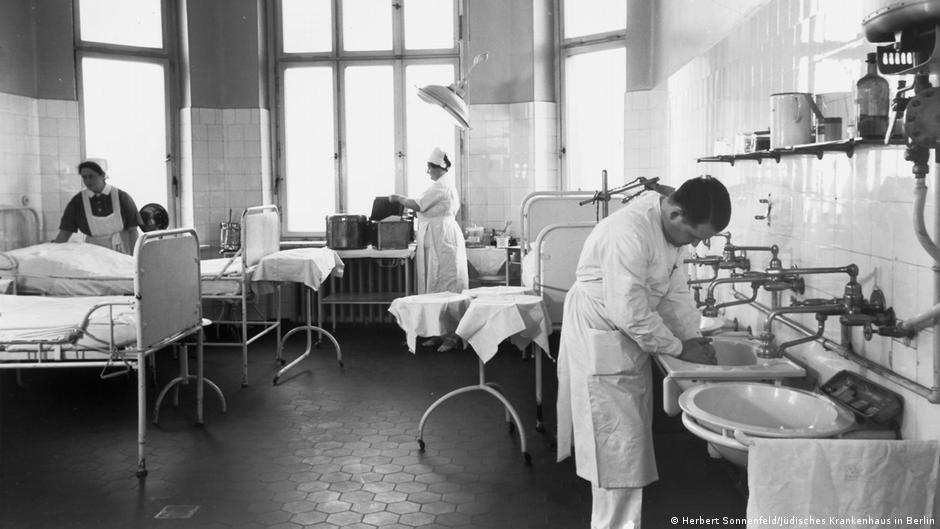
Picture the scene of the Battle of Berlin between the Soviets and Nazis on April 24, 1945: A group of Red Army soldiers arrive at the Jewish Hospital of Berlin to find hundreds of people living and working in the war-torn facility. A Russian soldier reportedly yells, “You are a Jew? Not possible. You can’t be a Jew, all the Jews are dead.”
The Jewish Hospital of Berlin, together with the Jewish cemetery Weissensee, is the only Jewish institution that operated and survived the Nazi era. It still operates today. How could an institution created to preserve Jewish life survive – and even longer – at the center of the Nazi killing machine?
Established in 1756, the Jewish Hospital moved to its present location in the north-western district of Wedding just before the outbreak of the First World War in 1914. From its inception, the hospital was open to all patients regardless of their faith and was a major symbol of Jewish unification. But after the National Socialists came to power in 1933, the hospital was barred from treating “Aryan” patients and non-Jewish staff were forced to resign.
A controversial figure: Walter Lustig
In December 1941, the Nazis established a so-called “Screening Unit for Transportation Complaints” at the Jewish Hospital to determine the “fitness” of Jews for deportation, and Walter Lustig was sent to lead it.
Lustig, a controversial figure who has been portrayed as both hero and villain in dramatizations of the hospital’s wartime history, was born in 1891 to a Jewish family in Ratibor (today Racibórz in Poland). He moved to Berlin in 1927 and worked for the police before his dismissal in 1933 – because he was Jewish – After his medical license was revoked in 1938, Lustig became head of the health services division. Reich Association of Jews in Germany, founded by the Nazis in 1939.
The Reach Association was a highly controversial organization. It initially helped Jews move out of Germany. Under the Nuremberg Laws it was mandatory for anyone identifying as Jewish to become a member and share detailed personal information such as property lists with the organization. In 1941, emigration was banned, and the Reich Association was forced to carry out preparatory work for the compulsory deportation of Jews to ghettos, forced labour, concentration and extermination camps in German-occupied Eastern Europe.
A deadly balancing act between mass murder
Jewish institutions, perhaps none more so than the Reich Association, were forced to perform a deadly balancing act in Nazi Germany. This included Walter Lustig as director of the hospital and later head of the Reach Association. Some witnesses said he decided to protect many of the children held at the hospital because of their “uncertain racial status”.
Others remember that Lustig did nothing when Gestapo officers visited the hospital and selected people for deportation. There is also evidence that he sexually exploited women in exchange for keeping them or their family members off deportation lists.
For some, Lustig was “the most negative example” of collaboration with the Nazis, says Gideon Botsch, director of the Emil Julius Gumbel Research Center on Antisemitism and Right-Wing Extremism at the Moses Mendelssohn Center in Potsdam. “But the problematic mechanism of this relationship between the Jewish community and the Nazi terrorist apparatus certainly lies in the systematic abuse of Jewish institutions for the purpose of destroying Jewish communities in Germany,” Botsch told DW.
The mass deportation of Jews from Berlin took place between October 1941 and April 1943, during which time Lustig became director of the hospital in 1942. Jews who were so sick that they could not be transported out of Germany were allowed a hospital delay of up to three months. Pregnant women were not spared unless they were about to give birth, after which they were allowed six weeks before deportation with their newborns.
Berlin in 1943: ‘the extermination of the Jews’
In late February 1943, the so-called “Factory Roundup” (“Fabrication”) involved the sudden arrest of over 10,000 Jews in Berlin and the surrounding area and their deportation to either the Theresienstadt ghetto in German-occupied Czechoslovakia or the Birkenau death camp at Auschwitz in German-occupied Poland. During the roundup, almost the entire staff of the Reich Association of Jews was deported to Theresienstadt.
During further arrests, many Jewish doctors, including some hospital doctors, were moved from their homes to a transit camp in the city center. After the war, Lustig’s Jewish secretary, Hilde Kahn, described how SS functionaries visited the hospital to discuss the deportation of 50% of the staff. “A week later, the affected employees were arrested in their homes along with their family members, and we never heard from them again […]” he told the Berlin public prosecutor’s office in the 1960s.
जून 1943 में नाजी प्रचार मंत्री जोसेफ गोएबल्स द्वारा बर्लिन को “यहूदियों से मुक्त” घोषित करने के बाद रीच एसोसिएशन को आधिकारिक तौर पर भंग कर दिया गया था (“यहूदी-मुक्त“)। इसके स्थान पर, नाजियों ने अपना उत्तराधिकारी संगठन, रेसिडुअल रीच एसोसिएशन बनाया, जिसका मुख्यालय यहूदी अस्पताल में था, और गेस्टापो के सीधे नियंत्रण में होने के बावजूद, लस्टिग को इसका प्रमुख बनाया।
फिर अस्पताल में अतिरिक्त कार्य स्थापित किए गए: जून 1943 में यहूदी अनाथों के लिए केंद्रीय आश्रय को वहां स्थानांतरित कर दिया गया; निर्वासन के लिए नियत यहूदियों के लिए बर्लिन के अंतिम शेष पारगमन शिविर को मार्च 1944 में अस्पताल में स्थानांतरित कर दिया गया था। लगभग 50 यहूदी पुरुषों और महिलाओं को भी शिविर में काम करने के लिए मजबूर किया गया था। कुछ को इसे चलाने का काम सौंपा गया था, दूसरों को – तथाकथित “हथियाने वाले” (“धरनेवाला“) – छिपे हुए यहूदियों का पता लगाने का आदेश दिया गया और उन्हें डेविड स्टार पहने बिना मैदान छोड़ने की अनुमति दी गई।
वह झूठ जिसने सैकड़ों लोगों की जान बचाई
युद्ध के अंतिम दिनों में, एक असाधारण घटना ने अस्पताल के पारगमन शिविर को नष्ट होने से बचा लिया। जैसे ही तीसरा रैह उनके चारों ओर ढह गया, गेस्टापो ने शिविरों में सभी यहूदियों को गोली मारने का अंतिम आदेश जारी किया। कर्ट नौमन एक यहूदी पूर्व बैंक क्लर्क थे जिन्हें अस्पताल के शिविर में काम करने के लिए नियुक्त किया गया था। उन्हें जल्द ही “आधिकारिक” बैंक के काम और फिर कैंप कमांडर और अन्य गेस्टापो नेताओं के लिए निजी काम चलाने की जिम्मेदारी सौंपी गई, मुख्य रूप से काले बाजार से वस्तुओं की खरीद करके।
19 अप्रैल, 1945 को, नौमान ने गेस्टापो के यहूदी मामलों के विभाग के प्रमुख एरिच मोलर के कार्यालय में प्रवेश किया, जहां उन्होंने मोलर को आदेश पर चर्चा करते हुए सुना। नौमान सीधे बर्लिन डाकघर गए, अस्पताल को बुलाया और एसएस अधिकारी को यह समझाने में कामयाब रहे कि यहूदी बंदियों को फांसी देने का आदेश उन्हें रिहा करने का आदेश था। नौमान की त्वरित सोच ने शिविर के लगभग 180 कैदियों की जान बचाई।
रिहाई के आदेश के बावजूद, कई लोग अस्पताल में ही रहे क्योंकि इसके आसपास का क्षेत्र भारी लड़ाई का स्थान था। 24 अप्रैल, 1945 को जब सोवियत सेना और रेड क्रॉस कार्यकर्ता अस्पताल में गए, तो उन्हें 370 मरीज़, 1,000 निवासी, 93 बच्चे और 76 कैदी मिले। इस समय तक, अस्पताल के स्टाफ सदस्य लगभग सभी “मिश्रित विवाह” वाले लोग थे (“मिश्रित विवाह“) यहूदियों और गैर-यहूदियों के बीच – इन विवाहों को तोड़ने के नाजी प्रयासों का हिस्सा – और तथाकथित”वैधता यहूदीमिश्रित यहूदी और गैर-यहूदी वंश के (उदाहरण के लिए “मिश्रित विवाह के बच्चे)। कुछ यहूदी थे जिन्हें गेस्टापो, एसएस या पुलिस की हिरासत में बीमार पड़ने के बाद इलाज के लिए वहां ले जाया गया था।
उन मरीजों में से एक ब्रूनो ब्लाउ, एक यहूदी वकील था। 1942 में टेगेल में तीन साल की जेल की सजा काटने के दौरान उन्हें गेस्टापो द्वारा यहूदी अस्पताल में स्थानांतरित कर दिया गया था। उन्हें कैंसर का पता चला और इलाज के लिए रखा गया। अपनी 2003 की पुस्तक “रिफ्यूज इन हेल: हाउ बर्लिन्स ज्यूइश हॉस्पिटल आउटलास्ट द नाज़िज़” में डैनियल बी. सिल्वर ने अनुमान लगाया है कि यह शायद “नौकरशाही व्यवस्था की एक वस्तुतः सहज जर्मन भावना” के कारण था। […] “Enforced without thought, even in the midst of mass murder.”
Story of neither resistance nor rescue
The survival of the hospital and many of the people in it is not as strange as it might first seem, says Beat Meyer, a former historian at the Institute for the History of German Jews in Hamburg. “It was in the interests of those in power to keep the hospital open,” she explains. “It was not an act of resistance in that sense. For Jews it was a workplace and as long as people there could be employed, they were somewhat protected from deportation, even though it was certainly dangerous to be under constant surveillance by the Gestapo.”
For Botsch, the story of hospital perseverance is neither one of resistance nor rescue. He says, “By 1943, most members of the Jewish community in Theresienstadt had been deported or murdered and, from the Gestapo’s point of view, they were left with the most useful tools for carrying out the task of destroying German Jewry.”
So what happened to Walter Lustig? Immediately after the war, Lustig hoped to rebuild the Jewish community and serve as its leader in Allied-occupied Berlin. However, a Jewish boxer who had survived the war recognized Lustig as the man whose parents had been deported and had him razed to the ground. Lustig was last seen in June 1945, boarding an official Soviet limousine with two uniformed officers. He was believed to be a Nazi collaborator, but was shot in the woods some time later.
Edited by: Sarah Hoffman and Felix Tamsut