The listing will be effective June 29, 2026, according to FTSE Russell.
SharpLink has 863,021 units of ether (ETH) in its corporate reserve.
SharpLink Gaming, Inc., a company listed on the Nasdaq, will officially enter the Russell 2000 and Russell 3000 indices as of June 29, 2026, as reported by the company itself on May 26, 2026.
Inclusion arises after publication preliminary changes made by FTSE Russell, the firm in charge of managing these US stock indices.
SharpLink currently holds 863,021 ether (ETH) in its corporate reserve, consolidating itself as the second largest public treasury of the Ethereum cryptocurrency behind Bitmineas reported by CriptoNoticias.
At the current price of ether, close to $2,083, those reserves are equivalent to approximately $1.8 billion.
Joseph Chalom, co-CEO of SharpLink, stated that the entry into these indices represents “a significant validation of the company’s institutional ETH treasury strategy.”
The Russell 2000 is one of the leading small business stock indices in the United States. It brings together small capitalization companies within the US market and is followed by index funds, exchange-traded funds (ETFs) and institutional investors.
For its part, the Russell 3000 groups the 3,000 largest listed companies in the United States and works as a broad indicator of the North American stock market.
According to FTSE Russell, around $12.2 trillion in assets use these indices as benchmarks for investment strategies and passive funds.
This means that SharpLink’s entry could increase its institutional visibility and generate automatic demand for shares from funds that track these indices.
Despite this inclusion, firm shows relevant unrealized losses linked to recent ETH price dropas seen in the following graph:
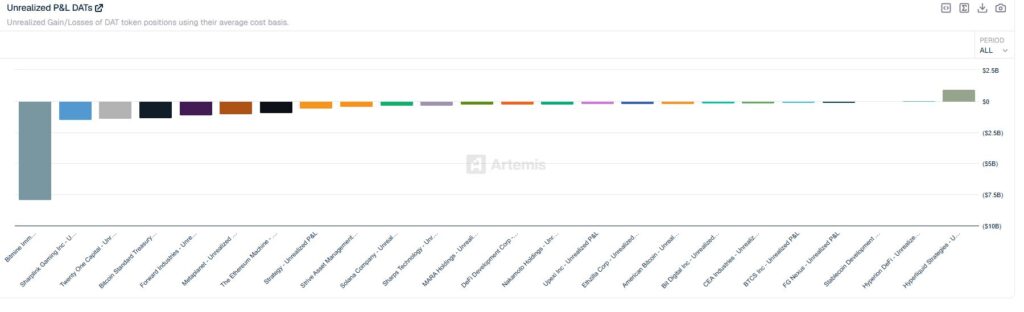
The blue bar corresponding to SharpLink shows unrealized losses close to $1.2 billion linked to the recent drop in the price of ether. Currently, the company appears as the second company with the highest unrealized losses in the sector, only behind Bitmine.
Unrealized losses are declines in value that have not yet become effective losses because the assets remain in the company’s possession and were not sold.
SharpLink uses a model similar to the one popularized by Strategy with bitcoin (BTC), but focused on ETH: use a public company as a vehicle for the accumulation of digital assets.
According to Chalom, Ethereum is “at the center of four structural trends that are transforming finance.” These are: stablecoins, tokenization, on-chain finance and the so-called artificial intelligence (AI) agent economy.
Even so, the case once again reflects the strong dependence that these companies have on the price of ether. Although joining the Russell 2000 improves SharpLink’s institutional exposure, the value of its balance sheet remains highly conditioned by ETH volatility.