What you need to know about Chinese dissidents detained in South Korea
- Former policeman Dong Guangping, imprisoned in China, has fled to South Korea in a small rubber boat
- South Korean authorities have detained him on suspicion of violating immigration laws
- Dong has tried to flee China before, but was sent back several times
- It is unclear whether South Korea will send him back to China
A Chinese dissident was detained by South Korean authorities this week after he was found adrift in a small rubber boat off the country’s west coast, his lawyer said on Wednesday.
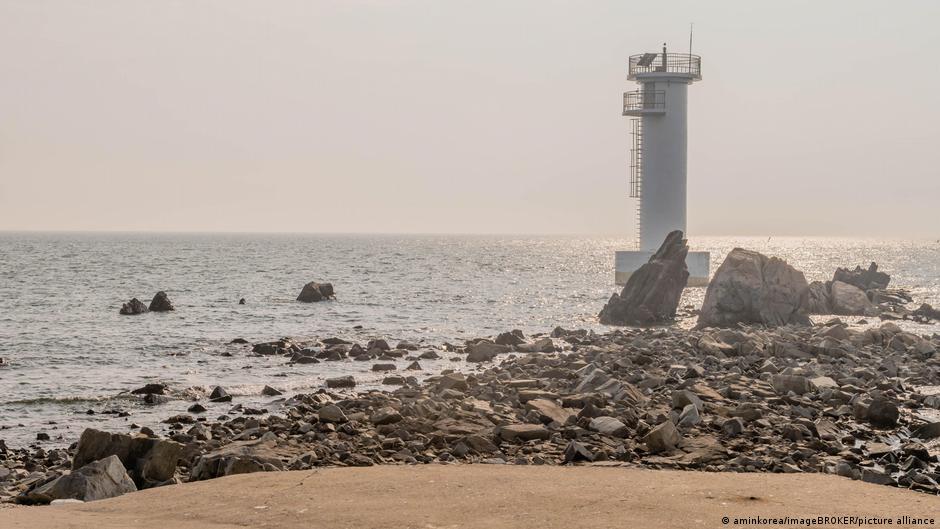
South Korean authorities found Dong Guangping, a former policeman who was imprisoned in China for his activism, adrift in a small rubber boat off the coast of Tiyan County in South Chungcheong province on Monday night, police said.
He has been detained and is being interrogated for allegedly violating South Korean immigration laws, the Tiyan Coast Guard said in a statement.
Dong’s lawyer Kim Ju-kwang confirmed his identity to the AFP news agency.
Kim did not say where Dong launched his 3.3-meter-long (11 feet) boat, which was equipped with a 10-horsepower engine.
Who is the Chinese dissident who has fled to South Korea?
Dong is known for his criticism of the Chinese Communist Party (CCP) and his political reform and human rights advocacy.
The US-based group Human Rights in China says Dong was fired from his job as a policeman after signing a petition a decade after the 1989 Tiananmen Square crackdown.
He was jailed for three years in 2001 for “inciting subversion of state power” and detained again in 2014 for activities related to the Tiananmen Square protests and massacre.
Dong has tried to flee China before. He fled Thailand with his family, who later settled in Canada. Despite Dong being granted refugee status by the United Nations, Thai authorities handed him over to Chinese police in 2015.
His lawyer told AFP that Dong’s current situation was “highly likely to be a political asylum case.”
the new York TimesThe dissident, who first reported on Dong’s detention on Tuesday, said the dissident had previously fled to Vietnam and Taiwan, but had to return to China each time.
Chinese-Canadian activist Sheng Xue previously shared news on social media of Dong’s attempted escape, leading to his arrest and deportation by Vietnamese authorities in 2021.
How have South Korean officials responded?
The right-wing opposition People’s Power Party has urged the liberal Democratic Party-led government to grant “full protection” to Dong.
“Prompt humanitarian steps must be taken to ensure he can safely travel to Canada, where his family is anxiously waiting for him,” party spokesman Chu Hyun-chul said in a statement carried by AFP.
“As a liberal democratic state, this is a matter of fundamental responsibility,” Chu said.
South Korea’s Foreign Ministry has not commented on Dong’s case.
South Korean President Lee Jae-myung and other leftist administrations have preferred a conciliatory foreign policy approach toward China. It is unclear whether this approach will affect Dong’s case.
South Korea, which formally began processing refugee applications in 1994, has granted political asylum to only a relatively small number of claimants. Despite receiving thousands of asylum claims, its approval rate remains in the low single digits.
Another Chinese dissident, Kwon Pyong, fled China to South Korea on a jet ski in 2023. He was convicted of illegal entry and given a suspended prison sentence.
Don’t let algorithms hide news. If you rely on our team for reliable reporting, please take a moment Select us as your favorite source on Google by clicking here and pressing the “Star” or “Favorite” buttonThat’s why you’ll always see our verified news first.
Edited by: Zack Crellin