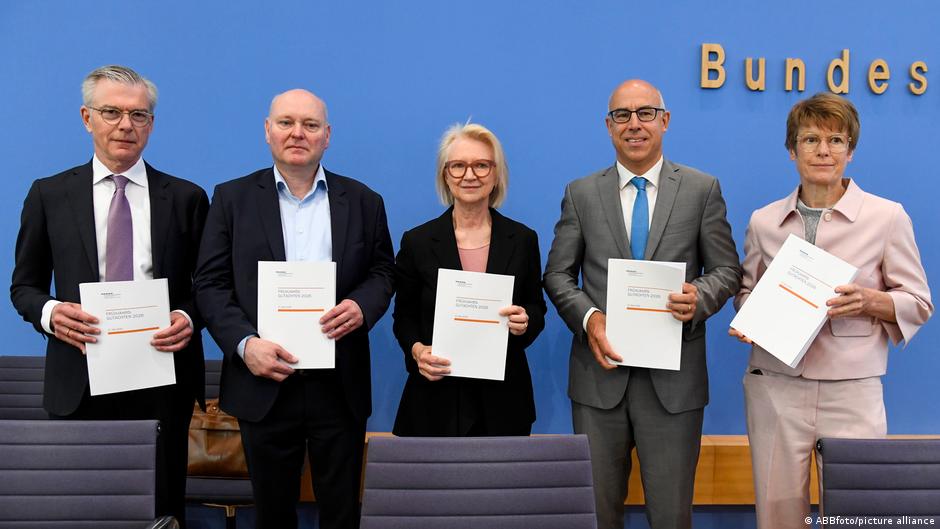
It was certainly not a happy meeting for Chancellor Friedrich Merz: On Wednesday (27 May), the Chancellor and several ministers from his cabinet met with the five economics professors who make up the German Council of Economic Experts – an independent advisory body to the federal government.
The council’s latest report provides no cause for celebration for the German government. On the contrary, it underlines how bad the state of the German economy is.
Stagnation instead of growth in Germany
“Unfortunately, we have had to reduce the growth forecast given in this year’s report,” President Monica Schnitzer said before the meeting at the Chancellery. “We now expect gross domestic product (GDP) to grow only 0.5% this year and 0.8% next year.”
GDP measures the total value of all goods and services produced, and serves as a measure of a country’s economic strength. Meanwhile, the inflation rate – that is, the rise in prices – is expected to climb to 3% in 2026.
These are devastating figures. In fact, these are the exact opposite of what the Chancellor promised as his top priority in May 2025 when his government took office: quickly getting the economy back on track.
Disappointment in German companies
Business leaders are expressing their dissatisfaction towards the government. Leading industry associations are expressing concern that since the end of World War II, Germany’s competitive position in the global economy has never been more uncertain.
One out of every four jobs in Germany is related to the industrial sector. For decades, German exports of cars, machinery, chemical and pharmaceutical products flourished and the country prospered as a result. However, since the long economic recession that began in 2019, German companies are losing their global competitive edge, and companies that export goods are openly questioning whether it is possible to turn things around.
Energy prices have increased dramatically
As recently as last fall, there was at least some hope that the economy would finally begin to pick up again in 2026. But the war in Iran scuppered those plans. Heating oil prices have increased by 40% and gas and electricity prices are expected to continue rising.
Before the Iran war, 20% of global oil and liquefied natural gas consumption was transported from the Iranian coast through the Strait of Hormuz. Like US President Donald Trump’s tariff policy, the blockade has affected the entire world. America is by far the world’s largest importer.
“Tariffs and the energy crisis are hitting the German economy particularly hard because it is both an exporter of goods and an importer of fossil fuels,” said Gabriel Felbermayer, an Austrian economist who was recently appointed to the German Council of Economic Experts.
At the same time, competitive pressures are increasing in global markets, especially from China. In 2025, China once again increased the amount of goods exported to Europe. Since Europe is the most important market for German exports, Felbermayer said, “this puts enormous pressure on German industries both domestically and in third-party markets.”
fewer kids and more retirees
The lack of economic growth is also highlighting the underlying structural problems facing Germany. For example, Germany’s rapidly aging population. In the coming years, post-war baby boomers will reach retirement age. At the same time, life expectancy is increasing, the birth rate continues to decline and immigration to Germany is declining. Additionally, as the population ages, the cost of caring for the sick and those requiring long-term care also increases.
In Germany, social security funds are financed by contributions from employees and employers. Currently, contributions account for a good 42% of payroll costs. Council President Schnitzer estimates, “Without reforms, the combined rate of contributions for all social insurance programs will exceed 50% by 2040.”
Expenditures will have to be curbed and earnings will have to be stabilized. The council recommends that the older generation contribute more to the costs. Overall, Schnatter said, “It is necessary to make reforms that will also result in real financial burdens.” However, his colleague, Achim Truger, disagrees due to his concern about creating hardships for the population.
This is why the governing coalition of the conservative Christian Democratic Union (CDU)/Christian Social Union (CSU) and center-left Social Democrats (SPD) is finding it so difficult to implement reforms. It remains to be seen which of the billions of planned cuts will ultimately be implemented. A proposal to require people without children to contribute more to long-term care insurance has also been criticized.
Concern about budget
Experts have also been expressing concerns about the fiscal policy of the federal government. He says that high levels of debt-financed spending on military buildup and renewal of Germany’s dilapidated infrastructure will not be without a price. The budget deficit is expected to rise to 3.7% of GDP this year and 4.3% next year. This is significantly higher than the three percent allowed under the EU’s sustainability criteria.
Only an economic boom can help and experts have some suggestions. He believes it is important to focus on technological progress as a driver of economic strength.
But they acknowledge that startups alone will not be enough, and that German industry needs a fundamental change in thinking. He says companies should shift their investments from the automotive sector to high-tech and healthcare sectors, where significant research spending is taking place.
This article was translated from German.