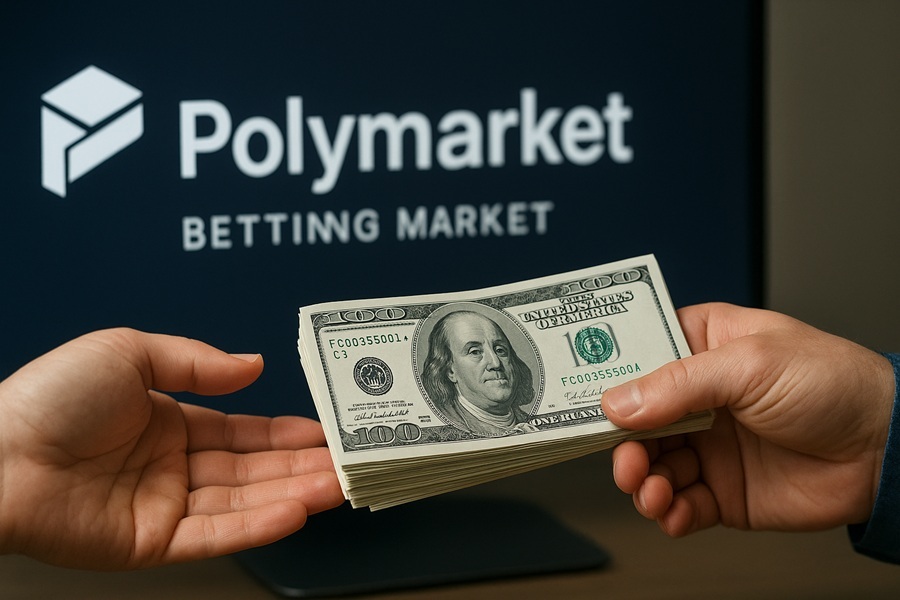
People have the right to put their money where they want.
If the State can limit where you put your money, it is because it is not yours.
Every December, the Spanish State sits a child from San Ildefonso—the old Madrid school—in front of a bass drum and makes him sing numbers. The scene is deliberate: the child’s voice lends an innocence and candidness that makes respectable what in any other context would be just a bet.
He Christmas giveaway It is pure chance, with no merit other than luck, and yet the State blesses it, retransmits it and turns it into a national liturgy. Then he gets paid twice: once by selling you the ticket and another by taxing your prize if your fortune catches up with you. He sells the chance and then collects it. That double extraction is the business, not the vice.
The same State that ritualizes luck just decided that you can’t bet on future events with your money. The General Directorate of Gambling Regulation this week opened a sanctioning file against Polymarket and Kalshi, the two largest prediction market platforms, and ordered the precautionary blocking of their websites for operating without a license.
The argument is the same as always: consumer protection, identity verification, control of minors, prevention of gambling addiction. But protection is the alibi, not the motive. What is being pursued is not the citizen’s risk, but a truth that the State does not control. Spain is just the most recent case of a pattern that is repeated in Portugal, Argentina, Brazil, India, Indonesia, and the background is the same everywhere: The State is not afraid of people losing money, it is afraid of the mirror of truth.
We do not defend Polymarket and predictive markets. We agree that, like most of the cryptocurrency market, they are a casino. But we defend the right of people to lose their money wherever they want. With an entire market about who will win an election, or whether a central bank will raise rates, it is not chance in the same sense as a traditional casino: in principle it rewards analysis, data, reading the moment.
I say “in principle” with intention. Because the mechanism, when looked at closely, is more modest than its defenders admit. The founding idea comes from afar: in 1907, the statistician and psychologist Francis Galton witnessed a contest at a livestock fair: hundreds of people paid to estimate the weight of an ox, and whoever came closest won. Galton, hoping to demonstrate the clumsiness of the crowd, collected the tickets and calculated the median of all bets. The collective number guessed the actual weight of the animal by almost a kilo, and beat all the individual experts—livestock farmers, butchers—who participated. The crowd was wise not by contagion or by consensus, but because everyone risked something by betting, and the mistake of one canceled the mistake of another.
Hayek took this observation to its theoretical consequence in The Use of Knowledge in Society: the price synthesizes the knowledge dispersed in millions of heads without anyone having to collect it. A prediction market would be exactly that applied to the future. The key is friction: those who put money behind their judgment filter out the noise of those who only give their opinions.
But there is a difference between Galton’s ox and a binary market with price visible in real time. At the fair, each attendee estimated without seeing the bets of the others. On Polymarket, the current price is public and updated per second, inviting mimicry as much as independent analysis. Many times it is enough to follow the herd to earn a few dollars.
Furthermore: an important part of the precision of these markets does not come from collective wisdom but from a less romantic mechanism. Robin Hanson, the economist who has theorized the most about prediction markets and whom the CEO of Polymarket himself cites as an authority, says it unequivocally: insiders are welcome on these platforms. The market is right, in part, because whoever knows collects his loot. The “truth machine” works, among other things, thanks to privileged information. It is not exactly the democratization of knowledge.
All this does not invalidate the usefulness of prediction markets, but it forces us to be more precise about what usefulness that is. They are not oracles. They do not replace analysis. There is another risk that should be mentioned: Habermas described the public sphere as the space where a society deliberates about what it wants. has to do; A prediction market does not deliberate, it calculates. The incentive pushes us to converge towards the winning answer, not towards the thought that examines it.
The risk of homogenization is not created by Polymarket, but monetized. And the distinction that dissolves part of the problem was already formulated by Hanson himself: voting on values, betting on beliefs. The market does not say what is desirable. It says what people think is going to happen.
Polymarket has a record. The company has a department raided by the FBI, a suspicious ghost office in Panama, proven cases of insider information – a US soldier was arrested for making a fortune betting on an operation that he himself was going to execute – and a dependence on the regulatory goodwill of the Trump administration that makes it politically fragile.
What is truly robust would be genuinely p2p prediction markets that are resistant to censorship, without a central server that a judge can order to block. But that technical debate does not change the principle in dispute, and it is the principle that I defend. I do not defend Polymarket. I defend the right of anyone to put their money where their mind is.although the intermediary company is shady, although many lose, although sometimes it is enough to follow the herd.
Because when you look at who is pushing the bans, the pretext of protection falls by itself. In Portugal, the regulator ordered the closure hours before the presidential results were known, after the market on that same election moved more than one hundred million euros. In Argentina, the complaint that ended in a national blockade was not presented by an association of victims of gambling addiction: it was presented by the Buenos Aires City Lottery, accompanied by the casino chamber.
The state monopoly of chance litigating against competition and calling it consumer protection. The Argentine project even contemplated facial biometric identification at the beginning of each session and penalties of up to ten years in prison. All that apparatus does not stand up so that you do not lose twenty euros. It arises because a handful of unknown people with money at stake predict a country’s elections earlier and better than their own official institutes. The State is not afraid that people will lose. Fear the mirror.
There is something ancient in this gesture. The tyrant who punished the augur for the omen, the doctor who breaks the thermometer to lower the fever. Polymarket does not cause the result: it announces it. And a power that needs to silence the predictions it makes about itself is already confessing, with the blockade, exactly what it fears. If the wisdom of the crowd were as unreliable as its censors say, there would be no need for precautionary measures or blockades. It would be enough to let people make mistakes and lose their money.
So the underlying question was never about gambling, nor about gambling addiction, nor about minors. It’s simpler and more uncomfortable. Can the State decide what facts in the world we are allowed to have an opinion about that costs us money?
Disclaimer: The views and opinions expressed in this article belong to its author and do not necessarily reflect those of CriptoNoticias. The author’s opinion is for informational purposes and under no circumstances constitutes an investment recommendation or financial advice.