
The cryptocurrency card market continues to establish itself as one of the main payment infrastructures within the digital asset ecosystem. According to data released on May 26, 2026, the sector has evolved from a niche product in 2023 to managing approximately $660 million in monthly volume, reflecting sustained expansion into everyday payment uses.
The growth is explained by the progressive integration of digital assets in traditional payment systems, where Cryptocurrency cards act as a bridge between both environments. This advance coincides with a shift in the market’s focus towards applications of practical use, with greater weight on transactional use as opposed to speculative dynamics.
The evolution of volume confirms this trend: in just three years, the sector went from reduced levels in 2023 (around USD 100 million per month) to the current 660 million dollars per month in April 2026, as seen in the following graph, driven by increased usage frequency in retail payments and digital services.
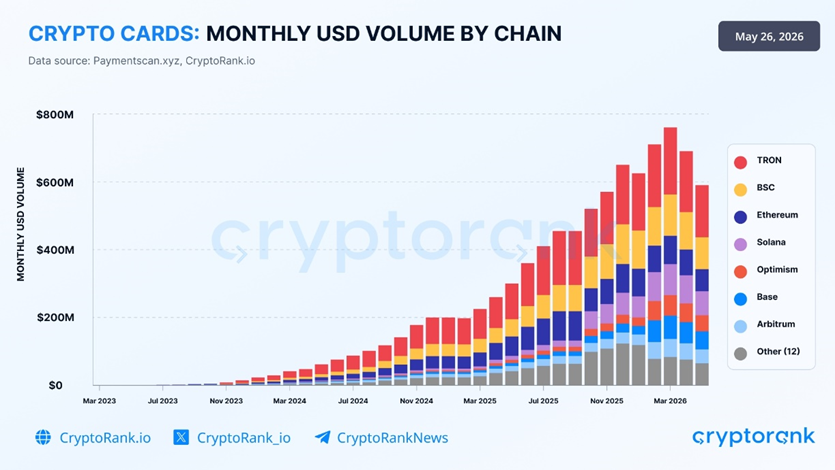
In terms of market distribution, TRON remains the network with the highest participationwith approximately $213 million in monthly volume, equivalent to about 32% of the total. Its share, however, has fallen from around 45% in 2023.
Binance Smart Chain maintains a relevant position with close to 15% of the market, although it also registers a drop compared to 23% in previous years.
In parallel, Solana stands out as one of the fastest growing casesgoing from a marginal share in 2024 to around 11.6% in 2026, driven by its adoption in payment infrastructures.
Ethereum, for its part, reduces its share from approximately 55% in 2023 to around 11% in 2026, however, this is due to a process of redistribution of activity towards your ecosystem of layer 2 solutions.
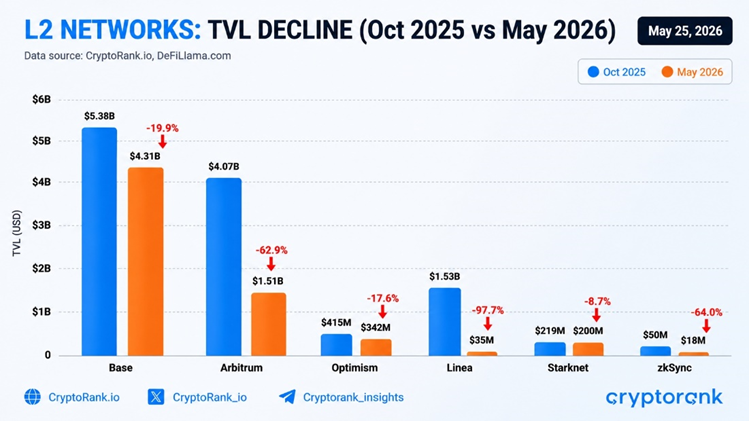
Within the Ethereum environment, networks such as Arbitrum, Optimism and Base concentrate a large part of the transaction volumealthough with a fragmented distribution between different implementations, reflecting a diversification of payment processing.
It is important to highlight that the growth of the sector relies on a strong dependence on stablecoins such as USDT and USDCwhich act as a liquidity base for most cards, as reported by CriptoNoticias. This introduces indirect exposure to regulatory or stability risks for these assets, which remain the primary means of conversion to fiat at the time of payment.
In turn, the sector operates in a stricter regulatory environmentwith user identification requirements (KYC) and automated tax reporting in jurisdictions such as the United States and Europe, which reduces legal friction but also conditions use in terms of privacy and operations.
Despite this, the cryptocurrency card sector is already represents approximately 33% of the investment focus within the ecosystemwith nearly 3.6 billion dollars raised in 2026, consolidating its position as one of the segments with the greatest capital attraction.
On the whole, The data shows a market in a phase of functional expansionwhere volume growth is spread across multiple networks and technical solutions. This behavior responds to greater integration between payment infrastructures, which operate in an increasingly interconnected manner.
In the current scenario, the development of these cards points to greater consolidation as a payment tool in the daily use of digital assets. Its evolution will depend on the ecosystem’s ability to sustain scalability, efficiency and user experience in real payment environments, in a context where Adoption is already directly linked to practical use rather than speculation.