
A developer known in the Bitcoin community as b10c published a finding on May 27 that expands the tools available for any user to verify the authenticity of the software they install on their node.
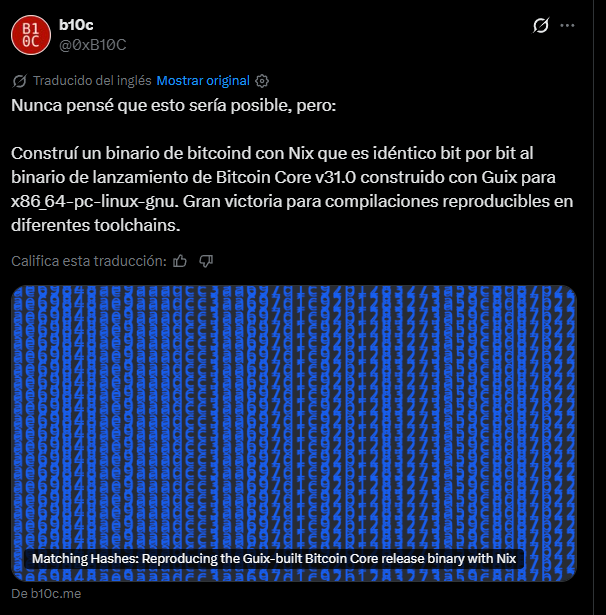
As documented by b10c in his personal blob, compiled the main program of Bitcoin Core v31.0 using Nix—a software build tool independent of the official process—and obtained a byte-for-byte identical result to the release binary built by the Bitcoin Core project with Guix.
Until this result, the only way to verify that the official software had not been altered was to reproduce the compilation process with Guix, the same tool used by the Bitcoin Core team. As b10c explainsthis meant that user trust depended on a single toolchain. Now, two completely independent build systems arrive at the exact same result, making it technically much more difficult for a silent software attack to go undetected.
A silent attack can be executed in different ways – in this case it would be a delivery attack – and consists of intercepting and modifying the software before it reaches the end user, without being detected by the end user. In this case an attacker compromises the code repository, a third-party software dependency, or the compiler itself (the tool that translates the code). If the official Bitcoin Core compiler was compromised, it would generate a malicious binary natively. The official team would digitally sign it without knowing that it is infected, because the origin itself was compromised.
These types of security breaches can result in the total loss of funds for those who operate nodes or wallets with compromised software. The b10c achievement directly attacks that risk vector at the most critical link: the Bitcoin client itself.
b10c is an independent developer who regularly contributes to technical research in the Bitcoin ecosystem. Their work is closely followed by the community for its methodological rigor and focus on protocol security. This project, according to the developer himself, took three years to complete.
Guix and Nix: two kitchens that prepare the same dish
To understand the finding, it is worth explaining what these tools are. When developers create a program like Bitcoin Core, they write the source code—the instructions—and then “compile” it: turn it into the executable file that the user downloads and installs. That conversion process is performed by a build tool. That is, they take instructions from human language to machine language.
Guix is the tool that the Bitcoin Core team officially uses to produce their release binaries. Nix is a different tool, developed independently, with its own architecture and operation. That both produce exactly the same result from the same code is equivalent to two chefs, in separate kitchens, following the same recipe with different ingredients, serving an identical dish down to the last gram.
The importance is that if someone had tampered with the software at some point in the process—whether in the code, in the build tool, or on the distribution server— The two results would not coincide. The exact coincidence is, in itself, proof that no one intervened.
A verification that did not exist before
The mechanism that makes this advance possible is called reproducible build: If two people, using different tools, compile the same source code and obtain exactly the same result, it is practically impossible for either of them to have introduced malicious changes without the other detecting it. b10c argues that this result makes Nix the first tool external to the project capable of independently validating binaries Bitcoin Core Officials.
However, b10c warns that this achievement is individual and is not yet part of a formal standard adopted by Bitcoin Core. The project does not have an established process for incorporating multiple verification tools, which means that cross-verification between Guix and Nix depends for now on voluntary initiatives like yours.
The developer concludes that the next natural step would be to build a model where trust in Bitcoin software does not rest on a single toolchain, but on multiple independent verifications that confirm each other — a principle that, he notes, is already standard in other areas of computer security.